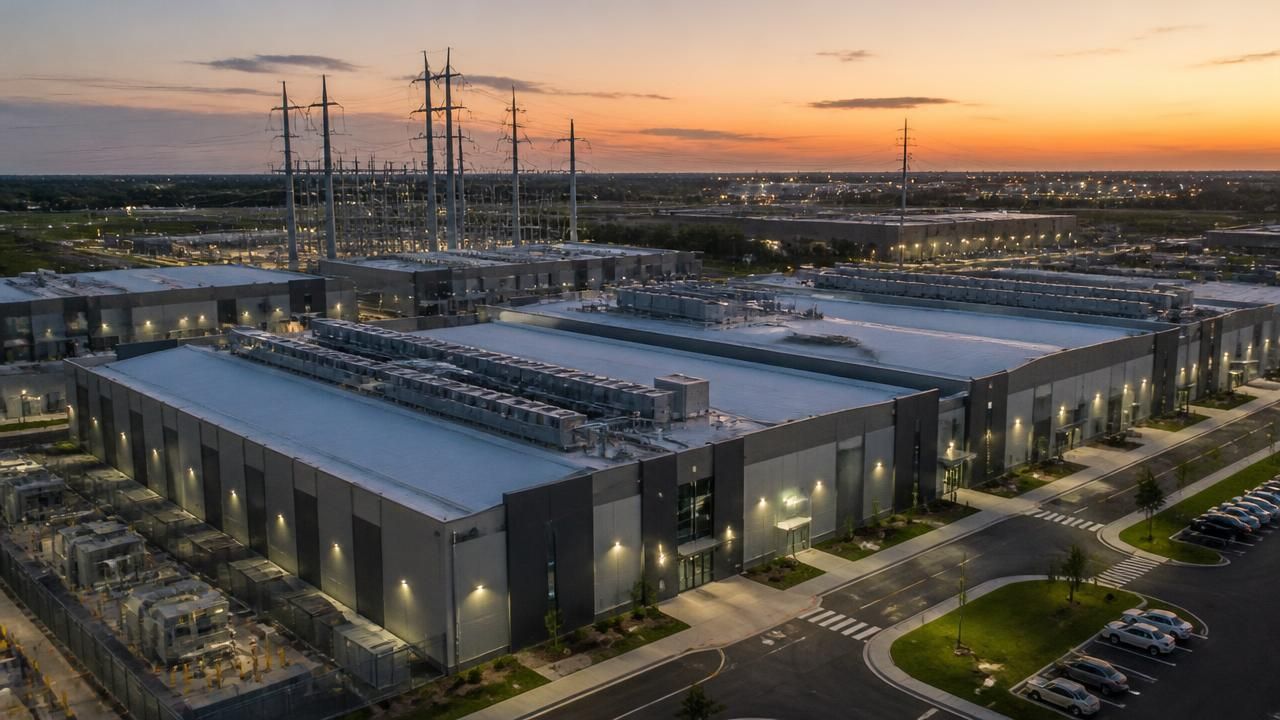
A Harvard-led study has put hard numbers on one of the tech industry’s most urgent questions: how much electricity and carbon pollution the United States’ largest data centers actually consume. The analysis estimates that 403 hyperscale facilities operating in the U.S. between May 2024 and April 2025 used about 2% of the nation’s electricity and emitted 25.7 million tonnes of carbon dioxide. That emissions total is roughly equivalent to Denmark’s, while the power demand rivals that of a midsized country or states such as Michigan, Wisconsin, or Indiana.
What the study measured
Researchers began with a commercial database of 675 facilities compiled from news reports, company statements, and satellite imagery. They discarded sites that lacked a reported electrical capacity or could not be verified as suitably large buildings with the cooling and electrical connection equipment expected of hyperscale operations. The final sample of 403 data centers had an average electrical capacity of about 40 megawatts, according to Ars Technica. The study is not a census of every server room or colocation site in America; it is a focused tally of the largest, most power-intensive facilities.
403 facilities. About 2% of U.S. electricity. 25.7 million tonnes of CO2.
The researchers were not able to separate AI compute from more traditional cloud and data services. That caveat matters because the current construction boom is widely associated with large language models and other AI workloads, but hyperscalers also run ordinary storage, networking, and enterprise software. Even so, the study provides a baseline that can be tracked as new campuses come online.
Why the findings resonate
The numbers land during an unprecedented rush to convert investment capital into hyperscale data centers. As Ars Technica noted, the speed of that buildout has made it difficult to plan how to supply the required electricity cleanly or with minimal impact on ratepayers. It has also been hard even to collect basic information on what is being built, where, and with what power sources. The Harvard tally helps fill that information gap, but it also highlights how much remains unknown.
Coverage of the study reflected different audiences and concerns. The Verge and WIRED emphasized the scale in accessible terms, with headlines comparing the electricity use of roughly 400 data centers to that of a midsized country or Michigan. Yahoo framed the power demand alongside Wisconsin, Michigan, and Indiana. Local and regional outlets highlighted geography: MSN reported that Oregon ranked No. 2 in power use among the states, a detail likely to intensify debate over siting, utility planning, and grid strain in the Pacific Northwest. Climate-focused coverage, including Unite.AI, stressed that fossil fuels power most U.S. hyperscale data centers. Business and international outlets, including CNBC TV18, Daily Sabah, and UA.NEWS, focused on the Denmark-sized emissions figure and the 25.7 million tonnes of CO2.
The AI caveat
The inability to isolate AI’s share is a limitation, but not a reason to dismiss the findings. AI training and inference are power-hungry, and the rapid expansion of GPU clusters has become a central driver of new data center construction. Yet the study’s sample includes facilities serving conventional cloud workloads as well. That means the 2% figure should be read as a snapshot of hyperscale infrastructure, not a precise measurement of AI’s carbon footprint. It also means the number could rise as AI-specific capacity expands, even if efficiency improvements offset some of the growth.
What comes next
The study’s implications extend beyond carbon accounting. Utilities and grid operators must plan for large new loads that can arrive faster than transmission and generation projects. Regulators and ratepayer advocates will ask who pays for upgrades and whether ordinary customers subsidize the buildout. Environmental groups will press for transparency on fuel sources and renewable procurement. Investors and technology companies, meanwhile, face growing scrutiny of their energy claims.
The most important contribution may be methodological. By publishing a transparent estimate for a defined period and a verified list of facilities, the researchers give policymakers, utilities, and journalists a benchmark. Future studies can track whether emissions fall as grids get cleaner, whether new facilities are matched with carbon-free power, and whether the AI boom concentrates energy demand in particular regions. For now, the headline is stark: a few hundred large data centers have become a measurable force in the U.S. power system, with an emissions profile comparable to a small European nation.