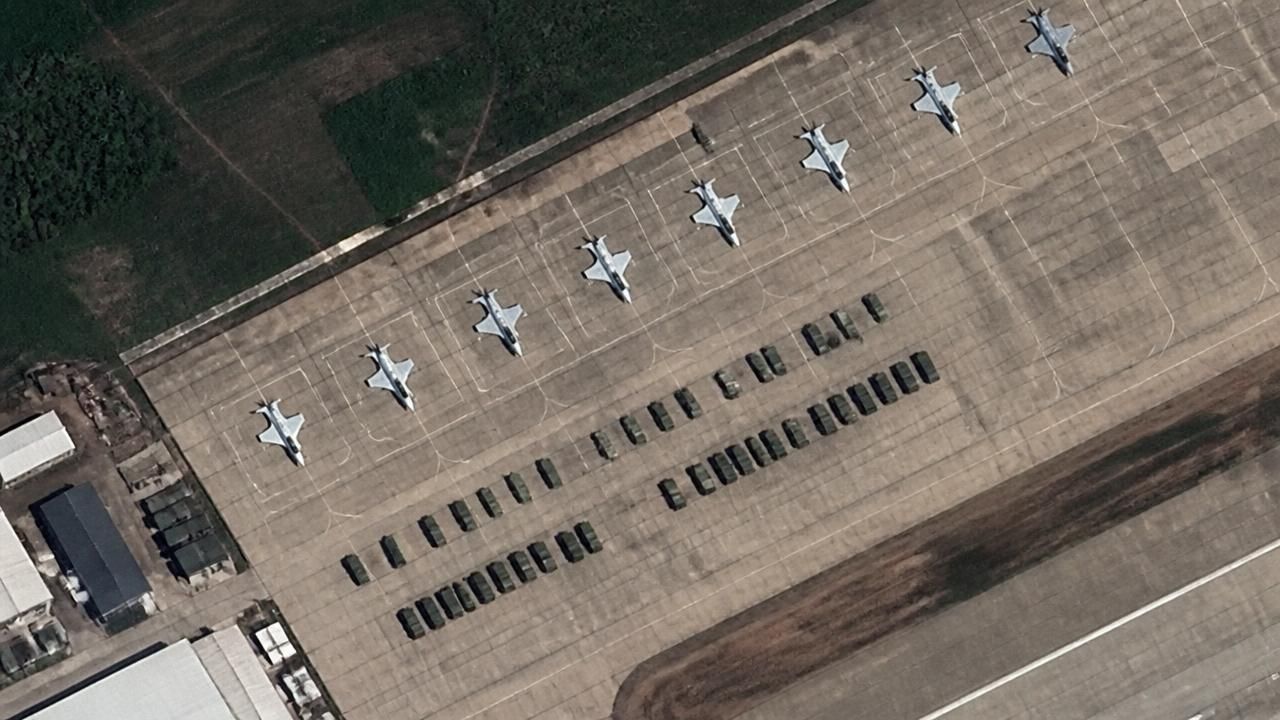
Commercial satellite imagery showing rows of light attack aircraft parked at a newly opened Chinese military facility in Laos has sharpened concerns across Southeast Asia, giving Beijing's air force what analysts describe as its first foothold in mainland Southeast Asia.
The images, captured by the commercial satellite provider Vantor and circulated by news organisations including the Guardian, Reuters and the Taipei Times, show eight light attack aircraft and more than a dozen military vehicles lined up in orderly rows at Ban Keun airport. India's Times of India identified the aircraft as K-8 attack jets, a Chinese-made trainer and light ground-attack platform that Beijing has exported widely across Asia, Africa and Latin America.
What the imagery shows
According to the Guardian, the satellite pass revealed eight light attack aircraft positioned on the apron at Ban Keun alongside what appear to be more than a dozen military vehicles arranged in rows. The Reuters report, headlined around the same imagery, confirmed that both "attack aircraft" and "military vehicles" were visible at the site, which was formally stood up as a "support and training centre" only last week.
Ban Keun airport lies roughly 60 kilometres north of Vientiane, the Laotian capital, in a stretch of countryside that had until recently hosted little more than a modest provincial airstrip. The facility's new designation, combined with the hardware now visible on its tarmac, marks a decisive shift in what the site is for — and in who is using it.
A first foothold in mainland Southeast Asia
What makes the imagery significant is geography. China operates a naval support base in Djibouti, on the Horn of Africa, and has been linked to expanding facilities at Ream in Cambodia. But the Guardian notes that the Laos site gives Beijing's air force its first foothold in mainland Southeast Asia — a subregion where China's economic reach has expanded dramatically over the past decade without a corresponding military presence.
Laos sits at the geographic heart of the Mekong region, bordering China, Vietnam, Thailand, Myanmar and Cambodia. A Chinese presence at Ban Keun places aircraft within reach of the Thai border, northern Vietnam and the Andaman-facing corridors of Myanmar — a placement that regional defence planners are unlikely to read as coincidental.
China's response
Beijing has pushed back against the framing of the facility as a base. Chinese officials have described the arrangement as a support and training centre and insisted it is "not directed at any third party," language meant to pre-empt the interpretation that the site is aimed at the United States, its allies or Laos's neighbours.
China says the facility is "not directed at any third party."
That formulation has become a familiar one in Chinese defence diplomacy, used previously in relation to Djibouti and to the disputed features it has militarised in the South China Sea. Analysts note that such statements tend to address intent rather than capability: the hardening of a runway, the parking of combat-capable aircraft and the stockpiling of vehicles together constitute military infrastructure regardless of how it is labelled.
How the region is reading it
Coverage of the story has varied sharply by outlet and region, reflecting how differently the same images land in different capitals.
- The Guardian framed the revelation around regional anxiety, emphasising the "concern in the region" prompted by the new centre and stressing that China's public line is that the facility serves no third-party purpose.
- Reuters led with the forensic detail — the visible aircraft and vehicles — keeping the focus on verifiable satellite evidence rather than diplomatic interpretation.
- Times of India foregrounded the hardware itself, naming the K-8 attack jets in its headline and underscoring a capabilities-first reading of the imagery.
- Taipei Times treated the base as a strategic development worth flagging to an audience already highly attuned to Chinese military expansion.
- Aggregators such as MSN and UA.NEWS carried the Guardian's reporting onward, amplifying the story across global feeds within hours.
The convergence is notable: whatever the editorial emphasis, no outlet reported a competing explanation for the aircraft. The disagreement is over meaning, not evidence.
Debt, dependence and the wider arc
Laos's receptiveness has to be read against its economic position. Vientiane is heavily indebted to Beijing, a consequence of the multibillion-dollar China-Laos Railway and associated infrastructure lending. That leverage has made Laos increasingly vulnerable to pressure, and it has already faced scrutiny over a special economic zone in the country's northwest where Chinese-run casinos and other ventures have drawn allegations of criminal activity.
For Beijing, the appeal is strategic depth. A mainland Southeast Asian air presence complements the network of ports, pipelines and rail links China has built across the Mekong region, and complicates contingency planning for the United States, which maintains treaty alliances with Thailand and the Philippines and a comprehensive strategic partnership with Vietnam.
What happens next
Expect further satellite tasking on Ban Keun. Commercial imagery has become the primary instrument through which military build-ups are detected and publicly documented, and Vantor's images — like those that previously exposed activity at Ream and in the South China Sea — will be compared against future passes for runway extensions, hardened shelters or additional aircraft.
The immediate diplomatic question is whether ASEAN will address the facility collectively. The bloc has historically avoided language that could be read as singling out China, and Laos, as a member, would be an awkward subject for a joint statement. That silence, analysts suggest, may be precisely what makes the Ban Keun arrangement durable — and what makes the next set of satellite images worth watching.