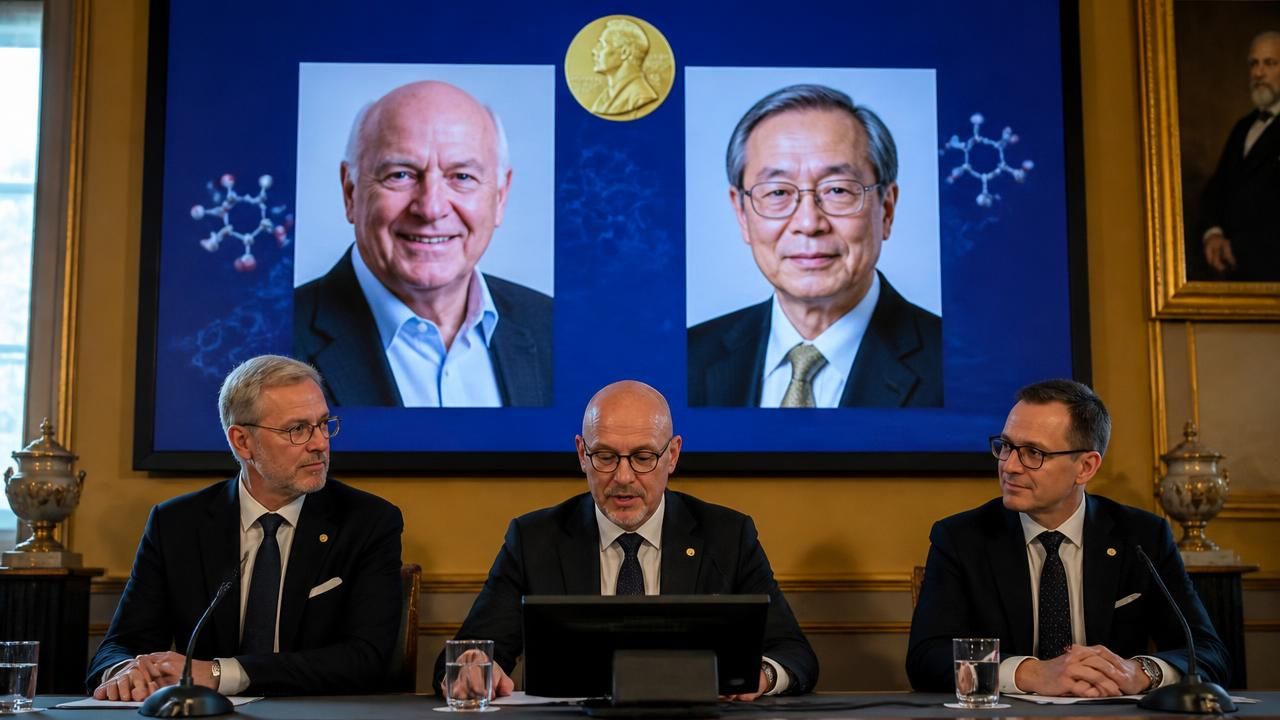
STOCKHOLM — The Royal Swedish Academy of Sciences on Wednesday awarded the 2026 Nobel Prize in Chemistry to Henri B. Kagan and Kenso Soai for discoveries that help explain one of biology’s deepest asymmetries: why life uses only one of two mirror-image forms of many molecules. The prize recognizes work in asymmetric catalysis, non-linear effects and autocatalysis—chemistry that shows how a tiny imbalance between left- and right-handed molecules can be amplified into the near-uniform handedness, or homochirality, that all known organisms rely on.
Life is remarkably selective. Amino acids in proteins are almost exclusively left-handed, while sugars in DNA and RNA are right-handed. Yet ordinary chemical reactions typically produce a 50-50 mixture, called a racemate, of both forms. Because enzymes are themselves chiral, they often fail to recognize the wrong-handed molecule. That selectivity is essential for life, but it poses a chicken-and-egg problem for origin-of-life researchers: if the prebiotic world began racemic, how did biology settle on one hand?
Two complementary breakthroughs
Kagan, a French chemist, and Soai, a Japanese chemist, approached that question from different angles. Kagan helped establish the field of non-linear effects in asymmetric catalysis. In many catalytic reactions, chemists assumed that the enantiomeric excess (ee) of a product would be proportional to the ee of the chiral catalyst—a 10% left-handed catalyst would give roughly 10% left-handed product. Kagan showed this need not be true. Certain reactions exhibit non-linear behavior: a catalyst with low enantiomeric purity can produce a product with much higher purity, effectively amplifying a small chiral bias. This was a conceptual breakthrough, revealing that chiral information can be magnified rather than diluted.
Soai discovered asymmetric autocatalysis, now known as the Soai reaction. In this reaction, a chiral product catalyzes its own formation, preferentially producing more of the same enantiomer. Starting with a minuscule excess of one hand—or even with a chiral seed—the reaction can drive the mixture toward almost complete enantiopurity. The product is both catalyst and result, a chemical self-replicator of handedness. As Chemistry World’s explainer noted, autocatalysis and non-linear effects are the twin mechanisms that make this possible: the product accelerates its own production, and the kinetics can amplify small imbalances in a non-linear fashion.
“Life is remarkably selective,” Ars Technica observed. “Most chemical reactions will make a 50-50 mix of the left- and right-handed forms of a chemical, but life uses only one of them.”
How the world framed the prize
Coverage of the award reflected the story’s dual identity—part fundamental chemistry, part origin-of-life detective story. Ars Technica framed it around the handedness problem, explaining that most key enzymes fail with the wrong-handed chemicals. The New York Times called it “pioneering work in ‘mirror’ chemistry,” emphasizing chirality as the unifying theme. MSN described it as solving “the mystery of life’s asymmetry.” Chemistry World, meanwhile, went deeper into the technical vocabulary, offering an explainer on autocatalysis and non-linear effects and why the Nobel committee chose them this year. Across outlets, the same core insight emerged: Kagan and Soai showed that chemical reactions can be biased, producing large excesses of one mirror form without biological enzymes.
Key mechanisms
- Kagan’s non-linear effects: a small chiral bias in a catalyst can yield a large chiral excess in the product.
- Soai’s asymmetric autocatalysis: the product catalyzes its own formation, amplifying one handedness over the other.
- Origin-of-life implication: a racemic prebiotic world could tip toward homochirality without enzymes.
Why it matters beyond the origin of life
Chirality is not just a philosophical puzzle. It is a daily concern in pharmaceutical chemistry. Many drugs are chiral, and the two mirror forms can have dramatically different effects—one may be therapeutic while the other is inactive or harmful. The thalidomide tragedy of the late 1950s and early 1960s, in which one enantiomer was sedative and the other teratogenic, remains a cautionary tale. Asymmetric catalysis, the field Kagan helped pioneer, allows chemists to make predominantly one enantiomer, reducing waste and improving safety. Soai’s autocatalytic reaction offers a rare experimental system for studying self-replication and the emergence of biological order from simple chemistry. It also has applications in chiral sensors, materials science and the study of complex systems.
The prize also highlights a shift in how scientists think about life’s origins. Rather than assuming homochirality was a frozen accident—a random choice that stuck—the work suggests a plausible chemical route by which a small initial excess could be amplified to near purity. That does not prove how life actually began, but it demonstrates that the necessary chemistry exists. The early Earth may have had local environments—mineral surfaces, evaporating pools, hydrothermal vents—where such amplification could occur. Laboratory experiments continue to test whether the Soai reaction or related systems could operate under prebiotic conditions.
What remains to be solved
Scientists still debate whether the Soai reaction is a realistic prebiotic mechanism or a beautiful laboratory curiosity. The reaction requires specific reagents, including diisopropylzinc and a pyrimidine aldehyde, that may not have been abundant on early Earth. But the Nobel recognizes the conceptual advance: non-linear effects and autocatalysis provide a general framework for understanding how symmetry breaking can occur. Kagan and Soai’s discoveries have inspired decades of research into chiral amplification, self-replication and the origins of biological homochirality.
The award will be presented on December 10, the anniversary of Alfred Nobel’s death, in Stockholm. For Kagan and Soai, the honor caps careers spent at the intersection of physical organic chemistry, catalysis and the deepest questions about life. As one observer put it, they did not simply study reactions; they showed how chemistry could give life a hand—one hand, specifically.