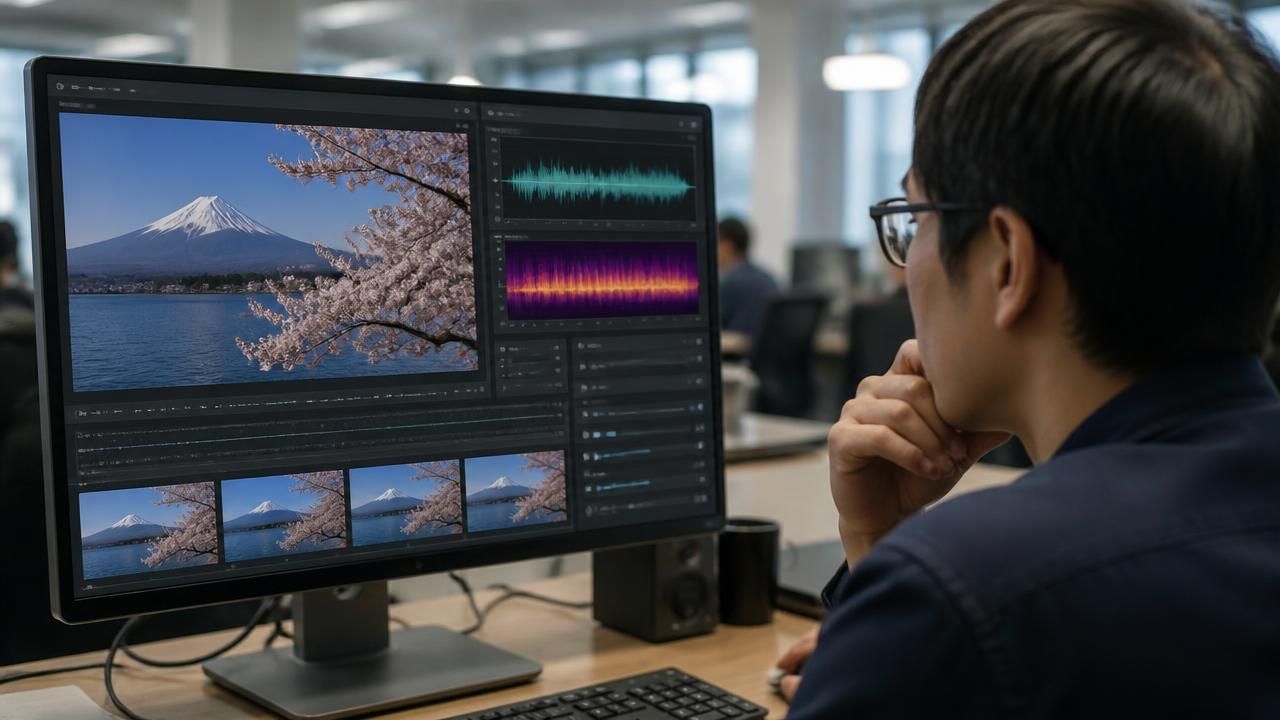
Google has quietly removed one of the biggest practical barriers to verifying whether a piece of media was made by artificial intelligence. The company announced that its SynthID detector is now available to anyone on a dedicated public website, SynthID.com, and that the tool has been expanded to recognize invisible watermarks embedded by partner companies — not just Google's own models.
The change, effective immediately, means that journalists, researchers, platform trust-and-safety teams, and ordinary users no longer have to route a question through Google's Gemini chatbot to find out whether an image, video, or audio clip carries an AI watermark.
What SynthID actually does
SynthID is not a visible logo or a metadata tag that can be stripped in a single pass through an image editor. It is an invisible signal written directly into the content itself — encoded into the pixels of AI-generated images and video frames, and into the waveform of AI-generated audio. Because the watermark lives in the media rather than alongside it, it is designed to survive common transformations such as cropping, compression, and resizing, at least within limits.
Google says its Gemini models alone have applied SynthID to more than 180 billion images and videos, along with what the company describes as roughly 240,000 years' worth of audio. That figure underscores how quickly watermarking has scaled from a research demonstration into industrial infrastructure.
A detector that no longer plays favorites
The most consequential change is interoperability. Until now, Google's detector flagged only Google's own watermarks. An image generated by ChatGPT and carrying a SynthID mark, for instance, would not reliably register — a limitation that made the tool nearly useless for anyone trying to assess material from across the AI ecosystem.
Google says the new detector supports watermarks from all of its partners. That matters because watermarking only works as a public-interest tool if a single check can return an answer regardless of which model produced the content. A fragmented verification landscape — where each vendor can only vouch for its own output — leaves users bouncing between tools and guessing at what a negative result actually means.
Google has framed SynthID as a provenance signal rather than a verdict: the presence of a watermark is strong evidence that content was machine-generated, but its absence proves nothing, since watermarks can be degraded, removed by determined adversaries, or never applied in the first place.
From research project to shared plumbing
SynthID was introduced by Google DeepMind in 2023 as an experimental approach to labeling generative output at the point of creation. Over the following two years, the company pushed the technology outward — publishing research on text watermarking, integrating marking into more Gemini products, and courting other AI developers to adopt the same standard.
The strategy borrows a page from digital provenance efforts such as the Coalition for Content Provenance and Authenticity (C2PA), which attaches cryptographically signed metadata to media files. The two approaches are complementary: C2PA credentials travel with a file and can be verified end-to-end but are often lost when platforms re-encode uploads, while pixel- and waveform-level watermarks are more resilient to re-encoding but carry less information and no cryptographic proof of origin.
Why the timing matters
The launch lands in a year of intensifying scrutiny of AI-generated media. Deepfaked political advertisements, cloned voices deployed in fraud, and synthetic imagery circulating during conflicts have all raised alarms among election officials, regulators, and platform operators. Transparency obligations under regimes such as the European Union's AI Act are pushing developers toward exactly this kind of labeling, and a free, publicly accessible detector gives regulators and civil society a straightforward way to test compliance claims.
Platforms also stand to benefit. A one-stop check lowers the cost of triage for moderation teams that currently rely on a patchwork of classifiers, reverse-image searches, and human judgment — none of which are reliable on their own.
The limitations worth remembering
- Absence is not evidence. A clean result on SynthID.com does not mean content is authentic. Many generators still do not watermark, and tooling to strip watermarks exists.
- Adversarial erosion is real. Heavy re-encoding, screenshotting, or generative "laundering" through a second model can weaken or destroy embedded signals.
- Detection is not attribution. Knowing that content was AI-generated says nothing about who made it or why.
- Watermarking remains voluntary. Adoption depends on vendor goodwill and, increasingly, on regulation.
What to watch next
The immediate test is adoption: whether the detector's partner list grows to include the major remaining image, video, and audio generators, and whether the watermarks hold up under the kinds of real-world degradation that social platforms introduce. A second question is whether the industry converges on shared technical standards rather than a stack of competing provenance schemes.
For now, Google has done something simpler and arguably more important: it has turned an opaque, chat-mediated check into a public utility. Whether that utility becomes a trusted piece of the information ecosystem — or another signal that adversaries learn to defeat — will depend less on the technology than on how widely it is deployed and how honestly its limits are communicated.