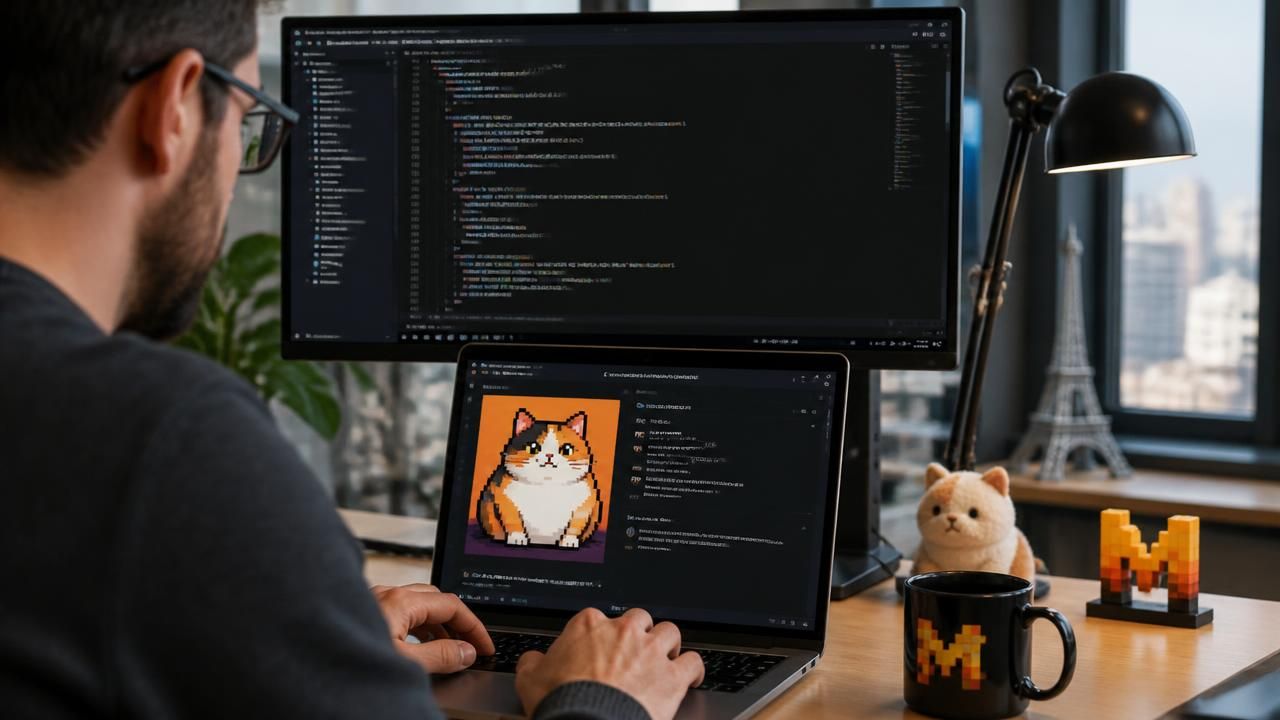
French artificial intelligence company Mistral has released a new freely available model it says can compete with the very best systems from the United States and China — and it has given the 1-trillion-parameter behemoth a name borrowed from internet cat culture: Le Chonk.
Officially designated Mistral Large 4, the model is now available in preview, with a final version scheduled to follow by the end of the month. Mistral says anyone can use and customize it, a positioning that places the Paris-based startup at the center of an increasingly fraught debate over who gets access to frontier AI — and who is left behind.
A trillion parameters, open to all
According to technical write-ups of the release, Mistral Large 4 is a multimodal, mixture-of-experts (MoE) model with roughly 1.05 trillion parameters. The MoE architecture matters: rather than activating every parameter for every token, the model routes each request through a subset of specialized sub-networks, which lets a system of this scale remain practically usable and comparatively efficient to serve.
The model is multimodal, meaning it can handle more than just text, and Mistral is pitching it squarely at agentic workloads — the class of applications in which an AI system plans, calls tools, browses, and executes multi-step tasks rather than simply answering a single prompt.
Its release arrives at a moment of mounting tension over access to top-end AI. The most capable models from leading US labs are typically gated behind APIs, enterprise contracts, and usage restrictions. Open-weight releases, by contrast, let third parties download, fine-tune, and deploy a model on their own infrastructure — a distinction that has become a geopolitical flashpoint as well as a technical one.
Built for niches, not just benchmarks
While Le Chonk is designed as a general-purpose competitor, Mistral has optimized it for specific domains: coding and cyberdefense first and foremost, along with manufacturing, finance, electrical engineering, and other specialized fields. That focus reflects a deliberate strategy, according to the company.
“There are a lot of areas where the other labs will not focus that much,” Guillaume Lample, cofounder and chief scientist at Mistral, told WIRED. “There are so many domains in which you can improve models.”
The emphasis on cyber is notable. Several outlets framed the release around exactly that: Mistral racing China on open-weight AI with cyber capabilities as the headline selling point. For enterprises and governments that need to run sensitive security workloads on infrastructure they control, an open-weight model tuned for defensive cyber operations is a more compelling pitch than a marginally higher score on a general reasoning benchmark.
The framing fight: meme, machine, or message
The coverage of Le Chonk illustrates how differently the same announcement can be read depending on the outlet.
- Ars Technica led with geopolitics, noting that the release lands amid escalating tensions over access to frontier AI and emphasizing Mistral's claim that a freely available model can challenge the best from the US and China.
- WIRED sharpened the framing further, describing Le Chonk as the best open-weight offering outside of China — an implicit acknowledgment that Chinese labs have set the pace in this category.
- The Next Web cast the news as Europe's answer to China's lead in open models, positioning Mistral as the continent's flagship AI champion.
- MarkTechPost focused on specifications, cataloguing the 1.05-trillion-parameter multimodal MoE architecture.
- Decrypt leaned into the branding, noting that a model capable of cyberdefense work is named after a cat meme.
That last point is not trivial. Mistral has consistently used approachable branding — and has previously leaned on a leaping-cat motif — to differentiate itself from the more austere, safety-forward messaging of its American rivals. The name Le Chonk, borrowed from a widely shared image of a rotund feline, is marketing as much as nomenclature: it signals that the model is meant to be picked up, poked at, and shipped by developers rather than locked in a vault.
Europe's open-weight gambit
The strategic logic is clear. Over the past two years, Chinese labs have flooded the open-weight ecosystem with capable models that developers around the world can run locally, eroding the practical advantage of closed American systems in many enterprise settings. If Western open-weight development stalls, the default infrastructure for a large share of the world's AI deployments could end up being built outside the United States and Europe.
Mistral, founded in 2023 and valued among Europe's most prominent AI startups, has built its identity around resisting that outcome. Its releases have generally been smaller and more efficient than the trillion-parameter monsters from American labs, so a model at this scale represents a step change in ambition — and a direct challenge to the assumption that open models must trail closed ones.
There are open questions. Mistral has not detailed the full training dataset, the licensing terms beyond the promise that anyone can use and customize the model, or independent benchmark results. The company's claim that Le Chonk can challenge the best is, for now, a claim. Preview releases are also a hedge: they let Mistral gather real-world feedback, manage compute demand, and adjust before the final version lands at month's end.
What to watch
Three things will determine whether Le Chonk lives up to its billing. First, independent evaluations of its coding and reasoning performance against both Chinese open-weight rivals and closed Western frontier models. Second, adoption: whether developers actually build agents and security tooling on top of it, which is where Mistral says the model's specialized tuning pays off. And third, regulation, as European policymakers weigh rules that could shape how open-weight models are distributed and deployed across the bloc.
For now, Mistral is making a bet that in the race for AI supremacy, openness is not a concession but a competitive weapon — and that a model named after a chubby cat can carry Europe's flag into the fight.