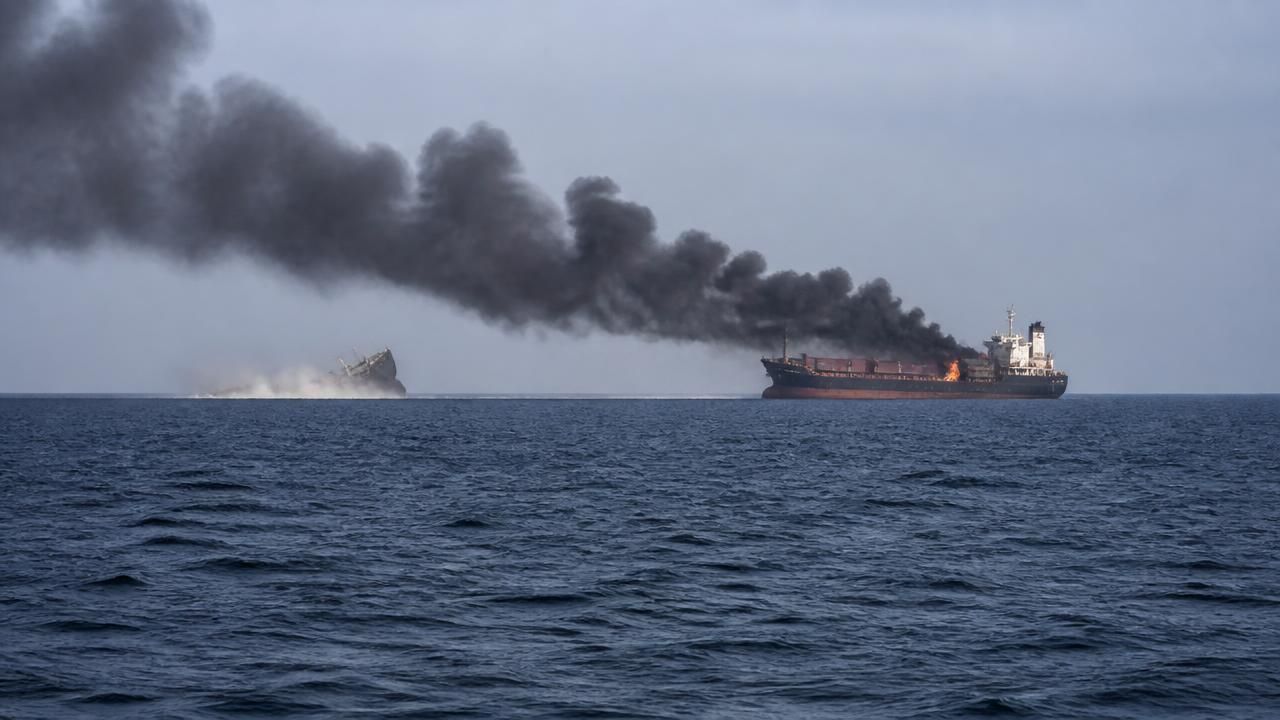
Drone attacks sank one cargo ship and set another ablaze in the Black Sea roughly 80 miles (128 kilometers) off the Bulgarian coast on October 6, killing at least two sailors, injuring others and leaving the fate of a missing crew unknown — the first time unmanned strikes have destroyed commercial vessels inside the exclusive economic zone of a NATO member state.
The Togo-flagged cargo ship Alfa Watan sank after being struck by multiple sea and aerial drones, according to the Associated Press, while the Palau-flagged Able was set on fire in the same assault. A Bulgarian ferry evacuated the Able's 18 crew members, with two severely injured mariners flown to a hospital in the Black Sea port city of Varna. The fate of the Alfa Watan's crew was not immediately known after the vessel went down, triggering an urgent search that continued into the following days.
Reports differ on the precise toll and the number of vessels involved. Ars Technica, citing the AP, reported that drones sank two cargo ships and damaged a third; other accounts confirmed only one confirmed sinking, with the second vessel left burning. The discrepancy reflects the fog of an attack that unfolded across a wide stretch of open water and was still being pieced together by maritime authorities.
Bulgaria calls the attack 'unacceptable'
Bulgarian Prime Minister Rumen Radev condemned the strikes in unusually blunt terms, framing them as an assault on sovereign maritime territory.
“This is an unacceptable attack in Bulgaria's exclusive economic zone” and “a blatant violation of international law and maritime law.”
The language matters. An exclusive economic zone extends up to 200 nautical miles from a coastal state's baseline, giving that government special rights over resources and maritime activity. A lethal drone attack inside such a zone — carried out against merchant shipping flying the flags of Togo and Palau — raises immediate questions under international maritime law, and it puts a NATO member's waters at the center of a conflict that has, until now, largely played out around Ukraine's own coast.
Kyiv blames Moscow, but attribution remains contested
One strand of coverage, carried by MSN's syndicated feed, framed the episode around Ukrainian accusations that Russia was responsible for the deadly sinking of a Turkish-linked vessel in the Black Sea. That framing aligns with a broader pattern: since Russia's full-scale invasion of Ukraine, commercial shipping in the Black Sea has come under repeated attack, and Moscow has separately been accused of conducting “hybrid warfare” incidents across Europe — from sabotage of undersea infrastructure to GPS jamming and arson.
But the sourcing around the October 6 strikes is thinner than the headlines suggest. The vessels' flags — Togo and Palau — are common flags of convenience, used by shipowners worldwide and frequently by so-called shadow-fleet operators moving sanctioned cargo. Neither Russia nor Ukraine has issued a detailed, verifiable claim of responsibility in the accounts available, and independent confirmation of who launched the drones has not been established. The most aggressive attribution comes from Ukrainian officials, whose claims could not be independently verified from the material available.
Black Sea shipping has become a war zone
The strikes did not emerge from a vacuum. Since 2023, Ukraine has deployed an increasingly sophisticated fleet of naval and aerial drones — including the domestically produced Magura V5 and Sea Baby platforms — against Russia's Black Sea Fleet, sinking or badly damaging multiple warships and forcing Moscow to relocate vessels from its historic base at Sevastopol.
Russia, in turn, has struck Ukrainian ports on the Danube and around Odesa, targeting grain infrastructure and threatening the shipping corridor that carries Ukrainian agricultural exports to global markets. Insurance premiums for Black Sea voyages have spiked repeatedly, and many shipowners have avoided the region altogether.
- Escalation: The October 6 attack is the first in which drones are reported to have sunk a commercial vessel inside a NATO member's EEZ.
- Casualties: At least two sailors killed; two seriously injured and hospitalized in Varna; one crew unaccounted for.
- Location: Approximately 80 miles (128 km) off Bulgaria's coast, well outside Ukrainian or Russian territorial waters.
- Legal dimension: Bulgaria characterizes the strikes as violations of international and maritime law.
Why the framing differs across outlets
The story has been told three distinct ways. Ars Technica led on the geopolitical escalation — the “unacceptable” language from Sofia and what it means that a NATO state's waters have been hit. MSN's syndicated headlines, including those emphasizing the search for missing crew, focused on the humanitarian and rescue dimension. The Independent's coverage foregrounded condemnation of the attack while the crew remained missing. And one strand of coverage placed Ukraine's allegation against Russia at the top of the story. Each is accurate in its own terms; none captures the whole picture alone.
What comes next
The immediate priority is search and rescue, with Bulgarian authorities scouring the area for survivors from the Alfa Watan. Beyond that, the attack creates pressure on NATO to define what, if anything, an assault inside a member's EEZ triggers — a grey zone that alliance planners have wrestled with since hybrid incidents began multiplying across Europe.
It also raises the cost of doing business in the Black Sea. If drone strikes can now reach vessels nearly 130 kilometers from a NATO coastline, the risk calculus for shipowners, insurers and crewing agencies shifts again. For the crews aboard the Alfa Watan and the Able, that shift was not theoretical. It was fatal.