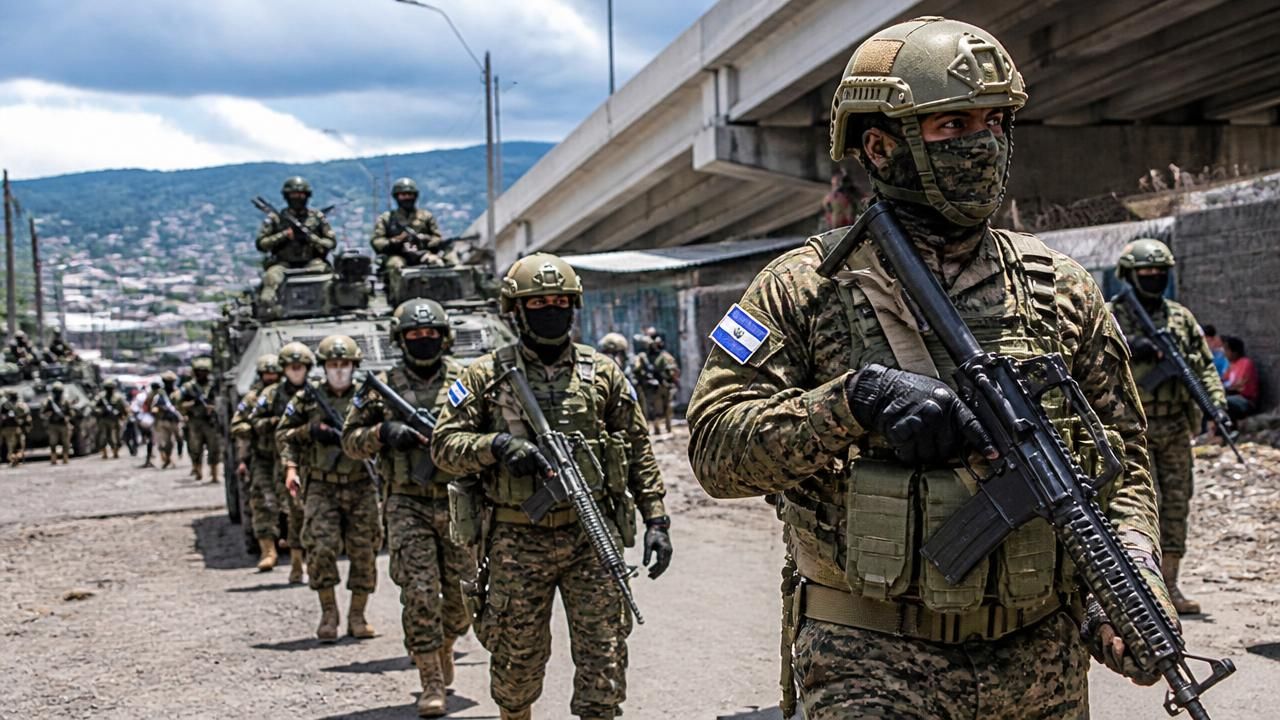
El Salvador has deployed more than 2,000 soldiers and police officers to Haiti, in a dramatic expansion of President Nayib Bukele's war on gangs beyond his own borders — a mission that has drawn celebrations in the streets of Port-au-Prince, a warning from Bukele to Haiti's criminal bosses, and quiet anxiety among Haitians who have seen foreign interventions go badly before.
The deployment, confirmed by Salvadoran officials and reported by UPI, Reuters and other outlets, followed what sources described as a gang ambush on Salvadoran personnel. According to a source cited by Yahoo News, an initial wave of roughly 1,000 troops was rushed to Haiti within hours of the attack, with the force subsequently swelling to more than 2,000. Officials in San Salvador cast the mission as a direct response to aggression against its forces rather than a pre-planned intervention.
A capital already lost to the gangs
Context for the deployment is stark. As the Guardian reported, Port-au-Prince has for roughly two years been almost entirely captured by heavily armed gangs. The emblematic casualty is Sylvio Cator stadium, the national football ground whose facade bears a bullet-peppered mural of Haitian striker Emmanuel Sanon and where Brazilian greats Ronaldo and Roberto Carlos once played. In 2024 the stadium fell under criminal control, its dilapidated red-and-blue stands turned into an outpost for fighters loyal to a gang boss known as Izo.
Haiti's national team, the Grenadiers, was left homeless, forced to play its World Cup qualifying matches abroad. The image — a national sporting shrine occupied by gunmen, a national team in exile — has become shorthand for the collapse of state authority in a country where a multinational security mission, led by Kenya, has struggled to restore order.
Bukele celebrates a strike — and issues a threat
Bukele publicly confirmed and celebrated an operation against the home of a key Haitian gang leader, according to the Associated Press, treating the strike as evidence that his security model can be exported. Fox News reported that the Salvadoran president warned Haitian gang leaders that his forces would finish them as they were finished in El Salvador, a reference to the mass incarceration campaign that drove his country's homicide rate to historic lows and made him one of Latin America's most popular — and most criticized — leaders.
The message from San Salvador has been blunt: the tactics that emptied El Salvador's streets of gangs will be applied in Port-au-Prince.
Human rights groups have long condemned that model for mass arbitrary detention, due-process violations and deaths in custody. The arrival of the same approach on foreign soil — welcomed by Washington, according to MSN, which reported that the deployment has President Donald Trump's blessing — raises difficult questions about accountability and sovereignty in a country whose government is already fragile and partially displaced.
Gang leader calls for peace as the balance shifts
In a sign of how quickly the arrival of foreign combatants has altered the calculations on the ground, Bloomberg reported that a prominent Haitian gang leader called for peace after El Salvador sent troops. The appeal was widely read as a defensive gesture rather than a genuine change of heart — an acknowledgment that well-armed, battle-tested Salvadoran units represent a threat the gangs have not previously faced.
Many residents of Port-au-Prince greeted the convoys with relief. After years of extortion, kidnapping and displacement, the sight of disciplined foreign forces moving into gang-held districts has produced scenes of cheering crowds. Yet the Guardian's reporting captures the ambivalence: Haitians are excited but uneasy, and some fear a full-scale offensive could trigger a violent backlash against civilians who have nowhere to flee.
Elections announced amid the fighting
The intervention has coincided with a political opening. Haiti has announced new election dates, according to Gazettextra, a step that would end a long stretch of institutional vacuum in which no elected president has been in office and the legislature has been effectively defunct. Holding a vote while foreign troops are still clearing gang strongholds will be extraordinarily difficult, but sitting authorities appear to be treating the Salvadoran deployment as the security umbrella that makes a ballot possible.
Washington's endorsement matters as well. The Trump administration has treated the Haiti mission as a test case for outsourcing security to willing regional partners, and Bukele — already a beneficiary of U.S. goodwill — has positioned himself as the hemisphere's go-to enforcer.
What to watch
- Force size and mandate: How many Salvadoran personnel ultimately deploy, and under what legal authority they operate alongside the Kenyan-led mission.
- Civilian toll: Whether an aggressive offensive in dense urban neighborhoods produces the displacement and casualties critics fear.
- The gangs' response: Whether the peace appeal holds or gives way to retaliation and new alliances.
- Elections: Whether the announced dates survive contact with the reality of a partially ungovernable capital.
For now, the story is one of a small Central American nation exporting its signature security policy into a country that has lost control of its own capital — and of a population that is hopeful, wary, and watching the convoys roll past the ruins of its national stadium.