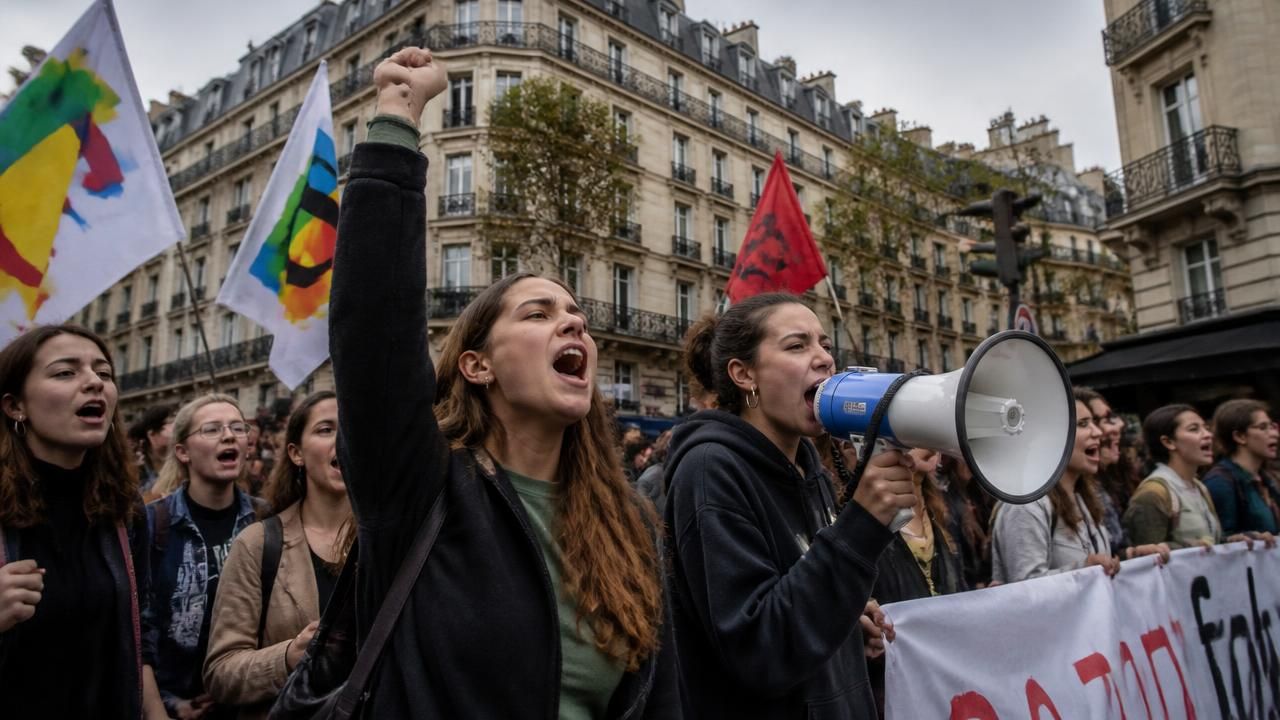
France's biggest nationwide day of school protests in years brought more than a quarter of a million people into the streets, according to government figures, as police fired tear gas and water cannons in Paris, Marseille and other cities. Organizers and some reports put the turnout at 450,000, underscoring the scale of a movement that has united students, parents and teachers against what they say is chronic underfunding of education.
The demonstrations shut down nearly 900 schools, according to NBC News, and led to 488 detentions and 43 police injuries, Al Bawaba reported. NPR noted the government's count of more than 250,000 marchers and said thousands of arrests had been made, a figure that differs sharply from the 488 detentions cited elsewhere. Reuters described the unrest as causing the 'heaviest toll in decades,' a phrase that captured both the physical damage and the political danger for the French government. In a sign of how quickly the story has escalated, BBC News reported that an officer has been charged after a student was hit by a projectile during the protests.
A movement broader than students
What began as student-led walkouts over education funding has widened into a coalition of parents, teachers and local unions. MSN reported that students, parents and teachers marched together in France's largest day of protests, a dynamic that has given the movement unusual breadth. The grievances are not limited to one city or one school: they touch on teacher shortages, overcrowded classrooms, and what protesters describe as a freeze on resources for public education.
The French government's own count of more than 250,000 marchers nationwide was lower than the 450,000 cited by The Sun and other outlets. Such discrepancies are common in French protest coverage, where police and organizers often offer competing estimates. But even the government's figure would make this one of the largest education-focused mobilizations in recent memory.
Clashes and casualties
In Paris and Marseille, police deployed tear gas, water cannons and, according to The Sun, grenades to disperse crowds. The tabloid described 'riot cops' firing at teen protesters and reported that a baby in a pram was hit by a firework and hospitalized. Inkl separately reported the same incident, framing it as a baby hospitalized by a firework as a quarter of a million people marched in support of students. The image of an infant injured amid clouds of tear gas has become one of the most emotionally charged elements of the story.
'School protests sweeping France cause the heaviest toll in decades.' — Reuters
The BBC focused on accountability, reporting that an officer has been charged over a student hit by a projectile. That detail matters because it shifts attention from crowd violence to police conduct, a recurring flashpoint in French protests. Al Bawaba's figures — 488 detained and 43 police injured — illustrate the two-sided cost of the day: mass arrests on one side, injured officers on the other.
Why the protests erupted
At the core of the unrest is education funding. Students have demanded more resources for schools, and their anger has resonated with teachers who say their pay and working conditions have deteriorated. Parents have joined because school closures and disruptions directly affect their families. The protests are also taking place against a broader backdrop of social tension in France, where street demonstrations over pensions, wages and public services have repeatedly challenged the government in recent years.
The shutdown of nearly 900 schools, reported by NBC News, shows how the movement has moved from symbolic walkouts to concrete disruption. When schools close, parents must arrange childcare, local economies feel the strain, and the government faces pressure to negotiate. The fact that both students and teachers are protesting gives the movement a built-in base that can sustain repeated days of action.
How the story is being framed
Different outlets have emphasized different facets. NPR and government figures stressed the scale of the nationwide rally while noting thousands of arrests. The BBC highlighted the charged officer and the student hit by a projectile. NBC News led with the nearly 900 schools shut down. Reuters framed the day as the 'heaviest toll in decades.' The Sun went with dramatic tabloid language: a baby in a pram, riot police, tear gas and grenades. MSN's headlines swung between 'tear gas in Paris and Marseille' and 'violence returns to the streets of France.' ABC News called it the biggest day of school demonstrations.
Those framings are not mutually exclusive. They reflect the same events through different lenses: public broadcaster, wire service, tabloid, and international outlet. Together they paint a picture of a country where an education dispute has become a test of public order.
What comes next
The immediate question is whether the protests will grow or fade. With 488 people detained and 43 police injured, the government may try to portray the movement as violent and fringe. But the participation of parents and teachers makes that harder. If schools remain closed and images of injured children circulate, pressure could build on officials to offer new funding or reopen negotiations with unions.
For now, France is witnessing a rare convergence: students demanding investment in their future, teachers demanding respect for their profession, and parents demanding functioning schools. The tear gas in Paris and Marseille has made the confrontation visible to the world. Whether it produces policy change or deeper stalemate will depend on how both sides handle the next day of action.