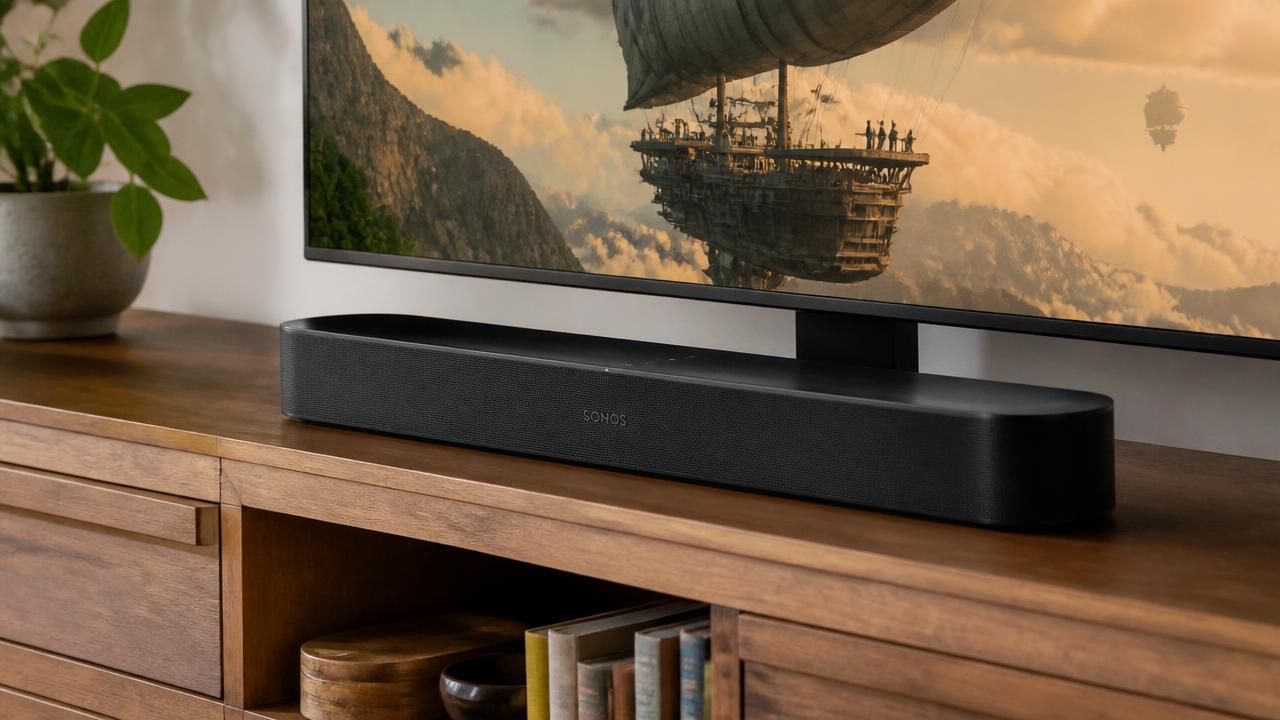
The Sonos Beam Gen 2, long the default recommendation for anyone looking to escape the tinny confines of a television's built-in speakers, has fallen to its lowest price on record. The soundbar is selling for $359 at Amazon and Best Buy during October Prime Day, a $140 discount from its $499 list price — and $10 below what it fetched during the previous Prime Day event.
The deal is notable less for the size of the discount than for its timing. Sonos is running a competing promotion of its own, with IGN reporting the company is hosting a direct sale that cuts up to 25 percent off soundbars, subwoofers and speakers. Together, the two events have turned a routine retail holiday into one of the most aggressive discount windows the premium audio category has seen this year.
A Soundbar That Punches Above Its Price
The Beam Gen 2 occupies a deliberate middle ground in Sonos's lineup. It is not the flagship Arc, and it cannot match the Arc's full Dolby Atmos immersion. But as The Verge noted in its deal coverage, buyers still get room-filling surround sound for considerably less money, plus native connectivity to the rest of the Sonos ecosystem — a feature that has quietly become the brand's strongest lock-in mechanism.
The Gen 2 addition of Dolby Atmos support is the headline upgrade over the original Beam, though it comes with an asterisk. Unlike the $699 Sonos Beam Ultra, which packs upward-firing drivers to bounce sound off the ceiling, the standard Beam virtualizes the Atmos effect through processing alone. The result is a taste of height-channel audio rather than a true overhead bubble.
"The Beam isn't as powerful as the Sonos Arc, nor can it match the flagship soundbar's Dolby Atmos immersion bubble. But you still get room-filling surround sound for less money — and the Beam ties into the Sonos ecosystem for added convenience."
Digital Trends framed the same trade-off more generously, arguing in its review of the Beam Ultra that the line proves shoppers "don't need a huge soundbar for Dolby Atmos." That framing has become central to how Sonos markets the category: smaller footprint, lower price, and virtualization software doing the heavy lifting.
Where the Deals Land
- Amazon: Sonos Beam Gen 2 at $359.99, down from $499 (The Verge, Mashable)
- Best Buy: Matching $359.99 price
- Sonos direct: $359 on the Beam Gen 2; up to 25% off soundbars, subs and speakers company-wide (IGN)
- Sonos Beam Ultra: The Atmos-forward model remains at $699, outside the steepest cuts
Mashable described the $130-$140 markdown as "its best price ever," while Kotaku characterized the drop as a record low. WIRED, meanwhile, widened the lens, rounding up Prime Day soundbar deals that save shoppers up to $200 across brands — a reminder that Sonos is discounting into a crowded field rather than into a vacuum.
The slight discrepancies in reported savings — $130 versus $140, 26 percent versus 28 percent — stem from which reference price outlets use. Sonos's official list price is $499, but third-party sellers have periodically floated the Beam below that in recent months, compressing the apparent discount.
Why a Soundbar, Why Now
The pitch for the Beam has always rested on a simple premise: modern televisions have gotten thinner and more expensive while their speakers have gotten worse. A $359 accessory that supports eARC for shared power and volume control with the TV — eliminating the multi-remote problem — is an easier sell than a full surround installation.
That practicality is also why the Beam Gen 2 has become a gateway product for Sonos. Once a buyer owns one Sonos speaker, adding a second, a Sub, or a pair of rear channels becomes materially cheaper in effort than switching ecosystems. Competitors such as Bose, Samsung and JBL have spent years trying to replicate that gravity; few have managed it.
The broader context is a premium audio market grappling with softer discretionary spending. Soundbars are a classic trade-down purchase — consumers who once considered a full receiver-and-speakers setup now consolidate into a single bar. Aggressive Prime Day pricing accelerates that shift, and both Amazon and Sonos have obvious incentives to capture it while attention is high.
The Fine Print
Shoppers comparing the Beam Gen 2 against the Beam Ultra should weigh the ceiling-bounce question carefully. If a genuine Atmos experience with detectable height channels is the goal, the extra $340 buys hardware that virtualization cannot fully simulate. If the goal is markedly better dialogue clarity and a wider stereo field than a television can deliver — and a foothold in a multiroom system — the Gen 2 at $359 is close to a straightforward answer.
Discounts of this magnitude on a current-generation Sonos product rarely persist beyond the promotional window. Historically, Prime Day pricing has reset within days, and the Sonos direct sale is similarly time-limited. Buyers on the fence should also note that Dolby Atmos support on the Beam Gen 2 arrives via a software update path rather than new drivers, meaning the hardware ceiling is fixed — a consideration for anyone planning to keep the bar for five years or more.