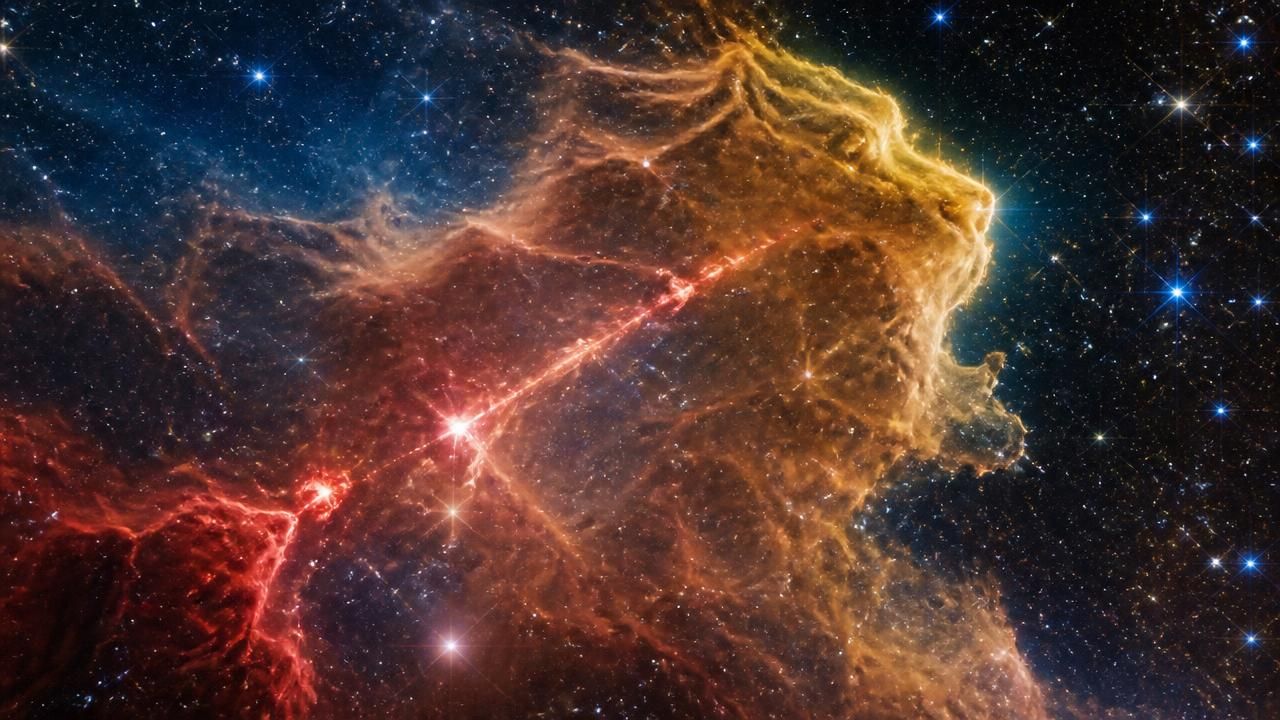
NASA's James Webb Space Telescope has released its sharpest view yet of NGC 7129, a star-forming region about 3,300 light-years away in the constellation Cepheus, where dozens of newborn stars are lighting up a cloud of gas and dust that observers have nicknamed the "Lion Nebula" for its unmistakable leonine profile.
The image, credited to NASA, ESA, CSA and the Space Telescope Science Institute (STScI), with processing by Alyssa Pagan of STScI, captures what the agency's release calls "a cauldron of cosmic creation" — a churning pocket of the galaxy where gravity, radiation and violent outflows are fighting over the same reservoir of gas.
What the telescope actually saw
Webb's near-infrared instruments cut through the dust that hides the region from visible-light telescopes, exposing protostars — infant stars still feeding on surrounding material — scattered throughout the glowing nebula. In the composite released by NASA, hot atomic hydrogen appears in a golden hue, while cooler molecular hydrogen, heated and compressed by shocks from embedded protostars, is rendered in red.
The most striking feature is a stellar jet stretching roughly eight light-years from end to end — a distance comparable to the span between the Sun and its nearest handful of stellar neighbors. Jets of this kind are launched by young stars spinning rapidly as they accrete matter, and they slam into surrounding gas at supersonic speeds, creating bright knots and bow shocks characteristic of Herbig-Haro objects.
- Object: NGC 7129, a reflection nebula and young star cluster in Cepheus
- Distance: Roughly 3,300 light-years from Earth
- Scale: Outflows and shocked structures spanning about eight light-years
- Instruments: Webb's near-infrared and mid-infrared cameras, capable of piercing interstellar dust
- Image credit: NASA, ESA, CSA, STScI; processing by Alyssa Pagan (STScI)
Why stellar jets matter
Jets are not merely decorative. As a protostar pulls gas inward, conservation of angular momentum would spin it apart unless some of that momentum is carried away — and outflows are one of the primary ways nature solves the problem. The jets also carve cavities in the natal cloud, clearing paths for radiation to escape and potentially regulating how much additional material a star can gather.
"A cauldron of cosmic creation," NASA's release described the scene, and the metaphor is apt: the region contains stars at many stages of development, from deeply embedded protostars still shrouded in dust to more evolved, luminous stars whose radiation is sculpting the surrounding gas into the shapes observers recognize today.
How the story was framed
Coverage of the same dataset has emphasized different angles. NASA and STScI led with the science, stressing the protostars and the shocked molecular hydrogen they energize. Newswise distributed the findings under a livelier banner — "Lion Nebula Roars to Life With NASA's Webb" — a framing that leans into the anthropomorphic shape of the nebula. Aggregators and regional outlets, including MSN and the Grand Junction Sentinel, foregrounded the visual spectacle, with headlines promising a nebula "shaped like a lion's head" and a jet "spanning eight light-years."
ScienceDaily took a subtly different tack, describing a cosmic lion "sculpted by a dying star." The discrepancy is instructive rather than contradictory. Star-forming regions are rarely single-purpose objects: NGC 7129 contains both very young protostars driving outflows and older, more massive stars whose intense ultraviolet radiation and winds have hollowed out the cavity that gives the nebula its distinctive silhouette. Depending on which population a given write-up highlights, the lion appears either born of newborn fury or chiseled by stellar old age.
It is also worth noting that "Lion Nebula" is a popular nickname, not an official designation. NGC 7129 is its catalog identity, and it belongs to a long tradition of evocative names — the Pillars of Creation, the Horsehead, the Crab — that help the public connect with objects otherwise known only by numbers.
The bigger picture
NGC 7129 sits in Webb's sweet spot. Infrared light passes through dust that scatters visible starlight, so the telescope can see into the cloud's interior where stars are actually forming. Hubble's earlier views of the region were striking but limited in how deeply they could penetrate the densest material; Webb's larger mirror and infrared-optimized optics reveal structure at finer scales and greater depth.
The scientific payoff goes beyond a pretty picture. Astronomers use observations like these to test models of how outflows interact with their environments, how much material is dispersed before it can collapse into new stars, and how the heavy elements forged inside stars are eventually recycled into the next generation. Each jet that Webb resolves is a data point in that longer story — the story of how a galaxy turns cold gas into stars, and stars into the raw material for more.
For now, the Lion Nebula offers a vivid snapshot of that process mid-roar: light from infant suns, shocks glowing red in molecular hydrogen, and a golden haze of atomic gas — all of it, roughly 3,300 light-years away, still in the messy business of being born.