Physicists at CERN’s Large Hadron Collider (LHC) have captured the clearest evidence yet that the quark-gluon plasma—the ultra-hot matter that filled the universe microseconds after the Big Bang—behaves like a true liquid. By tracking individual quarks as they blasted through the plasma, researchers saw them leave behind ripples, splashes, and swirling wakes, much like a duck moving through water. The finding, reported by Science Daily, suggests this primordial “soup” is so dense that it can slow speeding quarks and respond collectively as a fluid.
The littlest Big Bangs
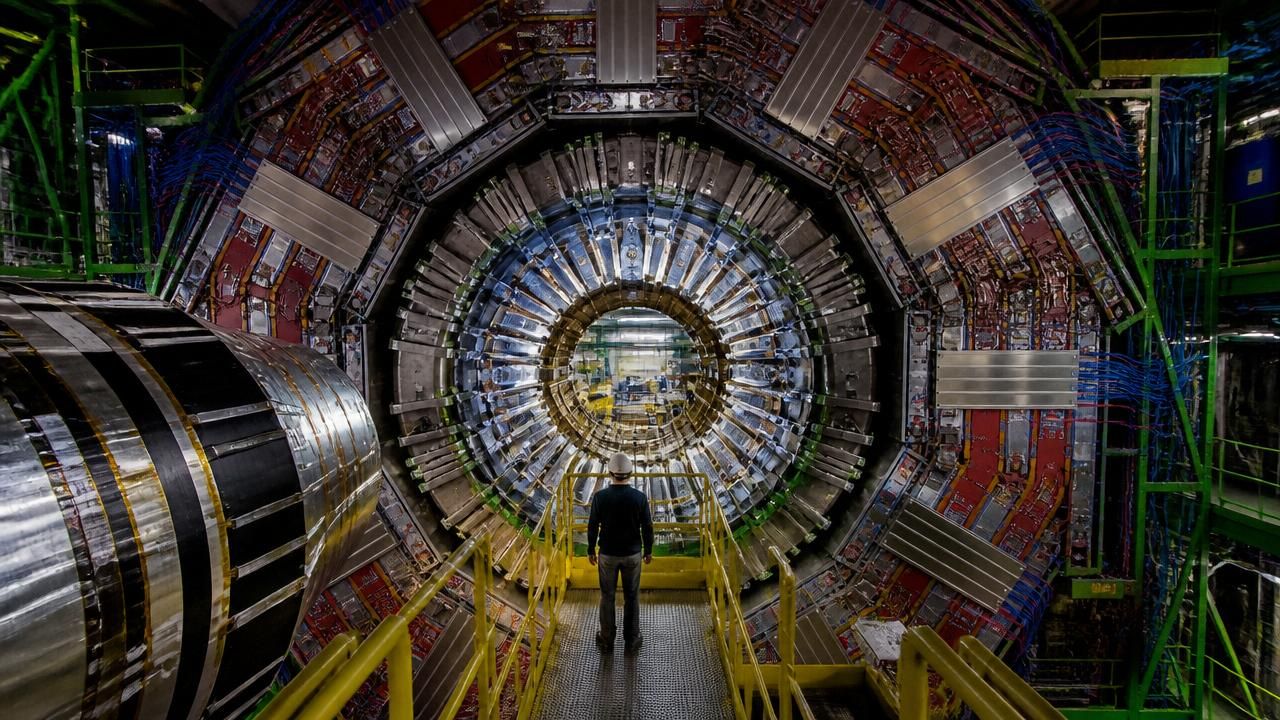
To study matter as it existed in the early universe, scientists use the LHC to smash heavy atomic nuclei together at nearly the speed of light. These collisions create tiny fireballs of extreme temperature and density—events that outlets including Yahoo and Wired have described as “Little Big Bangs” or the “Littlest Big Bang.” For a fleeting instant, quarks and gluons, normally confined inside protons and neutrons, roam free. This is the quark-gluon plasma (QGP).
Recent experiments have pushed the technique further, creating QGP with surprisingly small atomic nuclei. ScienceDaily reported that physicists created a tiny “Big Bang” using nuclei smaller than the lead ions typically employed. That result challenges the assumption that only large collisions can produce a QGP, and it has forced theorists to rethink how these exotic states of matter form.
Quarks make waves
The new LHC data offer an unprecedented look at how QGP responds to a fast-moving quark. As a high-energy quark traverses the plasma, it interacts with the surrounding quarks and gluons, losing energy and dragging the medium along. The result is a wake—a collective ripple that spreads through the plasma. Researchers observed these wakes directly, along with splashes and swirling flow patterns.
“They saw them leave behind ripples, splashes, and swirling wakes much like a duck moving through water,” Science Daily reported.
That fluid-like behavior is remarkable. In a gas, a fast particle would simply punch through, leaving little trace. But in QGP, the medium responds as a whole, with a very low ratio of shear viscosity to entropy density—making it one of the most perfect liquids ever observed. The finding strengthens the case that the early universe was not a dilute gas of particles but a strongly interacting liquid.
Surprising result in primordial matter
Yahoo’s headline—“Surprising result seen in primordial matter inside atom smasher”—captures the unexpected nature of the discovery. The QGP is not just hot; it is also strongly coupled, meaning its constituents interact intensely even when far apart by subatomic standards. This challenges simple models that treat the plasma as a collection of weakly interacting particles.
The experiments also hint at why smaller nuclei can produce QGP. In small systems, the collision geometry and fluctuations may create local hot spots dense enough to melt protons and neutrons. The observation of collective flow in these tiny fireballs suggests that the same liquid-like behavior emerges across vastly different scales.
Lead into gold? And dark matter?
Some coverage took a more sensational turn. MSN’s headline claimed that scientists “mimic Big Bang on Earth and turn lead into real gold.” The gold production is a real but peripheral effect: in peripheral LHC collisions, lead nuclei can lose protons through electromagnetic interactions and transform into gold. It is not alchemy in the medieval sense, and it is not the primary goal of the research. Instead, it is a byproduct of the extreme electromagnetic fields generated by the accelerated lead ions.
Another MSN headline pointed to a separate study suggesting that early-universe gravitational waves could help create dark matter. That theoretical work proposes that ripples in spacetime from the infant universe might have produced dark matter particles through gravitational interactions. While not directly tied to the QGP experiments, it highlights how early-universe physics is a broad quest to understand both visible and invisible matter.
How different outlets framed the story
Science Daily focused on the fluid dynamics of QGP, emphasizing the direct observation of quark wakes. Yahoo and Wired framed the experiments as “Little Big Bangs” that recreate the universe’s first moments. MSN leaned into the eye-catching claims—gold from lead and dark matter from gravitational waves. ScienceDaily’s second headline stressed the surprisingly small nuclei used to create the plasma. Together, these perspectives show a single scientific advance being interpreted through different lenses: fundamental physics, cosmic origins, and practical byproducts.
Why it matters
Understanding QGP is essential for reconstructing the first microseconds after the Big Bang. It also informs the physics of neutron stars, where similar extreme densities may exist. Future experiments at the LHC, the Relativistic Heavy Ion Collider (RHIC), and new facilities like FAIR and NICA will probe QGP with greater precision. Meanwhile, gravitational-wave observatories and dark matter detectors will test the broader early-universe theories.
The LHC’s “littlest Big Bang” may be tiny, but its implications are vast. By watching quarks make waves in a primordial soup, physicists are learning how the universe itself took shape—and how the forces that govern it behave under the most extreme conditions imaginable.