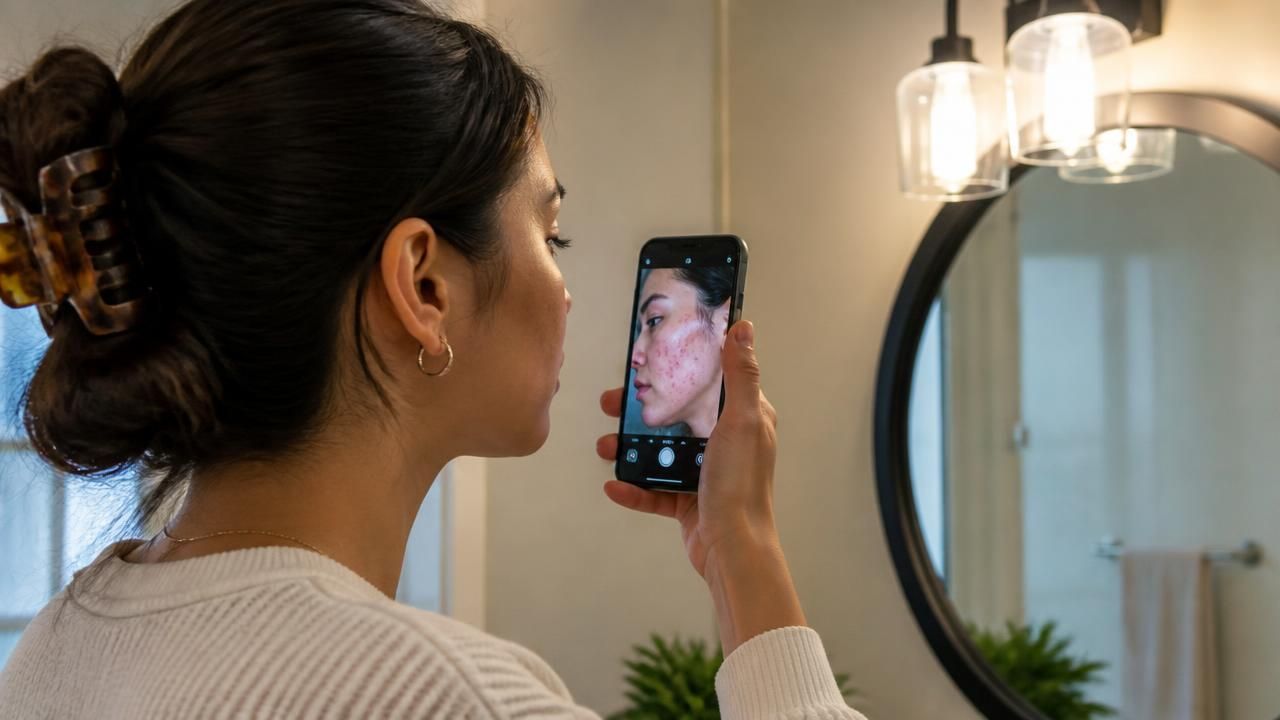
Utah has become the first state to allow an artificial intelligence system to prescribe medication without a physician reviewing every order, after healthcare startup Nolla Health launched a pilot program that lets residents scan their faces with a smartphone app and receive an acne treatment prescription generated autonomously by AI.
The company announced the program Monday, and it was first reported by Bloomberg. The service is initially limited to Utah patients, but the structure of the pilot — and the regulatory precedent it sets — is drawing attention well beyond dermatology.
How the system works
Users open the Nolla Health app and scan their face. The company's AI analyzes the severity and characteristics of the acne, then writes a prescription on its own. No synchronous video visit with a clinician is required, and no physician signs the individual order in the later stages of the pilot.
That is a meaningful departure from the telehealth model that has dominated digital medicine for the past decade, in which software triages and routes patients but a licensed human being ultimately authorizes the treatment. Here, the software is the prescriber in practice, with humans demoted to sampling and oversight.
The oversight glide path
Nolla is phasing in its physician supervision rather than removing it all at once, a design clearly intended to build a safety record while regulators watch.
- First 100 patients: Two physicians approve every AI-generated prescription before it is issued.
- Up to 500 patients: Physicians stop reviewing prescriptions before they go out and instead review them after the fact.
- Beyond that: Physicians review a sample of at least 10% of prescriptions.
Two physicians will approve each AI-generated prescription before they're issued for the first 100 patients, but will start reviewing them only after they're prescribed for up to 500 patients. After that, physicians review a sample of at least 10%.
That escalating autonomy is the heart of the story. It is not simply a technical milestone; it is an experiment in how much human judgment a state is willing to remove from the prescribing loop when the condition is low-risk, the treatment is well understood, and the population is large.
Why acne first — and what comes next
Acne is a deliberately modest proving ground. Topical and oral treatments are established, diagnosis is largely visual, and the consequences of a misprescription are rarely catastrophic. Inc. reported that the model could eventually extend to three additional conditions, signaling that Nolla and its investors view dermatology as a beachhead rather than a destination.
That ambition is what makes the Utah decision consequential. If acne prescribing without direct physician oversight becomes routine, the template can be argued for in chronic disease management, contraception, mental health, and other areas where access barriers are high and the clinical logic is algorithmic.
How the story is being framed
Coverage of the launch diverges sharply in tone, and the difference is instructive.
The Verge led with the mechanics — the face scan, the autonomous prescription, the staged physician oversight — treating it as a product and policy story about a startup testing the limits of delegated clinical authority. The Los Angeles Times emphasized the regulatory permission itself, framing it as Utah allowing an AI startup to prescribe without a doctor's direct oversight. MSN's headline was blunter still: AI just got a green light to prescribe drugs, at least in one state. The Seattle Times leaned into consumer accessibility, with a headline that captured the pitch precisely: no doctor needed.
Taken together, the framing shifts from what the technology does to what the state has permitted — a recognition that the news is less about dermatology than about the boundary between software and licensed practice.
The regulatory questions nobody has answered yet
Several unresolved issues hang over the pilot. State medical boards, not the FDA, generally govern who may prescribe, and Utah's move invites the question of whether other states will follow or push back. Liability is also unsettled: if an AI-generated prescription harms a patient, responsibility could fall on the company, the supervising physicians, or both. And the 10% sampling threshold raises a statistical problem — rare adverse events are precisely what a 10% sample is least likely to catch.
Patient consent, data privacy around facial scans, and the potential for algorithmic bias across skin tones are additional concerns that consumer-facing pitches tend to underplay.
What to watch
- Whether Utah's medical board formalizes the pilot into permanent rule or narrows it after review.
- Whether other states grant similar autonomy, creating a patchwork of AI prescribing rules.
- Which three conditions Nolla pursues next, and whether they carry higher clinical risk than acne.
- Whether payers and malpractice insurers accept AI-authored prescriptions as standard of care.
For now, the experiment is small, contained, and deliberately unglamorous. But the precedent is not. Utah has effectively said that for at least one condition, a machine may write the prescription — and a doctor will check its work only some of the time.