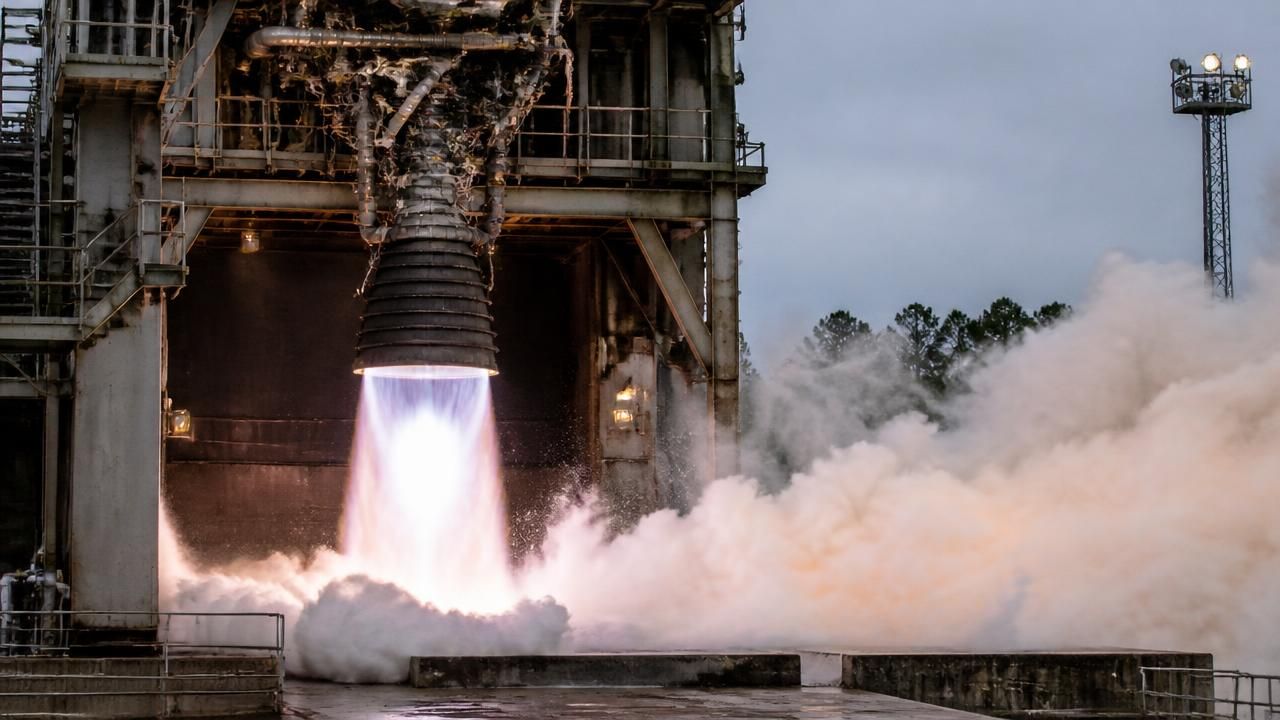
NASA fired an RS-25 engine on Wednesday, Nov. 18, 2026, running the developmental powerplant for a planned three minutes and 20 seconds — 200 seconds — on the Fred Haise Test Stand at the agency's Stennis Space Center near Bay St. Louis, Mississippi. The test of engine No. 10001 is part of a broader campaign to gather data that will shape how the engine performs on future flights of the Space Launch System (SLS) rocket, the heavy-lift vehicle at the center of NASA's Artemis lunar program.
The agency said the engine tested is a developmental unit and will never fly. Instead, it serves as an instrumented test article, allowing NASA and prime contractor L3Harris Technologies to measure how the engine behaves under flight-like conditions and to feed those results back into the design and manufacturing process.
What the Test Achieved
Hot fire tests at Stennis involve clamping an engine to a massive test stand, feeding it cryogenic liquid hydrogen and liquid oxygen propellants, and firing it for a predetermined duration while hundreds of sensors record temperatures, pressures, turbopump speeds, vibration and thrust. The 200-second burn is shorter than the roughly eight-and-a-half-minute run an RS-25 must endure during an actual SLS ascent, but it gives engineers a controlled window into engine performance and reliability.
In its release, NASA framed the test as a data-gathering exercise rather than a qualification milestone:
“While this developmental engine will not be used in flight, the hot fire test provides NASA and NASA's prime contractor L3Harris Technologies with the capability to capture critical data to improve engine performance and reliability for future Artemis missions.”
The agency has been steadily working through a test matrix of both leftover Space Shuttle-era engines and newly manufactured RS-25s. The engine itself has deep heritage: it began life as the Space Shuttle Main Engine, one of the most extensively tested and repeatedly flown rocket engines ever built, and it remains a remarkably efficient staged-combustion design. Adapting it for SLS has required new controller hardware and manufacturing changes, which is precisely what developmental engines like No. 10001 are meant to validate.
Why Artemis IV Matters
The immediate beneficiary of the test campaign is Artemis IV, a Moon landing mission NASA currently targets for 2028. That flight is expected to be the first to use the more powerful Block 1B configuration of the SLS rocket, which pairs the core stage with a new Exploration Upper Stage in place of the interim cryogenic propulsion stage flown on Artemis I, II and III. The upgraded upper stage is designed to carry larger payloads — including elements of the Gateway lunar station — alongside a crew of four astronauts.
Each SLS core stage is powered by four RS-25 engines, meaning the program requires a steady supply of flight engines as well as the developmental units used for ground testing. L3Harris, which absorbed the engine's long-time manufacturer Aerojet Rocketdyne, is assembling new engines while NASA works through acceptance testing at Stennis.
How the Story Was Reported
The test generated modest but geographically distinctive coverage. Local outlets along the Mississippi Gulf Coast, including WXXV News 25, emphasized the test's location and the economic role of Stennis Space Center in Hancock County, where the facility is one of the region's largest employers and a fixture of the coastal community. Aggregators such as MSN carried headlines stressing the Hancock County angle — “NASA test fires engine in Hancock County to support Artemis missions” — while science-focused sites like Phys.org syndicated the agency's own release nearly verbatim.
That pattern is typical for routine NASA test milestones: because the agency issues a standardized press release with imagery and technical details, much of the resulting coverage traces back to a single source, with outlets differentiating mainly in how much local context they add. Independent reporting on the test's specific engineering outcomes — thrust levels achieved, anomalies encountered, or data-quality assessments — was not publicly available in the immediate aftermath.
Context and Caution
- Facility: The Fred Haise Test Stand at Stennis, named for the Apollo 13 astronaut and Mississippi native, is one of the historic stands used for both Shuttle and SLS engine testing.
- Hardware: Engine No. 10001 is a developmental RS-25, not a flight unit, and will not be installed on any SLS rocket.
- Timeline: Artemis IV is currently planned for 2028, though the program has repeatedly slipped because of production and integration challenges.
- Program stakes: The RS-25 test campaign supports both near-term Artemis flights and longer-range planning for sustained lunar operations.
For NASA, the value of a test like this lies less in spectacle — the billowing clouds of steam and the roar audible for miles — than in the gigabytes of telemetry it produces. Each hot fire adds to a body of data that engineers use to certify that an engine built from a mix of heritage and newly manufactured components will behave predictably in the unforgiving environment of launch.
Whether that work keeps the Artemis IV timeline intact remains an open question. The agency has not published a detailed schedule of remaining RS-25 tests, nor did it indicate in its release whether the Nov. 18 firing met all of its test objectives. What is clear is that the engine test campaign at Stennis remains a gate through which every SLS mission must pass — and that the road to the Moon still runs through the Mississippi pine barrens.