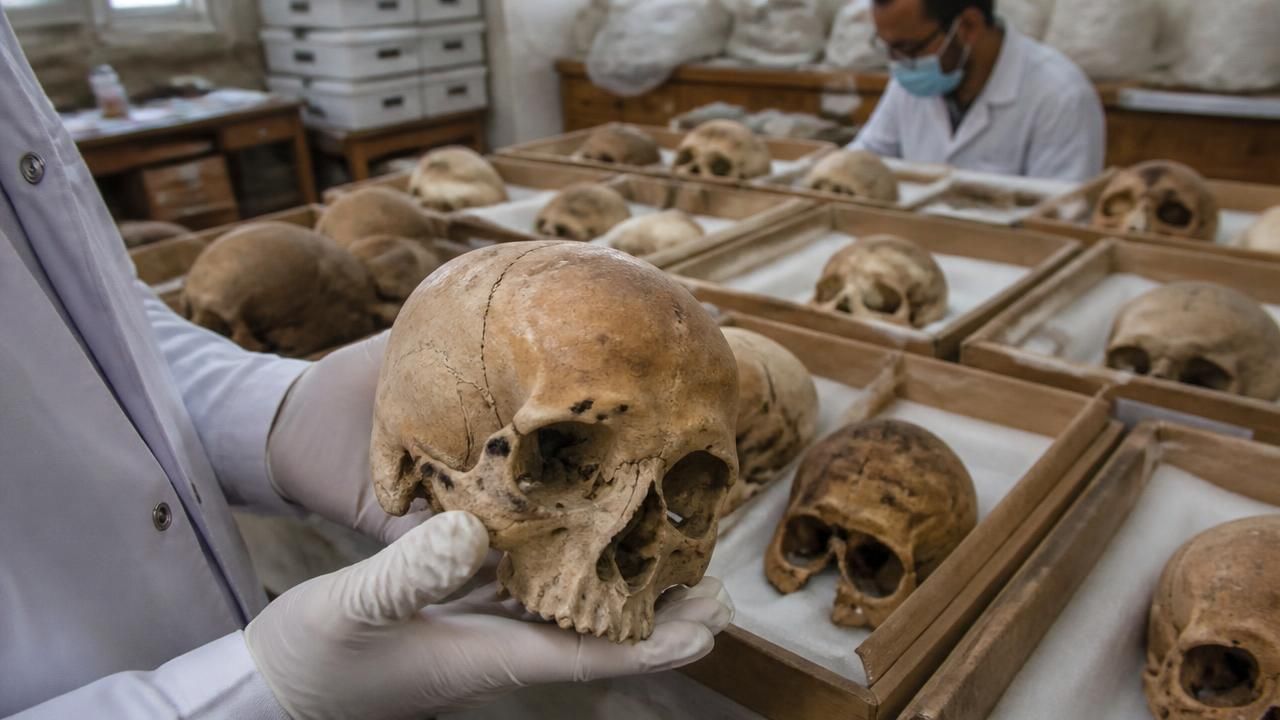
More than a century after they were unearthed from the desert sands of Abydos, a collection of human skulls tied to Egypt's earliest kings is once again at the center of one of Egyptology's most uncomfortable arguments: did the First Dynasty bury its pharaohs with living servants who were killed to accompany them into the afterlife?
A new paper published in the journal Frontiers in Environmental Archaeology reassesses skulls excavated from the royal tombs in the 1920s and concludes that more than one-third bear signs of blunt force trauma — injuries consistent with the deliberate killing of people who were interred alongside Egypt's first rulers roughly 5,000 years ago.
A 5,000-Year-Old Question Reopened
The tombs of the First Dynasty kings at Umm el-Qa'ab, near Abydos in Upper Egypt, are surrounded by rows of smaller subsidiary graves. Early excavators, including Flinders Petrie, documented hundreds of these burials clustered around the monuments of rulers such as Aha, Djer, Djet and Den. Their occupants — men and women, some apparently servants, officials, artisans or members of the royal household — were widely interpreted as retainer sacrifices: people who were killed so that they could continue serving their king in death.
The theory has never been settled. Many of the earliest tombs were plundered in antiquity or excavated hastily in the early twentieth century, using methods that would not meet modern archaeological standards, and the surviving physical evidence is fragmentary. Skeletal collections were dispersed to museums abroad, and much of the contextual data — who was buried with whom, and how — has been lost.
What the Skulls Show
The new analysis returns to that legacy collection. According to the paper, a careful reassessment of the crania found that over a third display evidence of blunt force trauma, a pattern the authors argue is difficult to explain through natural causes, disease or the ordinary wear of daily life in ancient Egypt.
That finding does not, on its own, prove that a systematic program of retainer sacrifice took place. Researchers note that trauma can accumulate in many ways, and that post-mortem damage, ancient robbery and rough handling during early excavation can all leave marks that mimic violence. But the concentration and character of the injuries, the authors suggest, strengthen the case that at least some of those buried around the royal tombs died violently at the hands of others.
Two Camps, One Debate
Roselyn Campbell, a bioarchaeologist at Purdue University and a co-author of the study, has spent her career examining how societies draw the line between acceptable and unacceptable violence — and how difficult that line is to see across millennia.
"I'm interested in how we as human beings decide which types of violence are okay and which are not, and how we even define violence," Campbell told Ars Technica. "It's very context specific. We have to be careful not to extend our own ideas about what violence is and how it's used into other cultures."
She describes a field split into two broad camps. On one side are scholars who accept that early Egyptian kings were accompanied in death by retainers who were killed — a practice paralleled in Mesopotamia, at the Royal Cemetery of Ur, and in other early states from China to the Andes. On the other are Egyptologists who argue the evidence is too thin, and that the subsidiary graves may hold people who died naturally, volunteered out of religious devotion, or were buried at a later date as part of ongoing funerary cults.
Legacy Data and Colonial Baggage
Part of the difficulty is historiographical. As Campbell points out, Egyptology developed within a European and colonial framework in which excavators arrived with firm preconceptions about what ancient Egyptian civilization was — and was not.
"With Egypt, we have such a long history of European and colonial archaeology; they came in with very specific ideas about what this culture was," she said. "You really have to make an effort to contextualize the legacy data we have."
That means treating the surviving skulls not simply as biological specimens but as objects with a messy archival history. Reanalysis of such collections requires reconstructing excavation records, museum catalogues and correspondence to determine what can legitimately be inferred from remains removed from their original context a century ago.
How the Story Traveled
Coverage of the study has varied sharply in emphasis. Specialist and science-oriented outlets have foregrounded the methodological question — what forensic reanalysis of old collections can and cannot establish — along with Campbell's caution about imposing modern definitions of violence on an ancient culture. Aggregators and general-interest outlets, by contrast, have tended toward a more declarative framing, with headlines asserting that 5,000-year-old skulls "reveal evidence of human sacrifice" and that the earliest kings "were buried among hundreds of servants."
The gap matters. The paper's contribution is not a definitive verdict but an accumulation of forensic detail that shifts the balance of plausibility. Whether that detail is described as proof or as supporting evidence changes how the public understands both the practice of early Egyptian kingship and the limits of archaeological inference.
Why It Matters
- Kingship and power: If retainer sacrifice was practiced, it implies the First Dynasty state could command the lives of its subjects on a scale that reshapes models of early Egyptian political authority.
- Method: The study demonstrates the value — and the hazards — of revisiting nineteenth- and twentieth-century museum collections with modern forensic techniques.
- Ethics: Human remains from colonial-era excavations raise continuing questions about repatriation, consent and who has the right to study the dead.
- Interpretation: Even strong forensic evidence leaves open whether retainers were killed unwillingly, volunteered, or died in some other way and were buried with ceremony.
For now, the skulls from Abydos remain what they have always been: ambiguous witnesses. But with each new analytical pass, the argument that Egypt's first kings did not go into the afterlife alone becomes harder to dismiss — and the debate over how to read the silence of the earliest tombs is likely to continue for decades more.