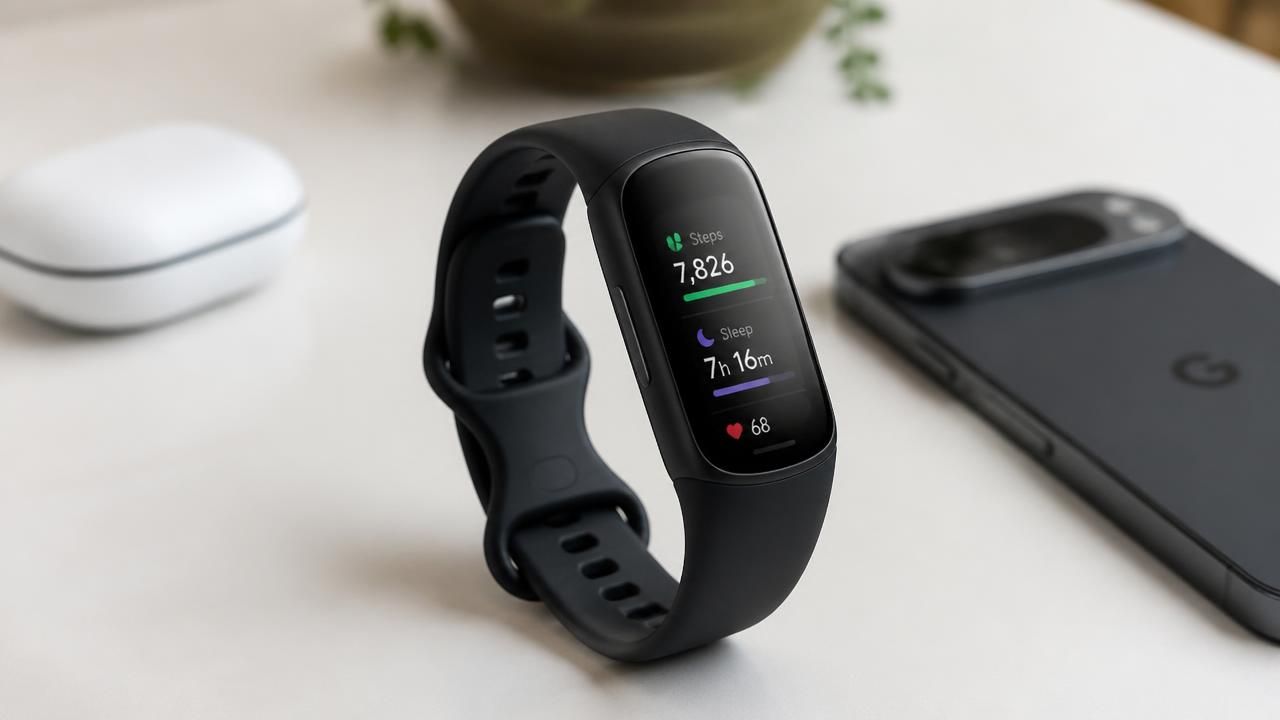
Google appears to be readying another wearable under the Fitbit banner. Newly surfaced images of a device called the Fitbit Edge, first posted by Android Headlines and reported by The Verge, offer the clearest look yet at what the company has planned for the middle of its fitness-tracking lineup — a midrange tracker that sits awkwardly, and perhaps deliberately, between the minimalist Fitbit Air and the full-fat Pixel Watch.
What the leak actually shows
According to The Verge, the Fitbit Edge is best understood as a successor to the Charge line, Fitbit's long-running family of mid-priced trackers. The leaked images show a device with a small screen capable of displaying some widgets, but one that is conspicuously less expansive than a proper smartwatch display. The Verge described the design as splitting the difference between the Pixel Watch and the Fitbit Air — a compromise form factor aimed at users who want more information at a glance than a band can provide, without committing to a full smartwatch.
It has a small screen that is able to display some widgets, but clearly isn't as expansive as a proper smartwatch. — The Verge
On the specification side, the leak points to a seven-day battery life, built-in GPS and an altimeter. Those three features alone would make the Edge substantially more capable than the minimalist Air, which appears to be positioned as a low-frills, fitness-first band. The Verge also notes that the Edge will carry limited app support — a meaningful caveat for anyone hoping for a cheaper Pixel Watch alternative rather than a serious dedicated tracker.
A crowded house: Air, Charge and Pixel Watch
To understand why the Edge matters, it helps to map Google's wearable portfolio. Google closed its $2.1 billion acquisition of Fitbit in January 2021, and has since run two parallel hardware philosophies: the premium Pixel Watch line, which launched in 2022 and runs Wear OS with Fitbit health tracking layered on top, and the legacy Fitbit trackers, which continue to sell on battery life, comfort and price.
The Charge family has been the anchor of that second track. The Charge 6, released in 2023, added built-in GPS and an electrodermal activity sensor while keeping the slim band design and multi-day battery that made the line popular. If the Edge is indeed the Charge's successor, the naming change would signal a broader rebrand — and possibly a repositioning of the whole midrange tier as Google tries to differentiate products that increasingly overlap.
The rumored Fitbit Air, meanwhile, has been framed in separate leaks as a return to basics: a stripped-down, fitness-first device. Together, the Air and the Edge would bracket the middle market from two directions — one prioritizing simplicity, the other capability.
How the story spread — and what each outlet emphasized
The leak moved quickly through the tech press, but not uniformly. The Verge focused on positioning and specs, framing the Edge as a Goldilocks device between two existing products. MSN ran its coverage under the headline "Exclusive: This is the Fitbit Edge, Google's next fitness tracker," emphasizing the imagery itself as the scoop. NewsBytes led with the display, headlining that the Edge "leaks before launch with screen near edges" — a detail-oriented framing aimed at design watchers. Firstpost took the launch angle, promising readers "what the new tracker may offer." A second MSN item bundled the story with the Fitbit Air, treating the two devices as a single narrative about "the return of Fitbit."
That divergence is typical of leak coverage, where the underlying artifact — a set of photos — is the same but the framing is dictated by each outlet's audience. Notably, several of the aggregated versions of this story were inaccessible behind access restrictions, a reminder that much of the modern tech-news cycle now travels through syndication and aggregators rather than original reporting.
Why it matters
The midrange fitness tracker is one of the few wearable categories with genuine mass-market reach. Devices in the $150–$250 band compete directly with the Apple Watch SE, Samsung's Galaxy Fit line and a deep bench of Garmin and Amazfit products. Google's advantage is the Fitbit brand's residual loyalty and the Fitbit Premium subscription business, which gives the company a recurring revenue incentive to keep hardware cheap and sticky.
A seven-day battery is a genuine differentiator. Most smartwatches, including the Pixel Watch, struggle to reach two days. If the Edge delivers a week of use with GPS and an altimeter on board, it becomes an easy recommendation for hikers, runners and sleep trackers who find nightly charging intolerable.
The risk is cannibalization. Google now sells overlapping wearables at adjacent price points, and every additional SKU complicates the pitch to consumers who already find the Fitbit-versus-Pixel Watch split confusing. Limited app support may be the company's way of drawing a hard line: the Edge is a tracker, not a watch.
What we still don't know
- Price. No leaked figure has surfaced for the Edge or the Air.
- Launch timing. Neither Google nor Fitbit has confirmed an event or release window.
- Platform. Whether the Edge runs a trimmed version of Wear OS or Fitbit's existing operating system remains unclear.
- The name. "Edge" comes from leaked materials and has not been verified by the company.
Google has declined to comment on unreleased products, and the company has a long history of leak-driven launches. Until an official announcement arrives, the Fitbit Edge remains a promising photograph and a set of specifications — one that suggests Google is finally ready to define what a Fitbit should be in the Pixel Watch era.