NASA is inviting the public to a movie night — and there is no ticket, no subscription and no paywall. In a promotional post titled "10 Things: Movie Night," the agency highlighted a slate of original documentaries and series available on NASA+, its free, on-demand streaming service, alongside content produced by the agency's Jet Propulsion Laboratory (JPL) and its Scientific Visualization Studio.
The pitch is deliberately casual: grab some popcorn and come along for the journey. But the underlying story is a notable shift in how a federal science agency distributes its storytelling — moving from occasional YouTube uploads and broadcast partnerships toward a full-fledged streaming destination.
What's on the Playlist
The featured programming spans the agency's scientific portfolio, from planetary science to astrophysics:
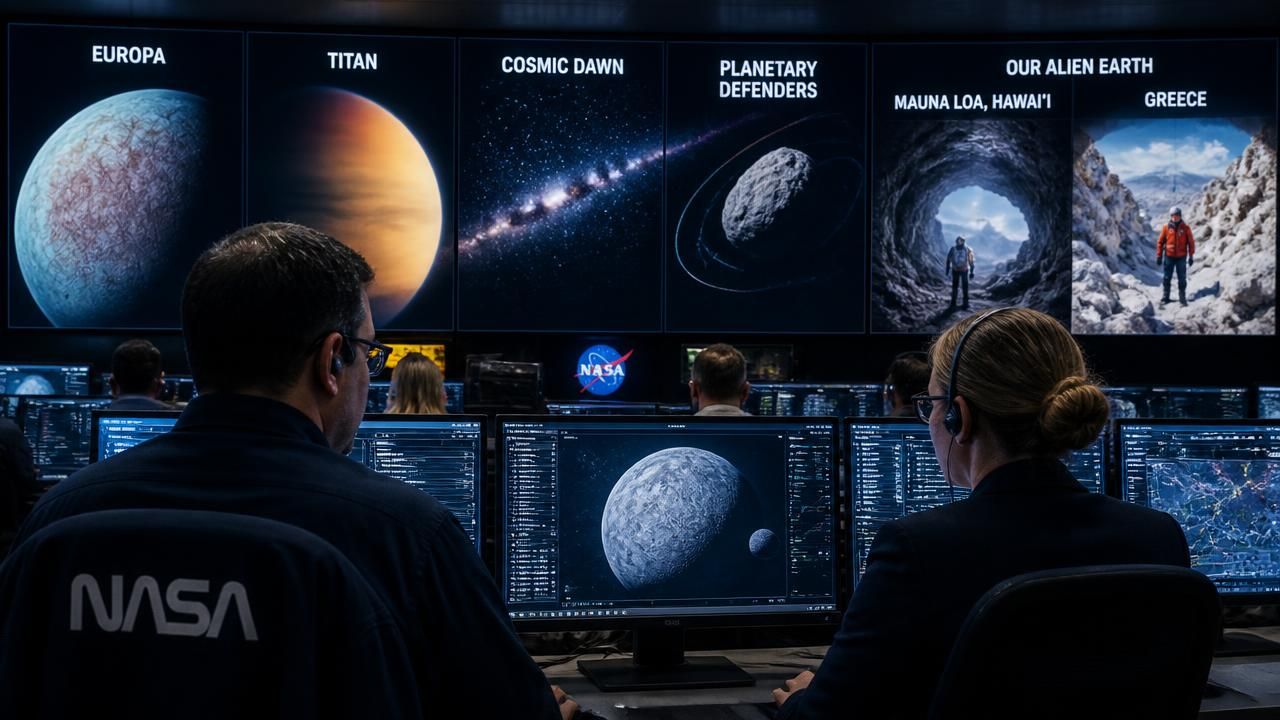
- Other Worlds: Europa and Other Worlds: Titan — deep dives into two of the most tantalizing moons in the solar system.
- Cosmic Dawn — a look at the earliest chapters of the universe.
- Planetary Defenders — the work of tracking near-Earth asteroids.
- Our Alien Earth: The Lava Tubes of Mauna Loa, Hawai'i and Our Alien Earth: Greece — field science conducted in Earth's most extreme analog environments.
- NASA Explorers: Sample Return and NASA Explorers: Space School — series-driven looks at missions and the people behind them.
- Listen to the Universe — sonification of astronomical data.
- Space Out! — a relaxation segment pairing music with imagery of Earth's Moon.
NASA frames the offering around its core mandate. "NASA's mission is to pioneer the future in space exploration and scientific discovery," the agency states, positioning NASA+ as "NASA's on-demand streaming service with original content from the space agency for the benefit of all." The service is free, requires no subscription, and includes live launch coverage, documentaries, original series and kids' content.
Why It Matters
The move fits a broader pattern in public science communication: agencies are becoming publishers and broadcasters in their own right, bypassing intermediaries to control tone, pacing and accuracy. For NASA, whose budget depends on public and political goodwill, that direct channel is both an outreach tool and an argument for continued funding.
It's free. It's on demand. And no subscription is required.
The content mix also reveals a strategy. Mission-specific documentaries like Planetary Defenders speak to policy audiences and enthusiasts; Earth-analog series like Our Alien Earth court general audiences with accessible adventure framing; Space Out! targets the ambient-content market that has exploded on streaming platforms. Each is designed to keep the agency visible between headline-grabbing launches.
The Other Side of the Screen: Access Denied
The same week that NASA advertised open, frictionless access to its content, a different corner of the open web illustrated the opposite problem. Four interview-based stories from Wikinews — the volunteer-driven, citizen-journalism project — were unavailable to automated retrieval, each returning an identical notice: "Please set a user-agent and respect our robot policy."
The policy, administered through the Wikimedia Foundation's technical infrastructure, is designed to block scrapers and crawlers that consume bandwidth without contributing back. In practice, it also means that four substantive human interviews sit behind a barrier for aggregators and news-synthesis systems, even though they remain readable in a browser.
What's Being Gated
The titles alone suggest a remarkably wide slice of American life and independent media:
- An interview with Joe Schriner, an independent candidate for U.S. president.
- A business profile-cum-interview with the owners of a dungeon, examining BDSM as a commercial enterprise.
- An interview with Indiana State Senator Mike Delph.
- A conversation with Kira Nerusskaya on obesity and the fat acceptance movement.
The juxtaposition is striking: a government agency actively pushing its content outward for anyone to watch, while a volunteer news outlet — whose entire value proposition is original, first-person reporting on subjects mainstream media rarely covers — is effectively invisible to the tools that increasingly mediate how audiences find information.
Two Models of Openness
Neither approach is simply right or wrong. NASA+ operates with public funding and a mandate to disseminate; its content is produced at taxpayer expense and designed for mass consumption. Wikinews relies on volunteers and donated infrastructure, and its robot policy is a reasonable defense against automated abuse that has driven server costs and editorial vandalism.
But the episode highlights an emerging tension in the information ecosystem. As AI-driven news aggregation and synthesis grow, the ability to be found depends increasingly on technical posture — robots.txt files, user-agent rules, API access — rather than on editorial quality. A documentary about Europa reaches millions; an interview with an independent presidential candidate reaches the crawlers only if the crawlers play by the rules.
For audiences, the practical takeaway is simpler. NASA+ is streaming now, free of charge, with a catalog spanning lava tubes in Hawai'i to the methane haze of Titan. The Wikinews interviews, meanwhile, remain available — but only to those who arrive in person.