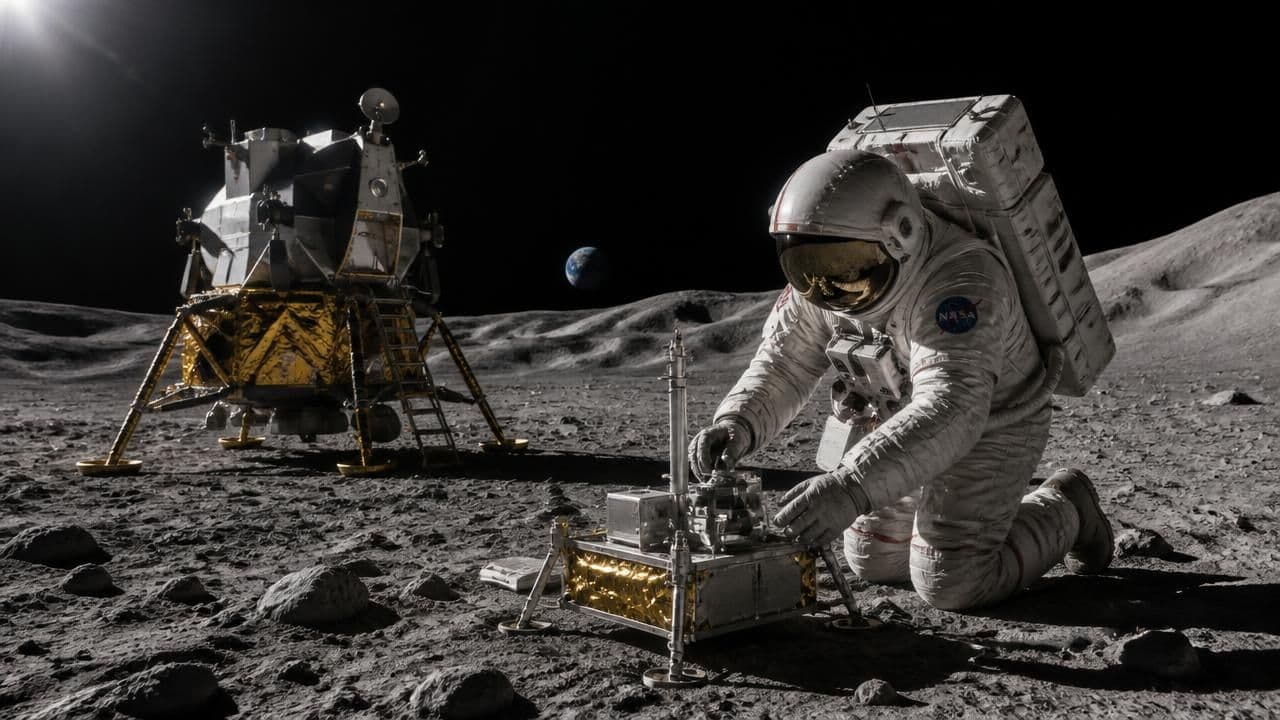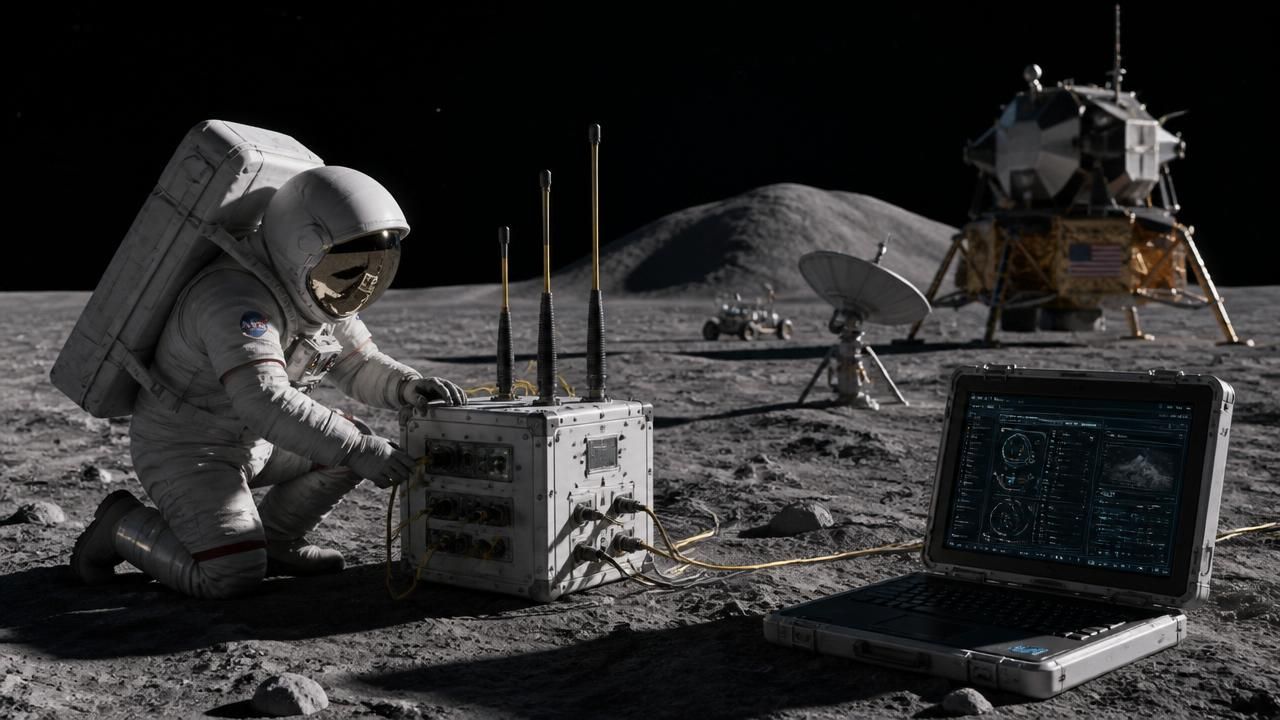
NASA has awarded Modulate Space Corporation a firm-fixed-price contract valued at approximately $38 million to develop key elements of a 5G communications system for the lunar surface — complete with built-in Wi-Fi 6 — as the agency lays the groundwork for a sustained human presence on the Moon.
The work, managed by NASA's Glenn Research Center in Cleveland, falls under a procurement whose unwieldy title telegraphs its dual purpose: the 5G System and Lunar Surface Communications Evaluation and Radio Propagation Measurements contract. NASA characterizes it as an "accelerated effort" organized into two primary work areas that together will produce a scalable, standards-based communications capability designed for future Moon Base surface operations.
"This accelerated effort is organized into two primary work areas that together will develop a scalable, standards-based communications capability designed to support future Moon Base surface operations." — NASA contract announcement
Two Phases, One Architecture
According to NASA, the contract is split into distinct performance periods that move the technology from the laboratory to the lunar surface:
- 5G Network-in-a-Box Development and Lab Demonstration — running from Oct. 1 through Jan. 31, 2028. This phase covers hardware, firmware, and software development and terrestrial validation of a self-contained, deployable 5G node.
- Lunar 5G and Wi-Fi Integrated Surface Network and Flight Demonstration — running from Nov. 30 through Dec. 31, 2028, and culminating in an actual demonstration of the integrated network on the lunar surface.
NASA says the demonstrations will give the agency hard-won insight into both system architecture and operational performance, while preserving the flexibility needed to evolve the technology for later lunar missions. The agency will acquire the technology development outright — hardware, firmware, and software — rather than simply purchasing a service, a structure that gives NASA the ability to steer the design and reuse it across programs.
Why Standards-Based 5G Matters on the Moon
The emphasis on commercially grounded standards is the strategic heart of the award. Rather than inventing a bespoke lunar radio protocol, NASA is betting on the same 5G and Wi-Fi 6 standards that underpin terrestrial networks, allowing the agency to ride the commercial supply chain and avoid the cost of a parallel, single-purpose ecosystem. In practice, that could mean relatively cheap, mass-produced chipsets adapted for space rather than costly one-off hardware.
Wi-Fi 6 (IEEE 802.11ax) matters here because a future lunar habitat will resemble a dense, noisy wireless environment: dozens of sensors, robots, rovers, life-support monitors, and astronaut-worn devices competing for airtime within a small pressurized volume. Wi-Fi 6 was designed for exactly that kind of congestion, with features such as target wake time that cut power consumption — a critical consideration when every watt must be generated by solar arrays or batteries during the two-week lunar night.
The Science Buried in the Title
The contract's most quietly significant element may be its radio propagation measurements. Wireless engineers on Earth can rely on decades of empirical data about how signals behave in cities, buildings, and open terrain. No such dataset exists for the Moon. Regolith, sharp surface topology, the near-vacuum environment, and reflections off landers and habitats will all shape how 5G and Wi-Fi signals travel and attenuate.
Measuring those effects is essential: without accurate propagation models, engineers cannot guarantee coverage inside a crater, around a habitat module, or between a base and a rover operating kilometers away.
A Long-Running Engineering Problem
Communicating across roughly 384,400 kilometers of space imposes a physics tax that no protocol can eliminate. Radio signals take about 1.3 seconds to reach the Moon and the same to return, producing a round-trip delay of some 2.6 seconds. Apollo-era missions relied on S-band links for voice, telemetry, and television, and every lunar mission since has operated under similar constraints, often with store-and-forward techniques and delay-tolerant networking.
Modern lunar communications planning — including NASA's LunaNet concept of an interoperable "network of networks" — aims to bring internet-like services, positioning, and navigation to the Moon, with relays in orbit and surface terminals sharing common standards. A 5G/Wi-Fi surface layer would serve as the access network at the edge, connecting users and devices to those backbone links.
A Widening Commercial Field
Modulate Space is not operating in a vacuum. A separate, smaller award reported in the same news cycle — a roughly $5 million contract to AiRANACULUS under NASA's CCRPP program — points to a broader push to advance lunar and space communications networks through multiple vendors and research tracks. The dual awards underscore a deliberate NASA strategy: fund several parallel efforts, keep interfaces standards-based, and let interoperability, not vendor lock-in, drive the architecture.
Other players are already testing the waters. Nokia Bell Labs and Intuitive Machines flew a compact 4G/LTE "network in a box" to the Moon aboard the IM-2 mission, an early commercial demonstration that cellular hardware can survive launch and lunar conditions. Military and aerospace trade coverage of the new award framed it squarely in those terms — as a race to network the Moon before the next wave of crewed landings.
How the Story Was Framed
The same announcement read very differently depending on the outlet. NASA's own release was procedural and engineering-focused, leading with the contract mechanism, dollar value, and performance dates, and closing with press contacts at headquarters in Washington and at Glenn Research Center. Aggregators such as Mirage News republished the release largely verbatim, extending its reach without adding analysis.
Trade publications, by contrast, led with ambition rather than paperwork, casting the contract as NASA "seeking a 5G communications system for future lunar missions" — a framing aimed at an aerospace and defense readership watching the lunar communications market take shape. Meanwhile, coverage of the adjacent AiRANACULUS award in financial feeds highlighted the smaller-dollar, research-oriented side of the same effort, reminding investors that the lunar economy is being built in increments, not single headline contracts.
What to Watch
The immediate milestones are the lab demonstration in early 2028 and the flight demonstration in the final weeks of that year — a compressed schedule for hardware expected to operate in one of the harshest environments humans have ever attempted to industrialize. Radiation, thermal cycling, dust abrasion, and mass and power budgets will all test the design.
If the demonstrations succeed, NASA will have something it has never had: a proven, standards-based wireless layer for the lunar surface, ready to be replicated across landers, habitats, and rovers as the Artemis era moves from flag-and-footprints visits toward an actual, networked Moon Base.
For more information about NASA and agency programs, visit https://www.nasa.gov.