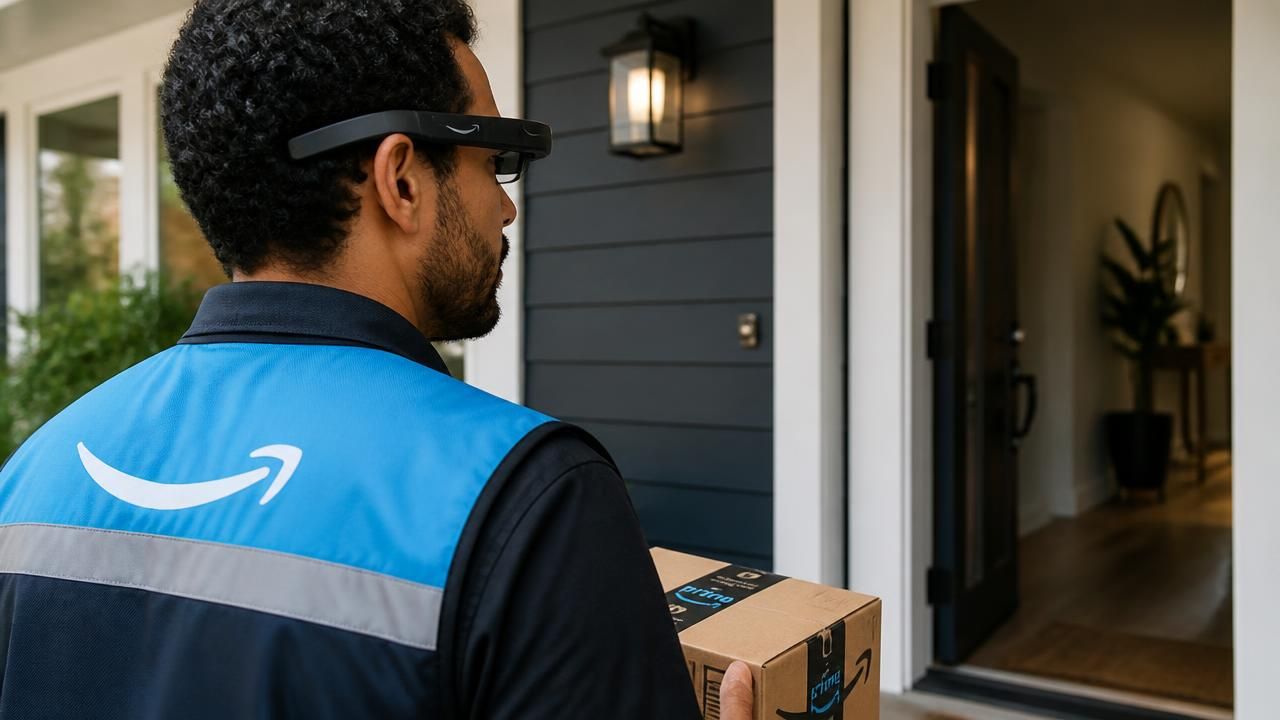
Amazon is testing artificial intelligence-powered smart glasses for its delivery drivers that could capture thousands of photographs in a single shift — including images of customers, their homes and their private property — and the company has no plan to let people opt out of being photographed.
The eyewear, first reported by Bloomberg, is designed to guide drivers through their routes while continuously recording whatever the wearer sees. According to that reporting, the glasses could produce “several thousand captures in a single driver’s typical shift,” footage that Amazon intends to upload to Wellspring, its internal AI platform. The company has been rolling the hardware out to a narrow group of drivers as a pilot.
What Amazon says the glasses are for
Amazon frames the program as an operational efficiency play. Viraj Chatterjee, the Amazon executive involved in the effort, told Bloomberg that the only purpose of the footage is to “enhance the delivery process,” and that the imagery is not intended for surveillance or marketing.
In practice, the glasses would sit at the intersection of two trends Amazon has pursued for years: computer vision systems that grade driver performance, and an AI infrastructure buildout designed to turn real-world data into training material. Wellspring, the platform named in the Bloomberg report, is the funnel through which that imagery would flow.
The answer that rattled privacy watchers
The most consequential line in the reporting came when Chatterjee was asked whether customers would be allowed to decline being captured on camera.
“We haven’t thought about that.” — Viraj Chatterjee, Amazon
Privacy advocates seized on the admission, arguing that a program running continuously through residential neighborhoods — past doorways, windows, children and visitors — creates an opt-out problem that Amazon should have solved before deployment, not after publication.
The scale is what makes the story land differently from earlier Amazon forays into sensing. Even a modest fleet of 100 drivers using the glasses for 200 shifts a year could generate hundreds of thousands of images, a volume of incidental data that has no obvious operational use but considerable potential intelligence value. Amazon’s vans already carry Netradyne cameras that film drivers and the road ahead; the glasses push that lens outward, into the front yards and living-room windows that the vans pass.
How the outlets framed it
The story has been told from three angles, and the difference is revealing.
- The Verge led with the volume and the ambiguity — “almost constantly,” thousands of captures per shift — and pressed hardest on the missing opt-out, pairing it with the surveillance denial.
- The Next Web stripped the story to its sharpest edge: customers cannot opt out. That headline treats the consent gap as the news, not a detail inside it.
- Blockonomi read the same facts through a market lens, reporting that Amazon stock rose roughly 2 percent on the AI-powered expansion — investors hearing “AI” and “fleet-scale data” rather than “camera in your driveway.”
All three descriptions are accurate. They diverge because the story is simultaneously an engineering milestone, a consumer-privacy event and a capital-markets signal, and each outlet picked the register its audience rewards.
The regulatory backdrop
The pilot lands in an unusually hostile environment for ambient data collection. Illinois’ Biometric Information Privacy Act has generated class actions over far less invasive technology. California’s privacy law gives residents rights over personal information collected about them, including images. Europe’s GDPR and the EU AI Act impose stricter tests for continuous visual capture in public space, particularly where bystanders cannot consent.
Amazon’s record here is relevant. In 2023, the Federal Trade Commission settled with the company over its Ring doorbell business, alleging that employees and contractors had improperly accessed customer videos, and separately over children’s voice recordings held by Alexa. Both cases established the pattern the current pilot raises again: a capability deployed at scale, scrutinized afterward.
Amazon is also not operating in a vacuum. Rivals including Walmart and FedEx have experimented with wearables for warehouse and logistics workers, and the broader industry is racing to collect the physical-world data that frontier AI models increasingly need. The competitive logic cuts against restraint.
What happens next
The glasses remain a test, and Amazon has not disclosed how many drivers are involved or when a wider rollout might occur. But the trajectory is clear: the hardware works, the AI pipeline exists, and the question of consent has been deferred rather than answered.
That deferral is the story. A company that spent a decade teaching customers to accept cameras on their porches is now proposing to put them on the people walking up the driveway — and when asked whether anyone could say no, the answer was that nobody had thought about it yet.