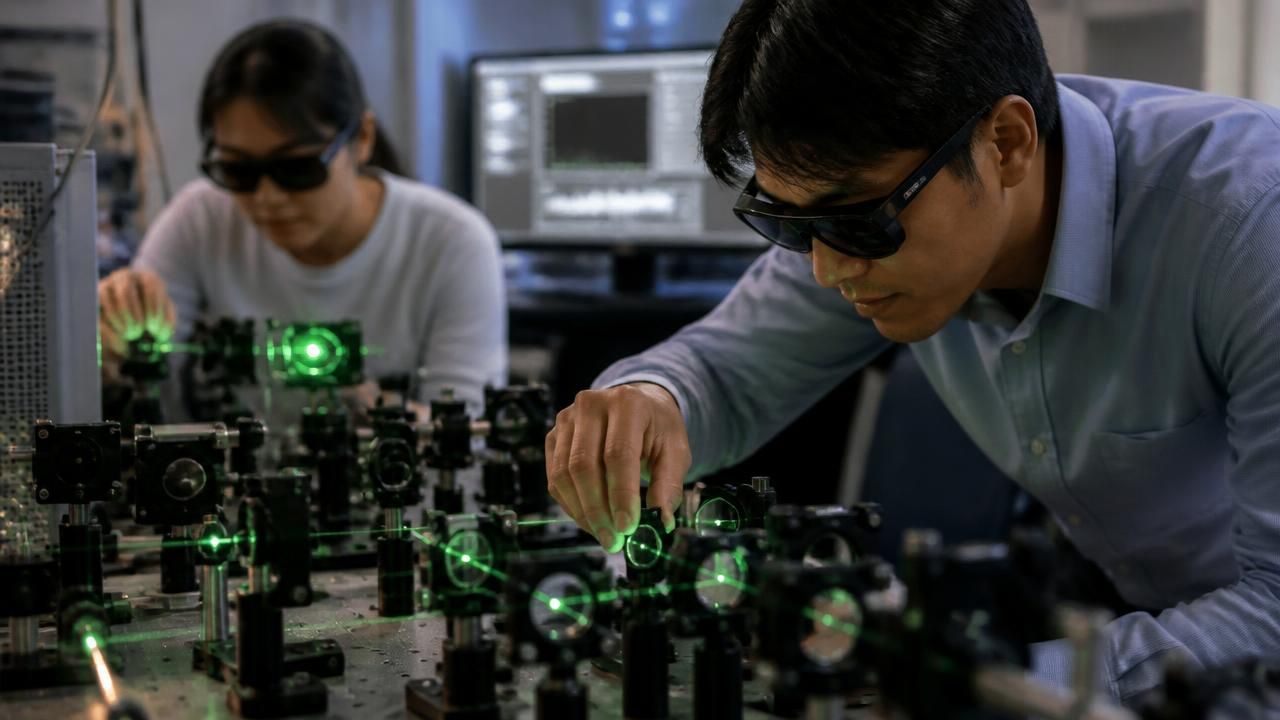
Researchers have demonstrated a long-sought method for identifying W states — a notoriously difficult form of multiphoton quantum entanglement — in a result that could make complex entangled systems far easier to measure and manipulate. The advance, reported by Science Daily, resolves a measurement problem that has stood for roughly a quarter of a century and arrives alongside a second line of progress: experiments that push quantum entanglement out of the laboratory and onto the busy fiber-optic cables already carrying the world's internet traffic.
Together, the developments suggest that the long-promised "quantum internet" is shifting from theoretical ambition to engineering problem — one that must now be solved on infrastructure that already exists.
The 25-year entanglement challenge
Entanglement is the phenomenon in which two or more particles become correlated so tightly that measuring one instantly constrains the state of another, regardless of distance. But not all entanglement is equal. Physicists distinguish between classes of multiphoton states, and W states occupy a peculiar position: unlike GHZ states, which collapse entirely if a single particle is lost, W states retain a residual form of entanglement even when one of their partners disappears.
That resilience makes them attractive for real-world technologies, where photons are routinely absorbed or scattered. Paradoxically, it also makes them hard to detect. Because W states tolerate loss, they cannot be identified by simply counting particles; researchers need a way to certify the full pattern of correlations without destroying them.
Identifying W states has been a 25-year entanglement challenge. Solving it could make complex entangled systems far easier to measure — and therefore far easier to use.
According to Science Daily, the new technique was both developed and experimentally demonstrated, meaning it is not merely a theoretical proposal. The practical consequence is a measurement toolkit that could be applied to quantum teleportation, quantum communication and quantum computing, where knowing precisely what state a system is in is a prerequisite for doing anything useful with it.
Teleportation, demystified
Quantum teleportation does not move matter. It transfers the state of a particle — its full quantum description — from one location to another, using a shared entangled link and a classical message that tells the receiver how to reconstruct it. The entangled resource is consumed in the process, which makes efficient generation and reliable identification of entangled states the central bottleneck.
Recent coverage framed the breakthrough in dramatic terms. One outlet described scientists as having "teleported an image across 100 quantum channels at once" — a headline that captures the ambition of parallel, high-dimensional teleportation but compresses the underlying physics into a single claim. What the reported work ultimately points to is scale: moving from one fragile entangled channel to many simultaneous ones, a prerequisite for any network carrying quantum information between multiple users.
Out of the lab, onto live fiber
Perhaps the most consequential shift is geographic rather than theoretical. Research highlighted by phys.org describes the quantum internet leaving the laboratory with the first real-world entanglement distributed over busy telecom fiber — cable that is simultaneously carrying conventional data traffic. That matters because quantum signals are exquisitely sensitive; a stray photon from an ordinary laser pulse can drown out a single entangled photon.
Compatibility with existing telecom infrastructure is not a convenience, it is an economic necessity. Laying dedicated dark fiber for quantum links would be prohibitively expensive at national scale. Running entanglement alongside classical traffic allows operators to reuse conduits, amplifiers and switching facilities that are already built and already paid for.
Why photon loss dominates the problem
Photons vanish. In optical fiber, signal attenuates exponentially with distance, and quantum states cannot be copied or amplified the way classical signals can — the no-cloning theorem forbids it. Phys.org's framing of quantum teleportation as a way to reduce photon loss in long-distance communications captures the core insight: rather than trying to push a fragile state across a lossy span, researchers can teleport it across a shorter, higher-quality link and use entanglement to bridge the gap.
- Science Daily emphasized the measurement breakthrough: a new method for identifying W states, ending a 25-year detection impasse.
- Yahoo leaned into spectacle, describing image teleportation across 100 quantum channels simultaneously.
- MSN focused on translation, framing the news as entanglement finally arriving on existing telecom networks.
- Phys.org split its attention between the physics of loss reduction and the first real-world deployment over busy commercial fiber.
What comes next
The convergence is striking. Identifying W states addresses the characterization problem — knowing what you have. Real-world entanglement over live fiber addresses the transport problem — getting it somewhere. Teleportation across many channels addresses the scale problem — getting it to many places at once.
Significant obstacles remain. Entanglement distribution rates over metropolitan fiber are still measured in hertz rather than megabits, quantum memories capable of storing states long enough to build repeaters are immature, and the cost of cryogenic detectors and precise timing systems remains high. The gap between a successful demonstration and a deployed network is typically a decade or more.
Even so, the direction of travel is clear. For 25 years, W states were an object physicists could describe mathematically but rarely isolate and confirm in the lab. If that barrier has genuinely fallen, and if entanglement can survive the noise of a working telecom network, then the quantum internet has crossed the threshold that matters most: from a phenomenon to an infrastructure.