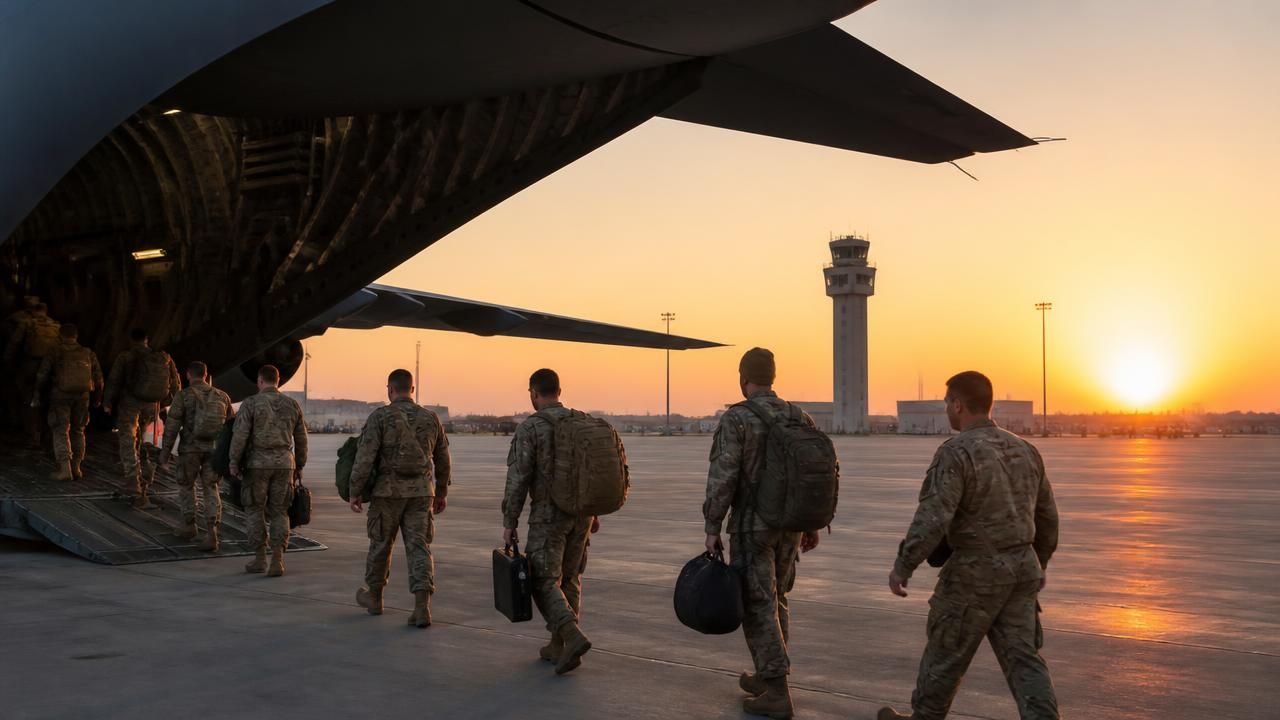
The United States has completed the withdrawal of its forces from Iraq, formally ending a military presence that began with the 2003 invasion and lasted, in one form or another, for more than two decades. The Pentagon confirmed the conclusion of the U.S.-led coalition mission this week, and Stars and Stripes described the moment as "closing another chapter in decades of war."
The exit marks the end of Operation Inherent Resolve, the international campaign launched in 2014 after the Islamic State swept across northern Iraq and seized Mosul. According to RFI, U.S. troops wrapped up their mission twelve years after that offensive — a timeline that has become the central frame for European and Middle Eastern coverage, even as American outlets emphasize the far longer shadow of 2003.
A War That Ran for 23 Years
NPR and other U.S. public broadcasters pegged the story to the invasion itself, noting that "23 years after the United States military invaded Iraq, sparking an insurgency and a civil war, the U.S. has withdrawn its forces, as the country still tries to combat Iranian influence." That framing — invasion, insurgency, civil war, withdrawal — compresses two very different wars into a single arc.
The first, from 2003 to 2011, toppled Saddam Hussein, dissolved the Iraqi army and fueled a sectarian conflict that killed tens of thousands of civilians. The second, from 2014 onward, was fought largely from the air and through local partners after ISIS declared a caliphate. British tabloid coverage leaned on the visual history of that period, promising "stunning images" tracing the arc from Saddam's execution to the rise and fall of ISIS as the last troops departed.
Iran Fills the Vacuum
The dominant analytical thread across nearly every source is the shift in regional power. MSN's aggregation headlines were blunt: "US withdraws forces in Iraq as balance of power shifts to Iran," and "US forces exit Iraq, emboldening Iran's proxies and Islamic State." Outlook India struck a similar note, reporting that after 20 years, U.S. troops are set to leave "as Iran's allies consolidate influence."
Iraq begins a high-stakes security balancing act as US troops withdraw. — Al Jazeera
Al Jazeera's framing is the most granular: not a simple handover, but a precarious equilibrium. Baghdad must now manage militias that are formally part of the state security apparatus but answer, in practice, to Tehran — while keeping enough distance from Washington to satisfy domestic political factions. Reports from the region note that Baghdad has delayed disarmament of those factions, a decision that removes an immediate flashpoint but leaves an armed parallel structure intact.
Telegraph India's headline captured the anxiety plainly: "US forces leave Iraq 23 years after invasion; fears grow over Iranian militias, Islamic State." The pairing is significant. The same withdrawal that reduces one source of friction may reopen another.
The ISIS Question
U.S. officials have consistently argued that Iraqi security forces, backed by coalition training and intelligence, are capable of containing the remnants of ISIS. Critics counter that the group's insurgency never fully ended — it receded into rural areas, extortion networks and sleeper cells. Without American air power and surveillance overhead, the argument goes, the group has more room to reconstitute.
The coalition's official line, reported by Bastille Post and others, is that the mission concluded rather than failed — a distinction with real diplomatic weight as Washington tries to preserve a residual advisory relationship and continued intelligence cooperation.
Oil, Money and Leverage
One strand of coverage looks past the battlefield entirely. MSN's report on how the U.S. controls Iraq's oil revenues through the New York Fed highlights a leverage mechanism that survives any troop withdrawal. Iraq's substantial oil proceeds are held in an account at the Federal Reserve Bank of New York, giving Washington a financial chokepoint that no militia can seize. That arrangement, dating back to the post-2003 reconstruction, is arguably the most durable American presence in the country.
It also cuts both ways. Any attempt to weaponize the account would trigger an economic crisis in a country where oil sales fund the overwhelming majority of government spending and public-sector salaries.
An Uncertain Future
The New York Times framed its coverage around exactly that uncertainty: "After Two Decades, U.S. Forces Leave Iraq to an Uncertain Future." Yahoo and MSN carried the straight Pentagon confirmation, while Greek Reporter and Khaama ran headlines emphasizing the sheer duration of the U.S. presence — more than two decades.
- The American view: a mission accomplished, with Iraqi forces ready to lead.
- The regional view: a vacuum filled by Iran and its allied militias.
- The Iraqi view: sovereignty regained, but with an unresolved disarmament question.
- The economic view: continued dependency on U.S.-held oil revenues.
What is not in dispute is the scale of the reckoning. A war launched to eliminate weapons of mass destruction that were never found, and then re-entered to defeat a caliphate that grew from its aftermath, has now ended without a decisive settlement on any of the questions it raised. Iraq will spend the next several years answering them on its own.