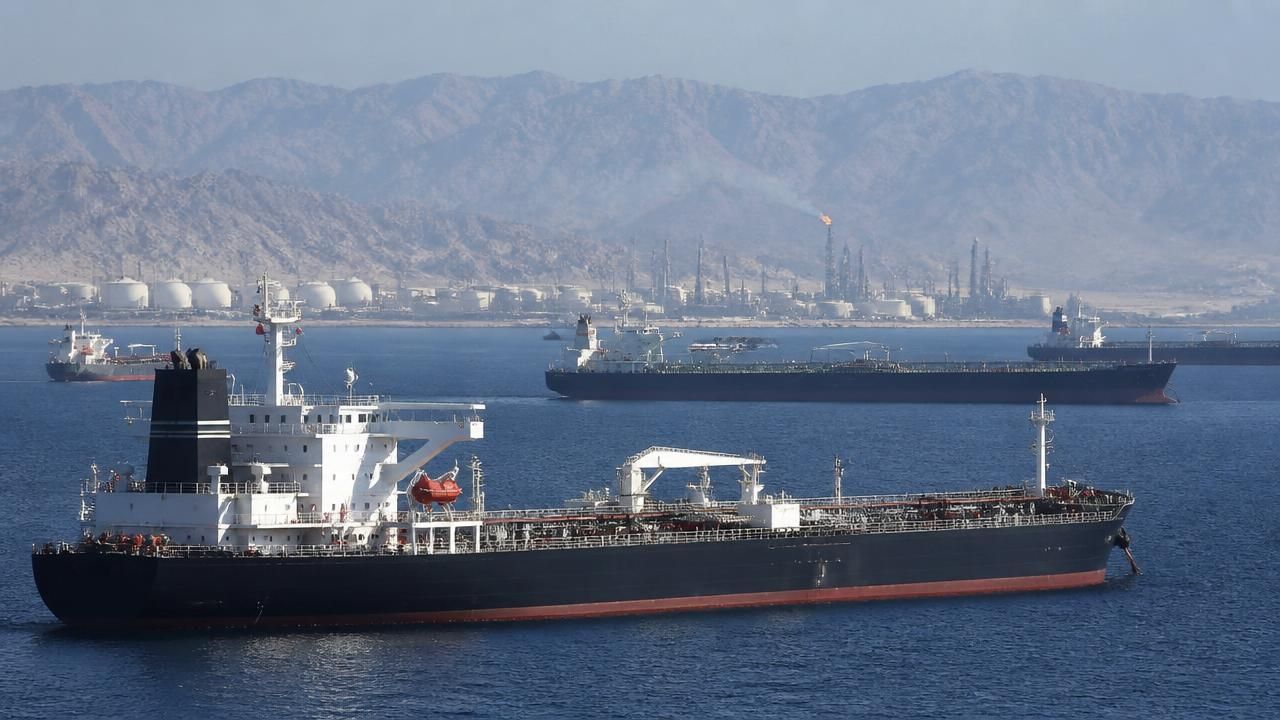
The most urgent threat to the global economy is no longer the strategic rivalry between Washington and Beijing, but the fragile oil supply chain running through the Strait of Hormuz. That is the argument advanced by Ashok Bhundia, deputy chief economist at the Institute of International Finance, who contends that thinning crude and diesel inventories in the Middle East now represent a sharper and more immediate danger than US-China competition.
The warning lands as oil prices hold above $80 a barrel, tanker rates along key Middle East routes touch record highs, and the dollar climbs to a two-month peak — a combination that traders and economists alike read as a classic supply-shock setup.
An oil risk that outranks geopolitics
Bhundia's case, reported by Bloomberg Markets, rests on the intersection of inventories and pricing signals. With oil and diesel stockpiles around the Strait of Hormuz already depleted, there is little buffer to absorb a disruption. Elevated crack spreads — the gap between crude prices and refined product prices — are already transmitting higher costs into the wider economy, a mechanism known as cost-push inflation.
Dwindling oil and diesel inventories around the Strait of Hormuz present a more urgent global risk than US-China strategic competition, and elevated crack spreads are driving cost-push inflation that could trigger a sudden market shock.
That framing represents a notable shift. For much of the past decade, macro strategists treated great-power competition as the defining systemic risk. Bhundia's view inverts that hierarchy: a physical commodity squeeze, he argues, could bite faster and harder than any tariff regime or export-control escalation.
Tanker rates at record highs
The shipping market is already pricing in that anxiety. OilPrice.com and Seeking Alpha both reported that tanker rates have surged to record highs as the risk premium for moving crude through Middle Eastern waters escalates. Insurance costs, rerouting decisions and crew-safety concerns all feed directly into the cost of a barrel delivered.
Analysts describe a compounding effect: when war-risk premiums rise, charterers either pay up or divert, tightening effective capacity elsewhere. The result is a freight market that amplifies even modest supply uncertainty into a global pricing event.
Crude holds above $80, and $100 re-enters the conversation
Reuters reported that oil is expected to hold above $80 a barrel as Middle East supply risks persist, with forecasters reluctant to call a ceiling while the security picture remains unresolved. More aggressive framing came from live-market coverage on MSN, where the prospect of $100 crude was tied directly to attacks on oil tankers and a deepening crisis around the Strait of Hormuz.
That strait is the world's most consequential energy chokepoint, carrying roughly a fifth of global oil consumption in normal conditions. Any sustained interruption would not be a regional story — it would be a global one.
The dollar, inflation and the cost-push channel
Currency markets have responded in textbook fashion. Blockonomi reported that the greenback strengthened to a two-month peak amid Middle East tensions and rising oil — a safe-haven bid compounded by expectations that energy-driven inflation could keep central banks cautious about easing.
The feedback loop is familiar to policymakers: higher energy costs lift headline inflation, complicate rate-cut timelines, and strengthen the dollar, which in turn raises import bills for emerging economies. Crack spreads sitting at elevated levels suggest the stress is not confined to crude but extends to refined products like diesel, the fuel that moves freight and feeds industrial supply chains.
Spillover: Indian exporters under pressure
The consequences are not limited to Houston, London or Singapore trading desks. Fibre2Fashion flagged that the evolving Middle East crisis is raising fresh risks for Indian exporters. Higher freight rates, lengthening transit times and costlier insurance squeeze margins for labour-intensive export sectors already navigating soft global demand.
India's position is particularly exposed: it is a major importer of crude and refined products, and its export corridors to Europe and Africa rely on the very sea lanes now judged riskier. A sustained freight shock would function as a de facto tax on Indian trade competitiveness.
How different outlets frame the story
Coverage of the same underlying risk diverges sharply in emphasis:
- Bloomberg Markets frames it as a macroeconomic hierarchy question — oil risk versus US-China rivalry — anchored in inventory data and inflation mechanics.
- Reuters focuses on price forecasts, treating the $80 floor as the central analytical question.
- OilPrice.com and Seeking Alpha concentrate on shipping economics, where tanker rates serve as the real-time stress gauge.
- MSN's live coverage leans into headline-driven escalation, pairing tanker attacks with the headline-grabbing $100 scenario.
- Blockonomi tracks the currency transmission channel, linking oil to dollar strength.
- Fibre2Fashion shifts the lens to emerging-market trade, asking who absorbs the cost.
Taken together, the picture is one of a market repricing a chokepoint risk in real time, across equities, currencies, freight and physical barrels.
What to watch
Three indicators will determine whether this remains a risk premium or becomes a shock. First, inventory levels around the Gulf — further draws would remove the last cushion. Second, tanker rates and war-risk insurance premiums, which are the fastest-moving signal of physical disruption. Third, crack spreads, which reveal whether the stress is spreading from crude into the refined products that drive broader inflation.
For now, the balance of commentary suggests markets are treating the Middle East as the dominant variable of the moment — a verdict that, if Bhundia is right, has less to do with geopolitics than with the simple, unforgiving arithmetic of empty tanks.