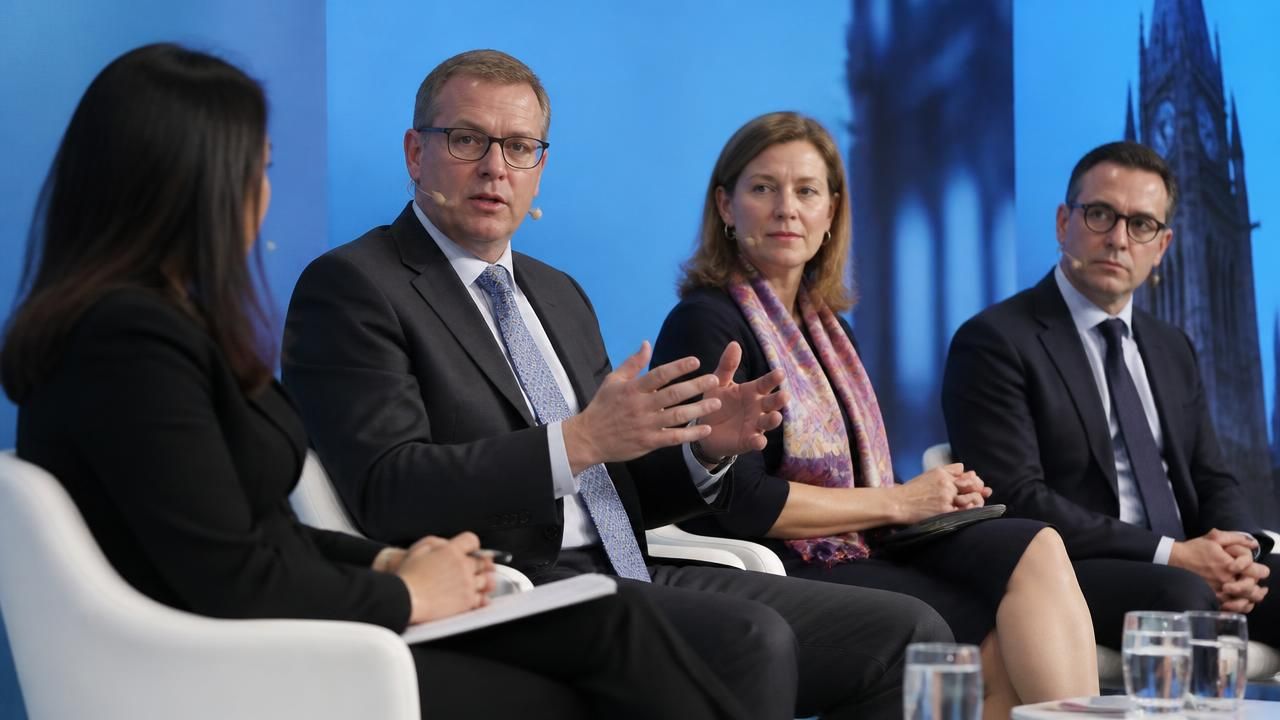
Three of the world's most closely watched public borrowers used a single stage at the 2026 Canadian Finance Conference to deliver the same message in different accents: the era of routine sovereign funding is over, and the institutions that raise money in the world's capital markets are rewriting their playbooks accordingly.
Randy Ewell, senior funding officer at the World Bank Group, Isabelle Laurent, deputy treasurer and head of funding at the European Bank for Reconstruction and Development, and Charles Perreault, senior director of debt management at Canada's Department of Finance, joined Bloomberg's Jorgelina Do Rosario for a panel discussion on how global issuers are adapting funding programs to changing interest rates, geopolitical uncertainty and evolving investor demand.
Three borrowers, three mandates, one market
The trio represents three distinct corners of the sovereign and supranational debt market. The World Bank Group issues to finance development lending across emerging and frontier economies. The EBRD borrows to fund reconstruction and private-sector development, most recently with a heavy concentration of exposure to Ukraine and neighbouring states. Canada's federal debt program, meanwhile, is the benchmark against which much of the country's financial system prices risk.
What unites them is the mechanics of issuance: benchmark sizes, curve building, currency diversification and the constant search for a durable investor base. As central banks in major economies have moved through the later stages of their tightening cycles, the cost of that funding has become less predictable — and the term premium investors demand for holding long-dated paper has reasserted itself after more than a decade of compressed yields.
Why the panel matters
Sovereign and supranational issuance is the plumbing of the global financial system. When the World Bank or the EBRD adjusts its funding calendar, it signals shifts in the cost of capital that ripple into corporate credit, municipal borrowing and emerging-market spreads. When a G7 borrower such as Canada changes the mix of its bond program, domestic pension funds, insurers and primary dealers must reposition their portfolios.
Three forces were identified as driving the recalibration:
- Rate volatility. Uncertainty over the path of policy rates complicates the timing of syndicated deals, pushing issuers toward a more opportunistic, data-dependent calendar.
- Geopolitical risk. Conflict, sanctions regimes, trade fragmentation and shifting energy flows have changed how investors assess both sovereign creditworthiness and the institutions that lend to states.
- Investor demand. The buyer base for high-grade paper is shifting, with pension funds and asset managers seeking duration, index eligibility and, increasingly, sustainability credentials.
The panel's central argument: issuers that diversify currency, tenor and investor base are better positioned to absorb rate shocks and geopolitical disruption than those reliant on a single funding channel. That logic has pushed supranational borrowers toward a broader menu of currencies and products — including sustainability-linked and green-labelled instruments — while domestic sovereigns have leaned on the reliability of their own dealer networks and domestic savings pools.
The panel's core position: diversification across currency, tenor and investor base is now a defensive necessity, not an optional enhancement, for issuers operating in a fragmented market. (Paraphrased from the Bloomberg-moderated discussion.)
The Canadian lens
Canada's presence on the panel is not incidental. The country's debt-management strategy has long emphasised transparency — published issuance calendars, regular consultations with market participants and a mix of auctions and syndications designed to keep benchmarks liquid. In a world where investors are re-pricing duration risk, that predictability becomes a competitive advantage, allowing the government to borrow at tighter spreads than less transparent peers.
For supranational issuers, the calculus is different but related. The World Bank and EBRD must balance the cost of funding against their development mandates, and they compete for the same investor dollars as sovereigns and top-tier corporates. Both institutions have historically used their triple-A ratings to borrow cheaply and pass favourable terms to member countries — a model that becomes harder to sustain as risk-free rates rise.
What to watch
Market participants will be looking for several signals in the months ahead: whether supranational issuers increase the size of individual benchmarks to satisfy demand, whether they lean further into emerging-market local-currency issuance, and whether sovereigns such as Canada adjust the share of long-dated versus short-dated debt in their programs.
The broader takeaway from the conference session is that the post-2008 assumption of permanently cheap, abundant sovereign funding has been retired. Issuers are now managing their balance sheets the way sophisticated corporate treasurers do — with scenario planning, diversified funding sources and a close reading of investor appetite.
A note on sourcing
This report is based on the Bloomberg Markets panel description from the 2026 Canadian Finance Conference. Other items aggregated in the same news feed — several pages from the English Wikinews project, including archived 2008 and 2012 campaign-trail reports and a Canadian riding profile — were served only as automated robot-policy notices and contained no retrievable editorial content. They were therefore excluded from the synthesis rather than merged into it.