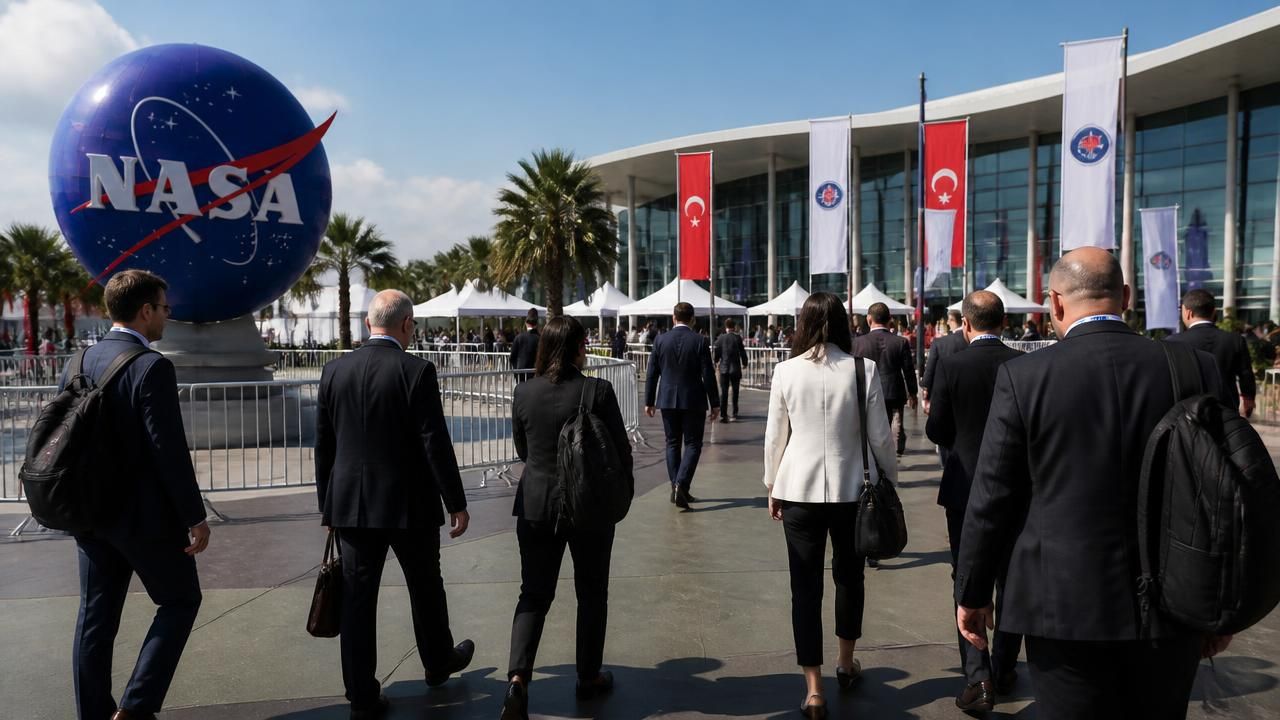
NASA will take its case for human exploration to the Moon and Mars to the 77th International Astronautical Congress (IAC) in Antalya, Türkiye, this week, leading a delegation that spans plenary diplomacy, technical sessions and media engagements from Monday, Oct. 5, through Friday, Oct. 9. The congress, organized by the International Astronautical Federation and hosted this year by the Turkish Space Agency (TUA), has become the sector's largest annual gathering — and, for the U.S. agency, a stage for making its Artemis-era pitch to international and commercial partners alike.
But the week's news also reflects a broader truth about space exploration in 2026: the story is no longer only about rockets. It is about workforce pipelines, public engagement in cities far from Cape Canaveral, and who gets to see themselves in the astronaut corps. Taken together, the coverage paints a movement that is expanding outward from the launchpad.
A Global Stage in Antalya
The NASA delegation is led by Deputy Administrator Matt Anderson, who anchors the week's headline event: a "One-to-One with Heads of Space Agencies" session at 3 a.m. EDT (10 a.m. local time) on Monday. The agency says its participation will highlight "America's leadership in human exploration to the Moon and Mars, advancing responsible exploration under the Artemis Accords, world-changing science, and support for the commercial space sector."
NASA will highlight "America's leadership in human exploration to the Moon and Mars, advancing responsible exploration under the Artemis Accords, world-changing science, and support for the commercial space sector." — NASA announcement
The week's technical program is equally deliberate. On Monday, Karen St. Germain, division director of NASA's Earth Science Division, delivers a keynote titled "Transforming the Speed of Science with a New Model for Earth Observation Cooperation: International and Commercial Fleets with More Rapid Mission Development" — a signal that Earth observation, not just deep space, is central to the agency's partnership strategy. On Tuesday, Jeremy Parsons, Artemis program manager, addresses "Artemis II Mission Results: The Industry Perspective," putting the contractor and commercial ecosystem at the center of the lunar campaign's next chapter.
The choice of Türkiye as host carries its own symbolism. The IAC has long rotated between established spacefaring nations and rising ones, and TUA's stewardship underscores how the international coalition NASA depends on now extends well beyond the traditional Western bloc. The Artemis Accords — non-binding principles for responsible lunar and cislunar activity — are the diplomatic instrument of that strategy.
The Workforce Question Looming Behind the Diplomacy
Yet as agency officials tout international cooperation, a quieter and arguably harder problem persists at home. The National Academies' report "Building a Better NASA Workforce: Meeting the Workforce Needs for the National Vision for Space Exploration" remains a touchstone for the challenge of staffing a multi-decade lunar and Mars program. The report's title alone frames the dilemma: the national vision articulated in policy has repeatedly outpaced the agency's ability to recruit, retain and develop the engineers, scientists and program managers needed to execute it.
"Building a Better NASA Workforce: Meeting the Workforce Needs for the National Vision for Space Exploration" — National Academies report title
The tension is structural. Artemis depends on a mix of civil servants and commercial partners; each has different pay scales, career ladders and talent pools. Sustaining momentum across administrations — and across the gap between one crewed mission and the next — requires an institutional memory that a shrinking or churning workforce cannot provide.
Atlanta to Cleveland: Exploration as a Local Story
Where national outlets focus on policy, other coverage shows exploration being reframed as a community and equity story. At the Congressional Black Caucus Foundation's legislative conference, Black astronauts made the case for space exploration directly to lawmakers and constituents, according to Maryland Matters — an event that positions diversity in the astronaut corps and the broader aerospace workforce as a policy issue, not merely an inspirational one.
Similar framing appears in academic and regional coverage. Georgia Tech has announced its "2026 Frontiers in Science: Advancing Space Exploration," an event tying university research to the national agenda. And in Ohio, Space Week returns with a slate of events across Cleveland, according to MSN — the kind of grassroots programming that builds the local constituencies on which long-term funding ultimately depends. While these sources offer little detail, their common thread is notable: exploration is increasingly marketed as something that happens in Atlanta, Cleveland and university lecture halls, not just in Low Earth orbit.
Historical Echoes
For perspective, archived dispatches from Wikinews — including reports on the launch of Space Shuttle Discovery on mission STS-124 and on the launch's further delay — remind readers how routine slippage has always been in human spaceflight. Those shuttle-era entries record both the triumph of a successful liftoff and the friction that preceded it. The Artemis program, built on a similar blend of ambition and schedule risk, inherits that pattern.
What to Watch
- Artemis II data: Parsons' industry-focused session may reveal how commercial partners are absorbing the mission's results.
- Earth observation reform: St. Germain's keynote could preview a faster, fleet-based model for climate and weather monitoring.
- Accords expansion: Any new signatories in Antalya would strengthen the diplomatic architecture around lunar activity.
- The talent pipeline: The gap between policy ambition and workforce reality remains the least glamorous — and most consequential — story in space.
The week in Antalya will produce headlines about leadership and cooperation. The harder questions — who builds the spacecraft, who flies them, and who feels invited to watch — will be answered far from the podium.