After more than a year of silence on its public updates page, NASA's Perseverance rover is filing dispatches from Mars once again — and the news is that the six-wheeled geologist has wandered into terrain unlike anything it has sampled since touching down in Jezero crater in February 2021.
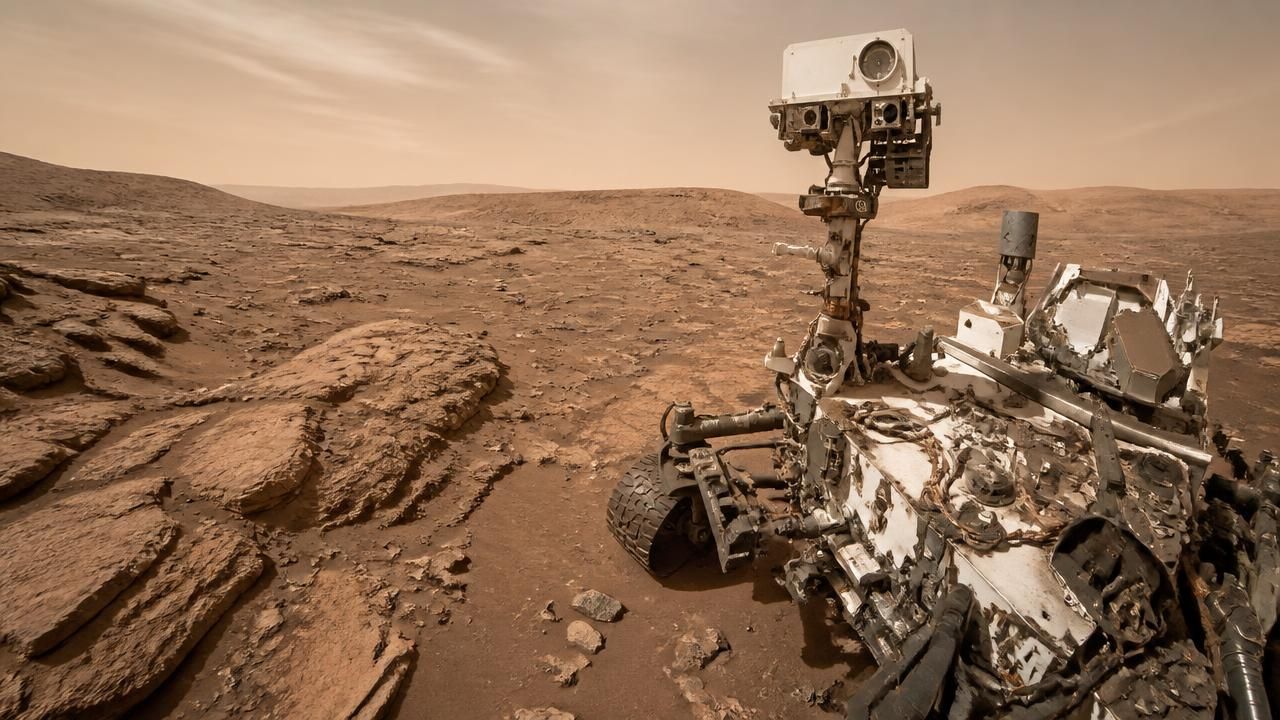
The update, published Sept. 21, 2026 and written by Athanasios (Thanos) Klidaras, a Ph.D. candidate at Purdue University, marks the resumption of a running log that had gone quiet. It opens with an image taken by the rover's SHERLOC WATSON camera, mounted on the turret at the end of the robotic arm, captured on Sept. 1, 2026 — Sol 1967 of the Mars 2020 mission — at 16:18:01 local mean solar time. The credit reads, as ever, NASA/JPL-Caltech.
A 'Wild West Frontier' Beyond the Crater Rim
Perseverance has spent 2026 exploring an area known as Lac de Charmes, a region of valleys and ridges west of the Jezero crater rim. In the mission's own framing, it represents a frontier — a place where the rover is operating at the edge of what planners mapped in detail from orbit.
"The rocks in this area are among the oldest Perseverance has encountered."
That sentence is the heart of the update, and it explains why the wander west of Jezero matters. Jezero crater's sedimentary deposits — the layered mudstones and sandstones that made it such an attractive landing site — formed in rivers and lakes at a time when Mars was already a mature, colder world. The rocks at Lac de Charmes, by contrast, formed when Mars was still a young planet being hammered by asteroid impacts, long before those lakebeds were laid down.
For planetary scientists, that is a change in subject matter as much as a change in scenery.
Reading the Earliest Chapter of Martian History
The ancient, impact-scarred crust Perseverance is now sampling belongs to the Noachian period, the earliest widely recognized chapter of Martian geologic history. Rocks from that era record the planet's primordial conditions: how its crust formed and differentiated, how often it was struck by impacts, and whether the building blocks of life were present and preserved.
The practical challenge is that such terrain is usually a mess. Impact bombardment shatters and reheats rock, overprinting the original chemistry. A valley-and-ridge setting like Lac de Charmes offers something closer to an exposed cross-section, letting the rover's instrument suite — SHERLOC's spectrometer, PIXL's X-ray fluorescence, Mastcam-Z's zoom lenses, and the coring drill — test whether these are pristine igneous rocks, altered by ancient water, or some mixture of both.
Each core Perseverance seals into a titanium tube is a bet on the future: NASA's Mars Sample Return campaign, which has been repeatedly redesigned and cost-constrained in recent years, is the only architecture on the books capable of bringing these rocks to terrestrial laboratories. Until then, the rover's updates page functions as a preliminary field notebook for scientists who will not touch the samples for years.
Ingenuity's First Night, and the Long Shadow It Cast
The Lac de Charmes campaign is a reminder of how much the Mars 2020 mission has evolved since its early days, when the rover's companion — the Ingenuity Mars Helicopter — dominated headlines with a single, improbable milestone: surviving its first night on Mars.
That event, in April 2021, was anything but trivial. Martian nights plunge to roughly minus 90 degrees Celsius, and Ingenuity was built from off-the-shelf components never designed for such thermal stress. Engineers feared the cold could fatally damage its batteries and electronics before it ever left the ground. It survived. Weeks later it became the first aircraft to achieve powered, controlled flight on another planet — a 39-second hop that rewrote what mission planners consider possible.
Ingenuity went on to fly 72 times over nearly three years, scouting terrain and proving that aerial reconnaissance belongs in the planetary toolkit, before a hard landing damaged a rotor blade in January 2024 and ended the experiment. Its legacy is visible in the design of future rotorcraft concepts and in the appetite for the kind of ambitious, cheap-to-fly add-ons that once looked like a long shot.
Citizen Scientists and the Widening Aperture of Space Science
The public-facing character of these missions owes a debt to a longer tradition of opening the data to outsiders. In 2006, UC Berkeley physicist Andrew Westphal launched Stardust@home, a project that asked volunteers to scan millions of microscope images of aerogel from NASA's Stardust spacecraft, hunting for microscopic tracks left by interstellar dust grains. Thousands of non-specialists signed up and became, in effect, the discovery team.
That model — raw imagery, distributed eyeballs, shared credit — is now standard. Perseverance's archive of raw images is public within days of capture, which is why hobbyists and researchers alike can watch a rock formation emerge on their screens in near real time from 225 million kilometers away.
What Comes Next
With updates resuming, the mission's science team is expected to document how Lac de Charmes fits into the broader Jezero story — whether the older rocks here were transported, emplaced in place, or altered by fluids that once moved through the region. Each answer sharpens the question that has driven Mars exploration for decades: when, and for how long, was the planet habitable?
For now, the rover keeps working, and the dispatches keep coming. Notably, they arrive in a news environment where attention is scarce and terrestrial stories crowd the wire — even the same syndication feeds that carry Mars updates also carry archival items as varied as a Paris student protest over France's CPE labor law and a 2008 miscellany roundup. Mars, it seems, must compete for the spotlight one sol at a time.