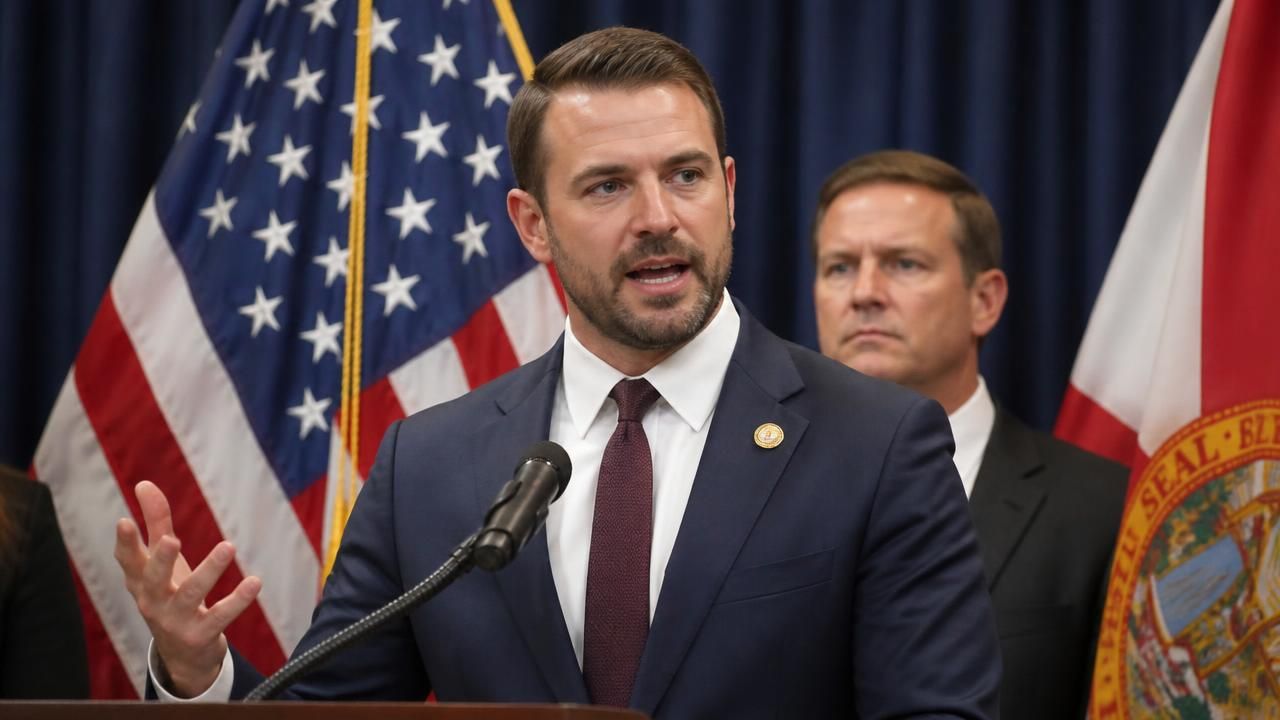
Florida Attorney General James Uthmeier is asking a judge to block OpenAI from allowing ChatGPT to present itself as a person, escalating a legal fight that could reshape how artificial intelligence chatbots operate in the state — and potentially set a national precedent.
The request, filed in Florida court, seeks an order barring OpenAI from “giving ChatGPT false human attributes,” according to The Verge. Uthmeier argues that ChatGPT’s conversational style — especially its use of first-person pronouns and emotional-sounding language — deceptively leads users to treat the bot as a trustworthy friend rather than a machine that can be wrong, biased, or manipulative.
“ChatGPT’s use of language, including first-person pronouns and output that mimics emotion, deceptively suggests to users that it is a trustworthy ‘friend,’” Uthmeier said, according to The Verge.
The filing comes a few months after Florida sued OpenAI over safety concerns, and it adds a new layer: the attorney general is not only seeking civil remedies but also pushing for criminal penalties for chatbot firms, according to an MSN report. That report ties the effort to revelations that the suspect in a Florida State University shooting had used ChatGPT to ask questions before the attack. The exact nature of those questions and their role, if any, in the shooting have not been fully detailed in the available coverage, but the connection has intensified political pressure on OpenAI and other AI developers.
A push to pause — and effectively ban — human-like AI
NewsbytesApp framed the action as Florida’s attorney general suing OpenAI and seeking a pause over child safety. That framing underscores how the case has become a proxy for broader fears about young people’s interactions with generative AI: that chatbots can form parasocial relationships, provide dangerous advice, or fail to distinguish between a simulated conversation and a real human connection.
Another MSN report asked how states could effectively ban ChatGPT. The answer, legal analysts suggest, may lie in injunctions that target specific features rather than the entire service. If a judge orders OpenAI to stop ChatGPT from using first-person pronouns, mimicking emotion, or otherwise encouraging users to see it as a person, the company might have to fundamentally redesign the chatbot in Florida — or geo-block the standard version of ChatGPT for residents. That would amount to a de facto ban on the ChatGPT experience that hundreds of millions of people use worldwide.
The Verge characterized the move as Florida seeking a ban on ChatGPT “acting like a person.” That is a notable escalation from earlier regulatory skirmishes, which often focused on data privacy, child exploitation risks, or misinformation. Here, the state is targeting the core design philosophy of modern conversational AI: anthropomorphism.
Why anthropomorphism is at the center
Uthmeier’s argument is that human-like language is not a harmless design choice. It increases engagement, which in turn generates more data for OpenAI’s training pipelines, and it convinces users to rely on ChatGPT more even as the company’s pursuit of engagement makes the system potentially less trustworthy. In other words, the very features that make ChatGPT feel friendly and accessible may also make it more persuasive — and more dangerous when it is wrong.
That claim echoes concerns from AI researchers, child-safety advocates, and some lawmakers who have argued that chatbots should be required to identify themselves as machines and avoid emotional manipulation. OpenAI has previously said that ChatGPT is not a person, that it can make mistakes, and that users should not rely on it for high-stakes decisions. The company has also built guardrails for minors and sensitive topics. But Florida’s filing suggests those voluntary measures are insufficient.
Legal and political implications
The case raises thorny legal questions. Can a state effectively ban certain kinds of AI output without running afoul of the First Amendment? Is ChatGPT’s speech protected, or is it commercial speech subject to consumer-protection laws? Can a company be held criminally liable for how users interact with its product, especially when the user is suspected of a crime? Those questions are likely to be litigated for years.
If Florida succeeds, other states could follow with their own injunctions, creating a patchwork of AI rules that would be difficult for OpenAI to navigate. That could force the company to offer a more robotic, less personable ChatGPT nationwide, or to fragment its product by geography. Either outcome would mark a major shift for an industry that has bet heavily on conversational interfaces.
OpenAI has not publicly commented in detail on the latest filing, according to the available reports. But the company has consistently argued that safety and innovation can coexist, and it has pointed to its usage policies, model spec, and red-teaming efforts as evidence of good faith. Florida’s attorney general, meanwhile, appears to be betting that a judge — and the public — will see ChatGPT’s friendly tone as a deceptive practice rather than a feature.
How the story is being framed
The four sources reveal distinct emphases. The Verge honed in on the personhood ban and the deceptive “friend” language. MSN explored how states could effectively ban ChatGPT through targeted injunctions. NewsbytesApp framed the lawsuit as a child-safety pause. And another MSN report highlighted the push for criminal penalties amid the FSU shooting suspect’s ChatGPT questions.
Together, they paint a portrait of a legal and political offensive that is moving faster than federal AI regulation. Florida is testing whether a state attorney general can do through litigation what Congress has not done through legislation: force a major AI company to change how its flagship product speaks, behaves, and presents itself to the public.
The outcome will depend on what the judge sees: a protective measure for vulnerable users, or an unconstitutional overreach into the design of a widely used technology. Either way, the case is likely to become a landmark in the rapidly evolving law of generative AI.