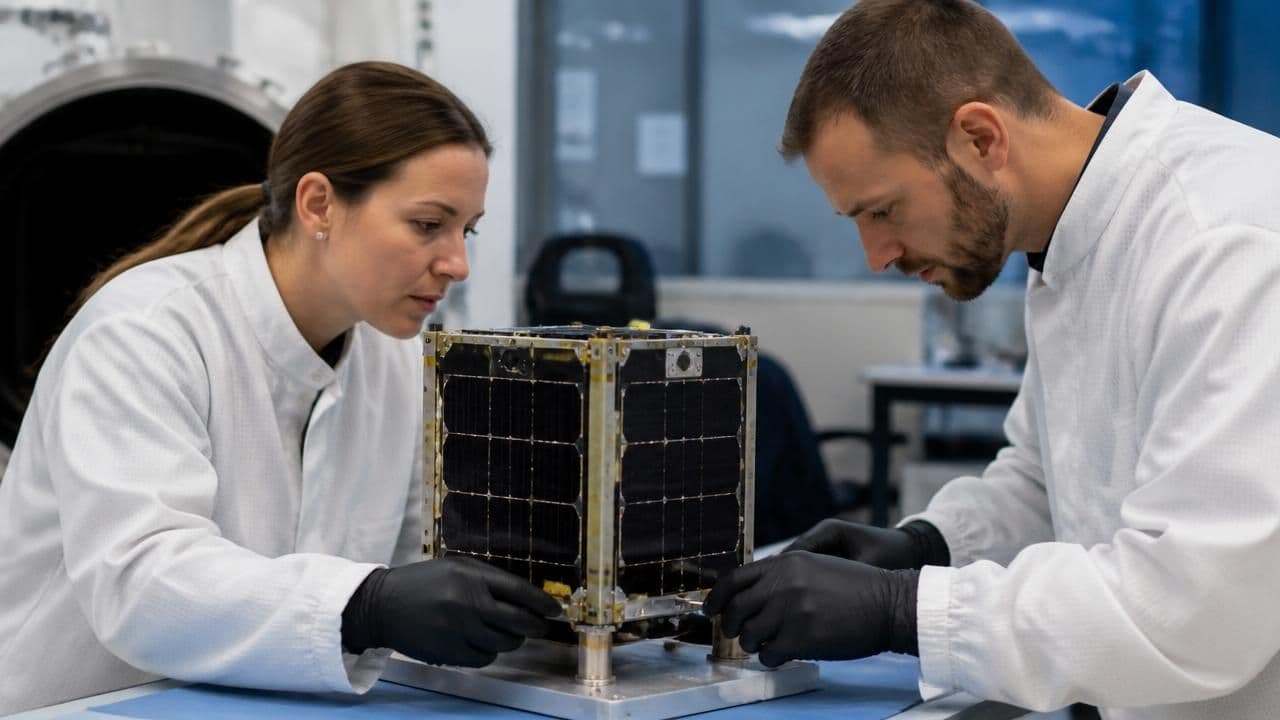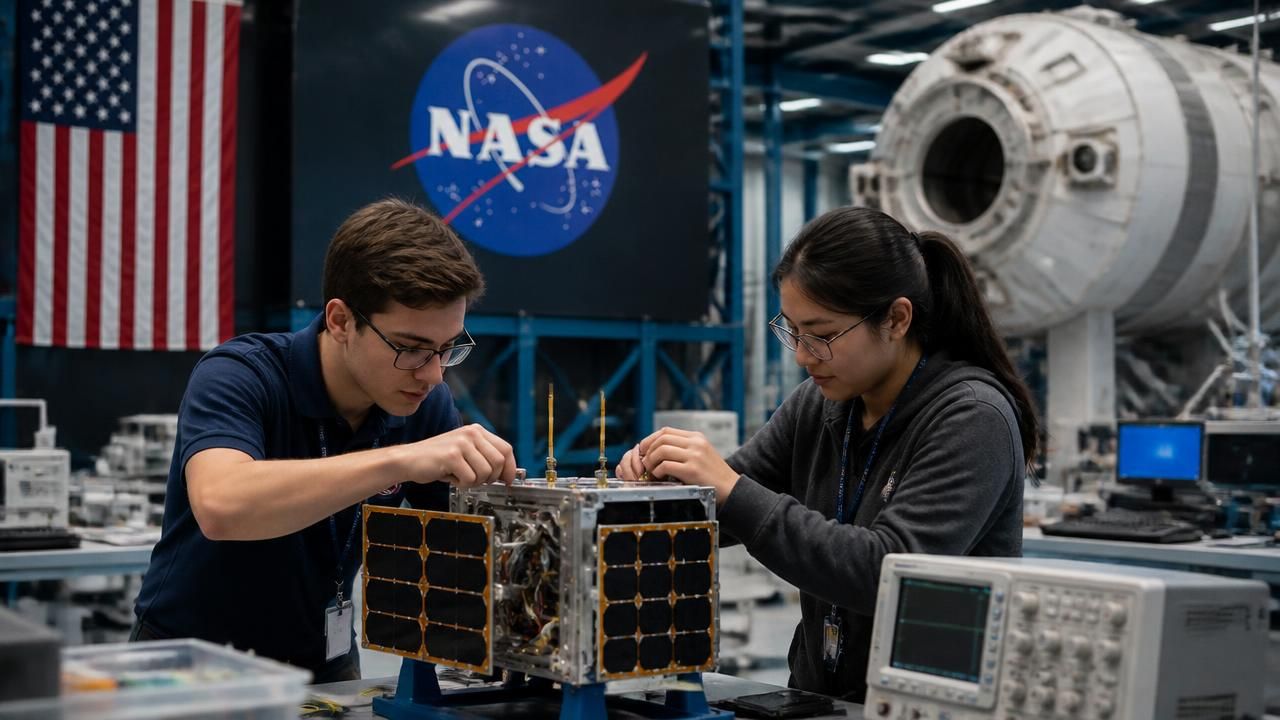
NASA will open registration for its ORBIT Challenge on September 14, 2026, inviting university and community college students across the United States to build businesses and hardware on top of the agency's own patent portfolio. The competition, formally the Opportunities in Research, Business, Innovation, and Technology for the Workforce Challenge, dangles up to $500,000 in prizes, mentorship from NASA engineers and scientists, and a slot in an accelerator program designed to push finalists toward careers in STEM and entrepreneurship. Registration closes November 16, 2026.
The announcement lands at a moment when NASA is under pressure on two fronts: sustaining a pipeline of technical talent that has thinned since the shuttle era, and demonstrating that the billions spent on spaceflight produce returns measurable on Earth.
Two Paths, One Portfolio
Students choose between two tracks. ORBIT Earth asks teams to commercialize NASA patents into terrestrial products, an explicit nod to the agency's technology-transfer apparatus, which has produced thousands of spinoffs over six decades. ORBIT Space asks teams to design next-generation technologies for exploration itself. Ambitious groups can pursue both through an optional Integration Bonus, a structure that rewards teams willing to bridge the commercial and the exploratory.
The most ambitious teams can pursue both through the optional Integration Bonus.
The pitch is unusually direct for a federal agency: this is not a design competition judged on paper alone. Teams work with real intellectual property and real mission challenges, and finalists present in person at a showcase that functions as a recruiting and investment event as much as an academic exercise.
A Legacy of Landings, Delays and Workarounds
The challenge is a forward-looking document, but it sits atop an operational history that the shuttle era documented in granular, often unglamorous detail. Archival dispatches from that period read like a timeline of the program's final chapter: Space Shuttle Endeavour entering the history books after nineteen years of service following the penultimate landing of the program; Atlantis touching down at Kennedy Space Center; Atlantis landing in California after a weather diversion; and, on another occasion, Atlantis's return postponed outright because of bad weather at the Florida landing site.
Taken together, those headlines describe a program whose public image was defined by launches but whose daily reality was governed by weather constraints, landing-site logistics and the constant management of aging hardware. That theme runs through the orbital record as well: one dispatch notes the ISS crew bypassing a faulty switch to power up the station's computers, a reminder that roughly two decades of continuous human presence in low Earth orbit have depended on improvisation as much as on design margins.
A note on sourcing: several of the archival dispatches reviewed for this article were reachable only as headlines and metadata, with full text withheld behind automated access restrictions. The operational picture they sketch, however, remains consistent with the public record of shuttle landings and station maintenance.
Why the Archives Matter to the Pitch
The contrast is the story. NASA's own framing of the ORBIT Challenge is relentlessly optimistic and institutional: mentorship, showcases, accelerator access, a career launchpad. The shuttle-era coverage is terse, concrete and incident-driven, measuring success in crosswinds and toggle switches. Both are accurate depictions of the same agency.
The Workforce Problem Behind the Prize Money
The half-million-dollar prize pool is modest by venture standards and significant by student-competition standards. Its real function may be as a funnel. NASA has warned for years about a graying technical workforce and the difficulty of competing with private space companies and the software industry for early-career engineers. By embedding students in its patent portfolio, the agency gains something a job posting cannot offer: a claim on ideas that students themselves helped shape.
The structure also mirrors a broader shift in American research policy. Federal labs are increasingly expected to convert publicly funded science into commercial activity, and university technology-transfer offices have become de facto venture arms. ORBIT Earth institutionalizes that expectation at the undergraduate level.
What to Watch
- September 14, 2026: Challenge opens.
- November 16, 2026: Registration closes.
- Both dates matter: the window between them is only nine weeks, short for community college teams that may need to assemble interdisciplinary rosters from scratch.
- The Integration Bonus: whether teams attempt both tracks will be an early signal of how seriously students treat the commercial space.
If the program works as intended, some of its outputs will look like the shuttle record: unglamorous, iterative and quietly essential. The measure of ORBIT's success will not be the showcase in 2027, but whether a handful of its teams are still building a decade later.
More information is available at nasaorbit.org.