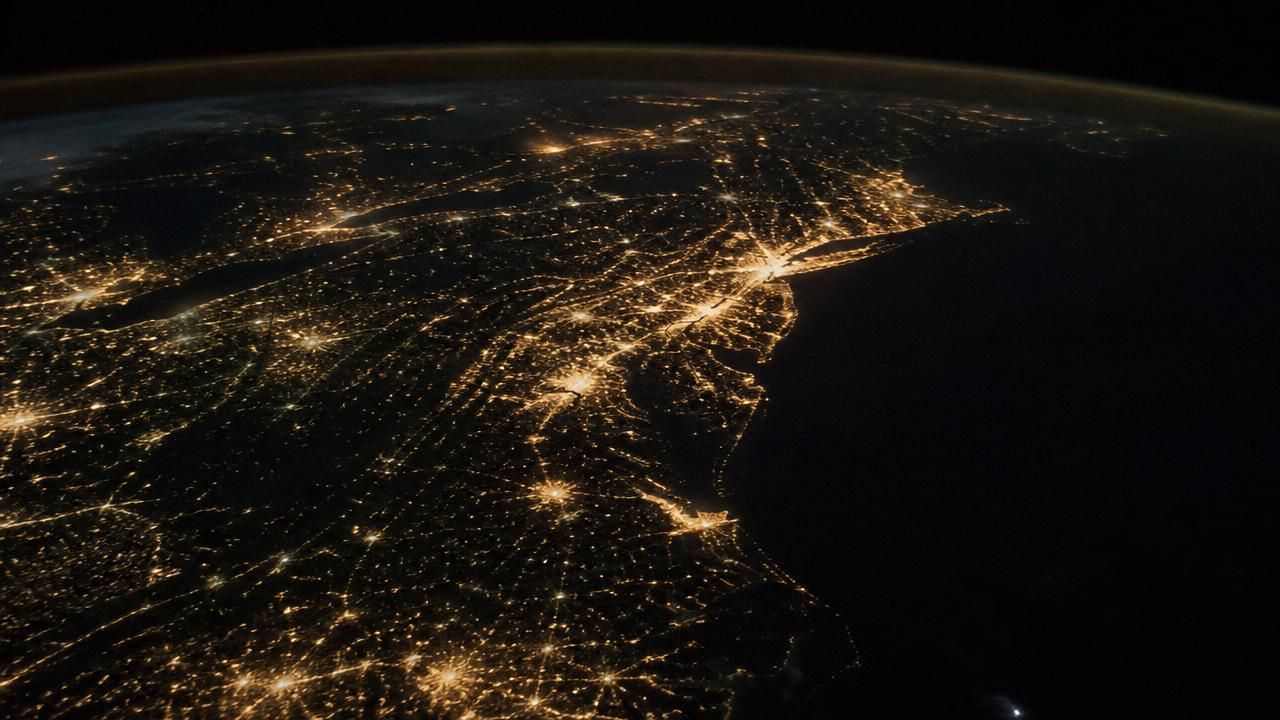
At approximately 3:40 a.m. local time on Sept. 8, 2026, from a vantage point 259 miles above the planet, NASA astronaut Jessica Meir pointed a camera at the United States and captured a continent reduced to geometry: a dark landmass veined with the amber and sodium glow of its cities, with the dense cluster of New York City near the center of the frame. NASA released the image as a Space Station view of Earth at night, credited to Meir, and framed it the way the agency typically frames such photographs — as both an operational document and an instrument of wonder.
That single exposure is, in its way, a summary of what the past several decades of space science have produced: not only data, but perspective. The same era that gave us that photograph has also delivered a rotorcraft that flew on another world, a lander that listened for marsquakes, twin CubeSats that relayed a landing in real time, and a growing body of research suggesting that our own Sun may be less of an oddity than astronomers once feared. Together, these stories — drawn from NASA and from the community-run news service Wikinews — sketch the outlines of a field that has become simultaneously more ambitious and more accessible.
A Continent, Drawn in Light
The orbital night image is deceptively simple. Its value lies in what it encodes: a precise orbital altitude, a precise timestamp, a named observer. NASA’s framing of the photograph is scientific and documentary rather than journalistic — it offers the image as an artifact of the International Space Station program, an orbiting laboratory that has been continuously crewed since November 2000. The agency’s captioning convention, which credits the astronaut-photographer alongside the institution, also quietly reinforces a point the agency has long made: that Earth observation remains one of the station’s most publicly legible outputs.
Where NASA emphasizes beauty and instrumentation, other outlets emphasize milestones. Wikinews, the citizen-written news project, approaches space coverage almost exclusively through events — launches, landings, anniversaries, survival.
Mars: A Helicopter’s Cold Night and a Lander’s Long Fall
Among the dispatches that reached readers through Wikinews was the report that NASA’s Ingenuity helicopter had survived its first night on Mars. The item sounds trivial; it is not. Ingenuity, a 1.8-kilogram experimental rotorcraft carried to the Red Planet beneath the Perseverance rover, was designed to prove that powered, controlled flight is possible in an atmosphere roughly one percent as dense as Earth’s. Engineers knew the flying was the headline risk. But the immediate threat, in the hours after deployment, was temperature. Martian nights at Jezero Crater plunge far below freezing, and the helicopter’s off-the-shelf components — a commercial processor, consumer-grade batteries — were never built for that environment. Heating was powered by a solar array that, until the craft charged, had to draw on a battery that had already spent months in transit. Survival through the first night was the unglamorous precondition for everything that followed.
The same outlet also carried word of an earlier mission milestone: the launch of NASA’s InSight lander alongside the twin MarCO spacecraft. InSight, which launched from Vandenberg Air Force Base in California, was the first interplanetary mission to lift off from the West Coast, and its goal was to probe the Martian interior — seismology, heat flow, and the planet’s deep structure. The MarCO pair were experimental CubeSats, no larger than briefcases, that flew separately to Mars to relay telemetry during InSight’s entry, descent and landing. Their presence turned a dependent mission into an independent one: for the first time, a small spacecraft could report on a landing as it happened rather than waiting for a Mars orbiter to pass overhead.
The Sun, Reconsidered
Further from the launch pad, Wikinews reported on research suggesting that the Sun’s mood swings — its cycles of quiet and violence — are not so strange after all. Solar astronomers have long puzzled over whether the Sun is a typical star or an outlier. Its eleven-year activity cycle, its occasional extended lulls such as the Maunder Minimum of the seventeenth century, and its comparatively modest output of flares have all been cited as evidence of peculiarity. The newer work, by contrast, places the Sun within the normal population of comparable stars, implying that its behavior — including its spells of unusual quiet — falls comfortably inside the observed range.
The implications are not merely academic. Solar variability drives space weather, which can degrade satellite electronics, disturb radio communication, threaten power grids and expose crews and passengers at high altitude to radiation. If the Sun is behaving normally, then the extremes recorded in the historical and geological record are exactly the extremes we should be planning for.
Fifty Years, and Then Seventy
Wikinews also marked the anniversary of Yuri Gagarin’s flight — fifty years of human space travel at the time of that report. On April 12, 1961, the Soviet cosmonaut climbed into Vostok 1, completed a single orbit in 108 minutes, and returned to Earth, becoming the first human being to leave it. The legend has hardened into a single word.
Poyekhali! — Let’s go!
Reportedly the last thing Gagarin said before liftoff, it has since been quoted at every subsequent generation of launches. The anniversary coverage differs in tone from NASA’s image releases: where the agency presents the present as spectacle, the anniversary stories present the past as precedent, a reminder that the routine orbital operations of today — 259 miles up, a camera pointed at a dark continent — began as an untested gamble by a single man in a sphere-shaped capsule.
Who Tells These Stories
There is a final thread here, and it concerns the plumbing of science news. Several of the Wikinews items used in this report were retrievable only as headlines, because the site’s robot policy blocked automated access without a proper user-agent string. The same service, in the same period, published an interview with Joe Schriner, an independent candidate for U.S. president — a reminder that Wikinews is not a space publication at all, but a general-interest, volunteer-written news project whose contributors choose their own beats.
That mix is instructive. Institutional sources such as NASA produce the imagery, the data and the credited photographs, and control the language in which discoveries are announced. Volunteer news operations, by contrast, record the milestones — the launch, the first night, the anniversary — with a granularity that press offices seldom bother with. Neither frame is sufficient alone. The photograph of New York at night tells you where we are. The report of a helicopter surviving a Martian winter night tells you how hard it was to get there.