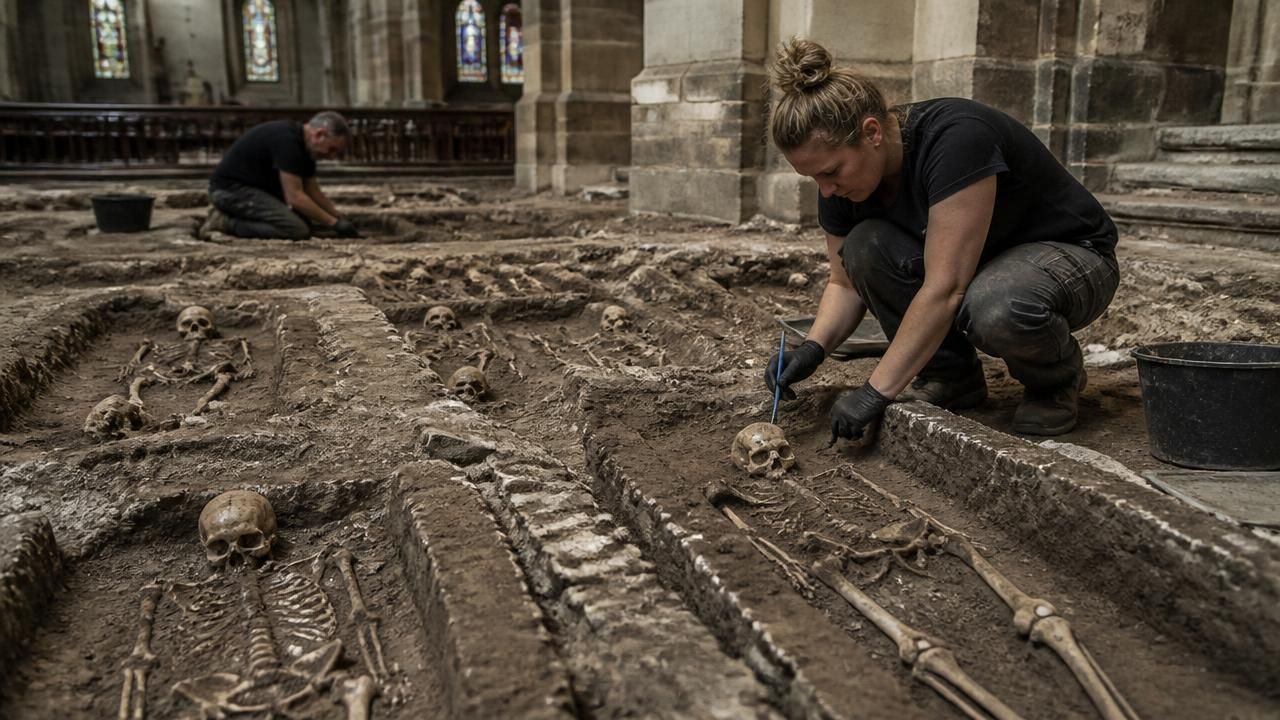
For generations, archaeologists working across Scandinavia and Central Europe looked at the graves beneath their trowels and saw families. Adults and children interred side by side, laid out in orderly rows beneath church floors or in churchyard plots, seemed to tell an obvious story: parents buried with their children, husbands with wives, generations resting together in death as they had in life.
Ancient DNA is now dismantling that comfortable reading of the medieval past. A wave of new genetic studies of medieval burials — most notably in Sweden, with a striking parallel case in Poland — shows that the people sharing graves and grave plots were frequently not close biological relatives at all. Kinship, it turns out, was only one of many forces shaping where a medieval person was laid to rest.
The Swedish graves that looked like families
The central finding comes from medieval Swedish cemetery sites where researchers sampled DNA from adults and children buried together. The assumption, based on proximity, grave construction and shared orientation, was that these were nuclear family units. Genomic analysis told a different story: in many cases the children were not the biological offspring of the adults buried with them, nor were the adults siblings or cousins.
That does not mean the burials were random. Instead, it suggests burial communities were organized around something broader than blood — households, servitude, fosterage, apprenticeship, religious confraternities, or simply the practical logistics of a parish churchyard where the dead were interred in sequence as space allowed.
The arrangement of a grave reflects the choices of the living, not necessarily the biology of the dead.
Gender, age and the ordering of the dead
The research also surfaced evidence of early gender-based burial customs. The positioning of bodies, the arrangement of grave goods and the spatial clustering of burials appear to have followed conventions tied to sex and age, implying that medieval communities were already making careful, rule-bound distinctions about who belonged where in sacred ground.
Among the most striking details to emerge from the Swedish material concerns infant girls buried in plots dominated by adult men — a pattern that complicates any simple assumption that children were always placed with their mothers or with other women. Whatever logic governed those placements, it was not reducible to the nuclear family template that modern observers have tended to project onto the medieval dead.
The young woman who may have walked across Europe
One individual case has captured particular attention. Analysis of a young woman's remains, combined with isotopic and contextual evidence, points to a life that involved extraordinary mobility. Researchers suggest she may have undertaken a pilgrimage spanning much of Europe — a journey that, if confirmed, would place her among the many medieval people whose travels left traces in bone and tooth enamel rather than in written records.
Pilgrimage was a defining feature of medieval European religious life, drawing millions toward Santiago de Compostela, Rome, Jerusalem and a network of lesser shrines. Most pilgrims left no documentary trace. Bioarchaeology and ancient DNA are increasingly the only way to recover their stories.
A parallel discovery in Poland
The Swedish findings are echoed by a separate and equally provocative result from Poland, where genetic testing has confirmed what researchers describe as the country's first known same-sex double burial. The grave — widely dubbed the "hugging skeletons" because of the way the two individuals were interred in contact with one another — contains two women. Crucially, DNA shows they were neither sisters nor cousins.
The finding is significant on two fronts. First, it rules out the simplest biological explanation for their shared grave, forcing interpreters to consider other forms of bond: partnership, close friendship, shared religious vocation, or a relationship whose meaning the surviving community chose to commemorate in the arrangement of the grave. Second, it demonstrates that the same methodological revolution driving the Swedish conclusions is reshaping burial archaeology across the continent.
Why this matters beyond the graves
The broader significance is methodological and interpretive. For decades, archaeologists inferred kinship from spatial proximity — a reasonable heuristic in the absence of any direct evidence. Ancient DNA has converted that inference into a testable hypothesis, and the hypothesis is frequently failing.
- Shared graves do not reliably indicate nuclear family relationships.
- Burial organization appears to have been governed by age, sex, status and community membership as much as by biology.
- High mobility — including long-distance pilgrimage — was more common among ordinary medieval people than written sources suggest.
- Absence of biological kinship does not mean absence of meaningful relationship.
The results also serve as a caution against reading modern social categories backward into the medieval world. When two women are buried embracing, or a child is laid to rest among men, the medieval community was making a statement — but not necessarily one that maps neatly onto contemporary ideas about family, gender or sexuality. As several commentators on the Polish case have noted, the value of the discovery lies less in any single modern label than in what it reveals about the range of relationships medieval people considered worth honoring in death.
What comes next
Researchers caution that sample sizes remain limited and that conclusions drawn from individual cemeteries cannot simply be generalized across regions or centuries. Medieval Europe spanned a thousand years and enormous cultural variation, from late pagan Scandinavia to the mature parish system of the high Middle Ages.
Still, the direction of travel is clear. As ancient DNA sampling expands — and as costs fall — the family trees that archaeologists have drawn over medieval graveyards for a century will be redrawn, one genome at a time. What is emerging is not a picture of medieval society without families, but a picture of medieval communities that buried their dead according to rules far richer, and far more interesting, than simple bloodlines.