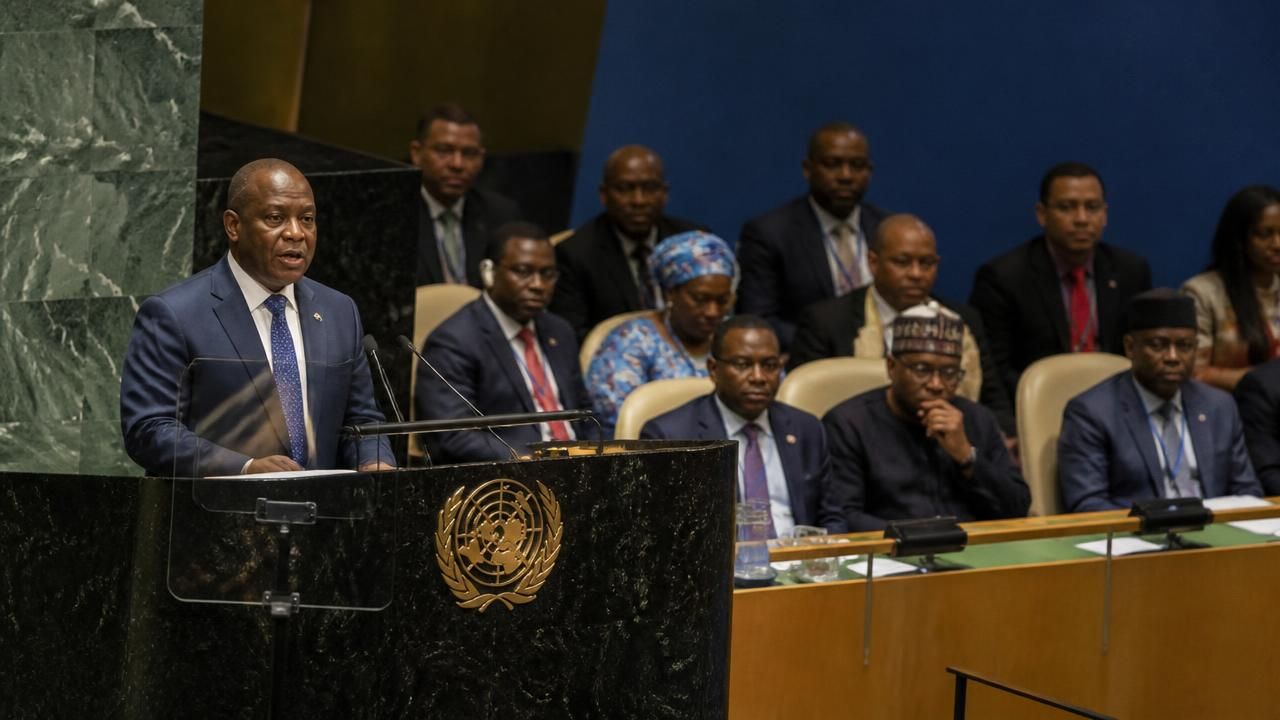
African heads of state used the United Nations General Assembly's annual high-level debate to demand permanent representation on the Security Council, mounting the broadest and most coordinated push yet in a campaign that has run for two decades without resolution.
Presidents from Nigeria, Kenya, Ghana, Sierra Leone, Liberia and Namibia each took the podium to argue that a body whose permanent membership was fixed in 1945 — when most of Africa was still under colonial rule — can no longer claim legitimacy in a world of 193 member states. Nigeria's Bola Tinubu went furthest, describing the post-war order as obsolete and calling for a radical shake-up of the UN's architecture, including a far-reaching restructuring of the Security Council. Kenyan President William Ruto and Ghana's John Mahama renewed similar appeals, while Sierra Leone's Julius Maada Bio framed the issue in blunt terms: Africa, he said, cannot be shut out.
UN Secretary-General António Guterres gave the campaign a significant rhetorical boost, calling the absence of a permanent African seat indefensible — language that African diplomats quickly seized on as evidence that the institution's own leadership recognizes the status quo as untenable.
"The lack of a permanent African seat is indefensible." — UN Secretary-General António Guterres
Who is asking for what
The demands are not uniform in detail, but they converge on a common core. Nigeria has explicitly called for two permanent African seats on an enlarged council. The continent's formal position, codified in the 2005 Ezulwini Consensus and reaffirmed repeatedly since, asks for two permanent seats with the same veto powers held by the current five, plus two additional elected non-permanent seats for Africa.
Africa's weight in the institution is not in question. Its 54 member states make up roughly 28 percent of the General Assembly, and the continent's population of more than 1.4 billion is larger than that of any of the five permanent members' regions. Yet Africa holds only three of the ten rotating non-permanent seats at any given time, and none of those members can veto a resolution.
The veto question
Whether new permanent members would receive veto power is the sharpest fault line. Associated Press reporting on the debate noted that African leaders are pressing not only for permanent seats but for veto powers — a demand that the existing five permanent members have never collectively entertained. Washington signaled support in 2024 for two permanent African seats and a rotating seat for small island developing states, but stopped well short of endorsing an expansion of the veto. Other permanent members have offered varying degrees of rhetorical sympathy while avoiding binding commitments.
Critics of extending the veto argue that multiplying veto holders would make a paralyzed council even less capable of responding to crises, from Gaza to Sudan. African diplomats counter that a council whose decisions bind the continent, but on which the continent cannot veto, is a democracy deficit at the heart of the global order.
Why reform keeps stalling
The procedural hurdles are formidable. Amending the UN Charter requires a two-thirds vote in the General Assembly and ratification by two-thirds of member states — including all five permanent members. In effect, the P5 hold a veto over any reform that would dilute their own privileges. Talks have been confined for years to the Intergovernmental Negotiations process, which critics describe as a talking shop with no mandate to produce a text.
There is also the question of which African states would occupy the seats. Rival candidacies — Nigeria, South Africa, Egypt, Kenya and others all have plausible claims — have complicated the continent's ability to present a single slate, and the African Union's Committee of Ten, chaired from Sierra Leone, has spent years trying to manage those rivalries. Adam Smith of the New York Times noted that African leaders are demanding the change from the same rostrum where the continent's exclusion was first entrenched.
Beyond the Security Council: finance and the '1945 order'
Several leaders deliberately linked Security Council reform to a broader critique of post-war institutions. Ruto paired his council appeal with a push for fairer global finance, arguing that a system that prices African borrowing at punitive rates and underfunds climate adaptation is the same order that excludes Africa from decision-making. Tinubu made the temporal argument explicit, saying the 1945 settlement is obsolete and that the UN must change or lose relevance.
The reform push also sits alongside the Pact for the Future adopted at the 2024 Summit of the Future, which committed member states to prioritizing Security Council reform and to redressing Africa's historical underrepresentation — language that African negotiators now cite as a benchmark against which inaction will be measured.
Tanzania's parallel bid
Not every African state is waiting for charter change. Tanzania formally launched a bid for a Security Council seat, vowing to champion Africa's voice within the existing structure — a reminder that the non-permanent route remains the only realistic short-term avenue for influence, even as leaders dismiss it as a consolation prize.
- What Africa wants: two permanent seats with veto power plus two additional elected seats.
- What supporters of expansion offer: seats, in some cases, but not the veto.
- What stands in the way: a charter amendment that requires P5 ratification, plus unresolved rival candidacies.
- What has changed: explicit backing from the UN Secretary-General and a U.S. endorsement, in principle, of African permanent membership.
What happens next
African diplomats say they will press for the Intergovernmental Negotiations to move from process to text, and for a concrete timeline. Realists in New York note that the same demand has been made at nearly every General Assembly since 2005, and that the arithmetic of charter amendment has not changed. But the political context has: the Secretary-General's intervention, the U.S. opening, and the insistence of a critical mass of African presidents have made the status quo harder to defend than at any point in the past two decades.
Whether that pressure produces seats — or another decade of communiqués — will be the measure of whether the 1945 order can still be revised by the states it was never designed to include.