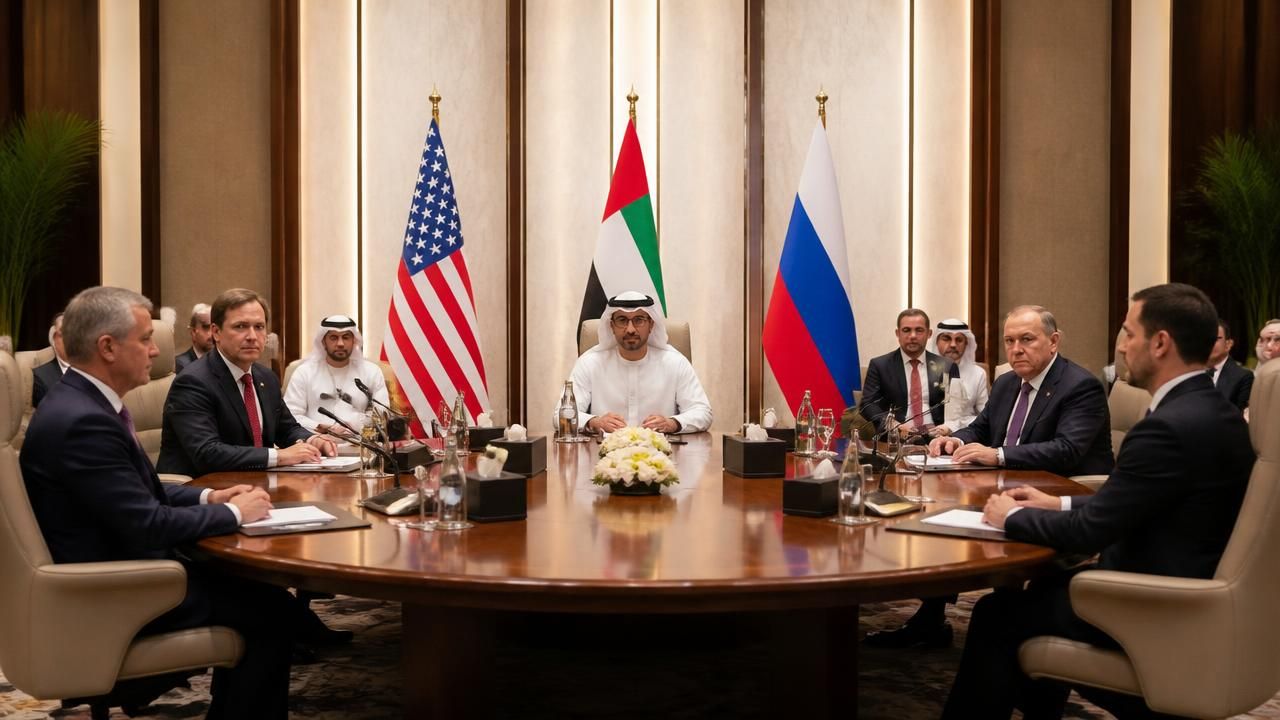
Delegations from the United States, Russia and Ukraine convened in Abu Dhabi on Tuesday for the first round of trilateral, U.S.-mediated peace talks since February, opening a two-day session that the White House says will center on the thorniest issue dividing the parties: security guarantees for a postwar Ukraine.
The meeting in the capital of the United Arab Emirates marks a rare moment of direct, three-way engagement nearly four years into Russia's full-scale invasion, and it has drawn unusually broad international attention — from European capitals to the G7 summit in Paris, where Ukraine was expected to dominate the agenda as the Emirati talks got underway.
What's on the table
According to NPR, which first reported the session's structure, the two-day gathering is the first such meeting since February and will focus on security guarantees — the framework of commitments Kyiv says it needs before any ceasefire can hold. The White House framed the discussions as a working session rather than a signing ceremony, tempering expectations even as it confirmed the trilateral format.
Reporting from the region, Gulf Today described the encounter as "trilateral talks aimed at ending the Russia-Ukraine war," while Germany's DW and The Moscow Times both characterized it as a restart of U.S.-brokered diplomacy that had stalled earlier this year. Pakistan's Tribune and Turkey's ANEWS used nearly identical language — a "new round of US-brokered peace talks" — underscoring how uniformly the session has been framed as a resumption rather than a breakthrough.
A shift in tone on territory
The most closely watched development came not from the negotiating table but from briefings around it. MSN reported that Ukraine and Russia have shown "a little bit of flexibility" on the question of territory — the issue that has torpedoed every previous round of talks. That characterization, if accurate, would represent a significant departure: Kyiv has consistently rejected recognition of Russia's annexation claims over Crimea and four partially occupied regions, while Moscow has demanded Ukraine cede territory it does not fully control.
Not everyone reads the signal as encouraging. Kurdistan24 framed the Abu Dhabi session around growing fears over territorial concessions, reflecting anxiety in Kyiv's European backers that pressure to end the war quickly could produce a settlement that rewards aggression. Those concerns have intensified as Washington's attention has shifted toward burden-sharing with Europe.
"The two-day session in the UAE's capital, Abu Dhabi, is the first such meeting since February. It will focus on security guarantees, the White House said before the discussions." — NPR News
Moscow upgrades its delegation
One concrete indicator of seriousness came from the Russian side. The Jefferson City News Tribune reported that Russia upgraded its delegation for the U.S.-led talks — a personnel decision widely read as a signal that Moscow intends to engage substantively rather than merely attend. The Moscow Times confirmed a "new round" of U.S.-mediated talks was underway, while Russia's own state-adjacent outlets described the Abu Dhabi meeting as "planned," a notably low-key framing from a government that has alternated between dismissing and embracing American mediation.
The composition of the delegations has not been fully disclosed by any of the three governments, and none has confirmed the rank of its lead negotiator. CBS News and the Associated Press both reported the start of talks, with AP noting the parties entered the room "amid deep divisions" — a reminder that the gap between opening statements and a durable settlement remains vast.
Europe watches from Paris
The timing was not accidental. The Globe and Mail reported that attention at the G7 gathering in Paris turned to Ukraine as the Abu Dhabi talks began, with European leaders keen to ensure that any U.S.-brokered framework preserves their own security architecture and does not foreclose Ukraine's eventual path into Western institutions.
That dynamic partly explains the skepticism emanating from some European commentary. Dutch-language coverage distributed by MSN carried a pointed headline asserting that Russia and Ukraine "continue to ignore Donald Trump" — an argument that the parties are using American mediation as cover while pursuing maximalist goals. It is a reminder that the same set of facts is being read in sharply different ways: as diplomacy resuming, as a pressure campaign succeeding, or as a stalling tactic dressed up as negotiation.
Why it matters
The Abu Dhabi format is significant less for what it may produce this week than for what it establishes. A sustained trilateral channel — with the U.S. in the chair, the UAE as host, and both belligerents at the same table — creates the first real mechanism since February for translating battlefield stalemate into political bargaining.
- Security guarantees are the declared agenda item, and the one on which Kyiv's willingness to accept any ceasefire likely depends.
- Territory remains the unresolved core; reports of "flexibility" are unconfirmed and contested.
- Delegation strength — particularly Russia's upgrade — is being read as a proxy for intent.
- European buy-in looms over the process, with G7 leaders insisting they must be party to any durable framework.
Whether the Abu Dhabi talks become a genuine negotiating track or another round of positional diplomacy will become clearer when the two-day session concludes. For now, the parties are talking — in the same room, under American auspices, for the first time in months. In a war defined by hardened positions, that alone is being treated as news.