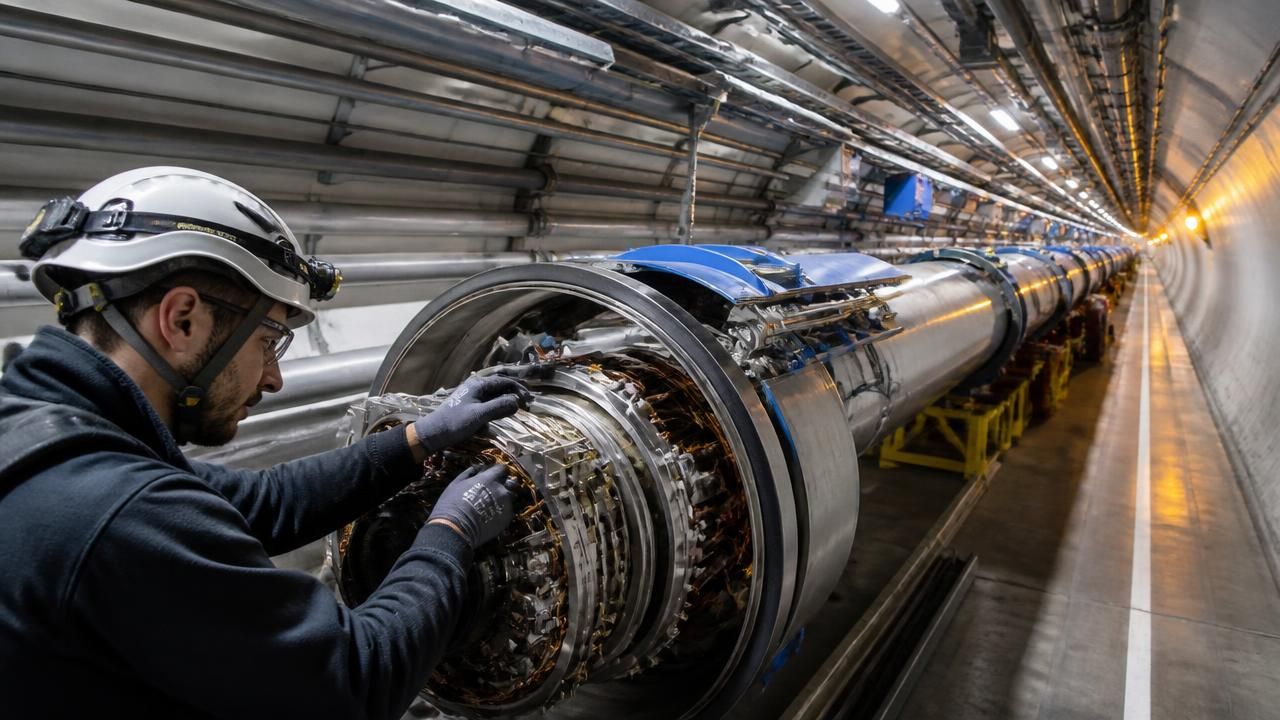
CERN has begun disconnecting and dismantling key components of the Large Hadron Collider, formally closing out the machine's third physics run and opening the most ambitious overhaul in its 17-year operating history. The work centres on replacing some of the 27-kilometre ring's most critical superconducting magnets — the first major step toward the High-Luminosity LHC (HL-LHC), an upgrade intended to hand physicists a far wider window into the fundamental workings of the universe.
A stronger, tighter, busier collider
At the heart of the change are new superconducting magnets that will generate magnetic fields roughly 40 percent stronger than those in the current machine. Those fields are what steer, focus and ultimately squeeze the two counter-rotating proton beams down to microscopic size before they are slammed together at nearly the speed of light. A tighter squeeze means a denser beam — and a denser beam means far more collisions for the LHC's giant detectors, ATLAS and CMS, to record and analyse.
The technical leap comes from niobium-tin (Nb3Sn) magnet technology, which can sustain higher fields than the niobium-titanium magnets that have focused the beams since the LHC first switched on in 2008. CERN describes the goal this way:
The High-Luminosity LHC will push the collider's collision rate several times beyond its original design, allowing physicists to study rare processes and measure the Higgs boson with a precision the current machine simply cannot reach.
Planners expect the upgrade to multiply the volume of accumulated data by roughly an order of magnitude over the machine's lifetime — the difference between glimpsing a rare process and being able to map it statistically.
What the last run produced
The shutdown arrives after a productive final stretch that produced a strikingly varied set of headlines, and the way different outlets covered the machine's closing chapter says as much about the LHC's scientific reach as about the science itself.
- No microscopic black holes. Dedicated searches by ATLAS and CMS found no evidence that the collider's high-energy collisions produce microscopic black holes — a result that finally closes the loop on a fear that dominated public discussion of the LHC before it even started operating, when speculative theories suggested the machine might create tiny, short-lived gravitational singularities.
- Quantum entanglement at record energies. ATLAS and CMS reported observing the 'spooky' phenomenon of quantum entanglement in pairs of top quarks — the heaviest known elementary particles — making the LHC the first facility to demonstrate entanglement at such extreme energies and reinforcing the strange compatibility of quantum mechanics and high-energy physics.
- Exotic new particles. The LHCb experiment continued to add to the growing catalogue of new hadrons, including pentaquarks and tetraquarks whose behaviour does not fit neatly into the simple quark model that dominated physics for decades.
- Higgs precision physics. With a decade of data in hand, physicists moved from 'discovery' to 'characterisation' of the Higgs boson — measuring its couplings and decay channels with increasing exactness and looking for any deviation that might betray physics beyond the Standard Model.
Framing the shutdown
Coverage of the transition has diverged sharply in emphasis. Russian state agency TASS framed the milestone bluntly as the collider having 'officially finished its scientific work', a characterisation that captures the end of Run 3 but understates the planned decade of data-taking that follows. Physics-focused outlets instead foregrounded the upgrade's Higgs-boson ambitions — the notion that the true prize of the next phase is not discovery but precision. Technology and gadget-heavy publications led with the headline-friendly discoveries, treating the shutdown as a backdrop to the last run's most exotic results. Aggregator-driven articles revived the old microscopic-black-hole question, this time as a negative result rather than a scare.
The differing angles reflect a genuine ambiguity: the LHC is simultaneously ending a chapter and beginning another. Detectors are being prepared for higher radiation loads and denser data streams; civil-engineering work is underway for new galleries and cryogenic plants; and thousands of scientists are already re-tooling their analyses for a machine that will look, from the beam's perspective, like a considerably more crowded place.
Why it matters
The stakes extend well beyond the Higgs. The Standard Model describes ordinary matter with spectacular success, yet it offers no explanation for dark matter, no accounting for why the universe contains more matter than antimatter, and no natural home for gravity. Supersymmetry, extra dimensions and a host of other proposals all predict particles or subtle deviations that the LHC has so far failed to find — a null result that has left the field searching for a more sensitive instrument rather than a different theory.
That is precisely the argument for the HL-LHC. Rare processes that occur once in a billion collisions become measurable when the collision rate rises by a factor of five to seven or more. Hypothetical particles too heavy to be produced copiously may still leave faint fingerprints through quantum loops that alter the decay of familiar particles — fingerprints that only a much larger data set can resolve.
There are costs and complications. The magnets are among the most difficult components ever mass-produced for a particle accelerator, requiring years of industrial qualification. The upgrade's price tag runs into the billions of Swiss francs, funded through CERN's member states, and it will be years before the machine is cooled down, commissioned and colliding again. Between now and then, the LHC's experiments will keep mining existing data, publishing results from collisions that happened years ago.
For the thousands of researchers who depend on the collider, the transition is bittersweet: the end of a run that delivered new particles, new quantum effects and a definitive null result on one of the most feared theoretical possibilities, and the beginning of a machine designed to answer questions the current one could only pose. The universe's hidden building blocks, as one headline put it, will have to wait a little longer to be revealed — but the tools being installed now are built to find them.