UNITED NATIONS — The contest to become the world's most senior diplomat has entered an unusual phase of paralysis. Three rounds of informal straw polling inside the Security Council have failed to produce a consensus candidate to succeed António Guterres, whose second term as United Nations secretary-general expires on December 31, 2026.
With no contender yet able to assemble the required nine Council votes — and, more importantly, to avoid a veto from any of the five permanent members — the race for the UN's top job has become a wide-open diplomatic scramble. Its outcome will shape how the 193-member organization confronts war in Ukraine and Sudan, the humanitarian crisis in Gaza, accelerating climate stress and one of the worst funding squeezes in its 80-year history.
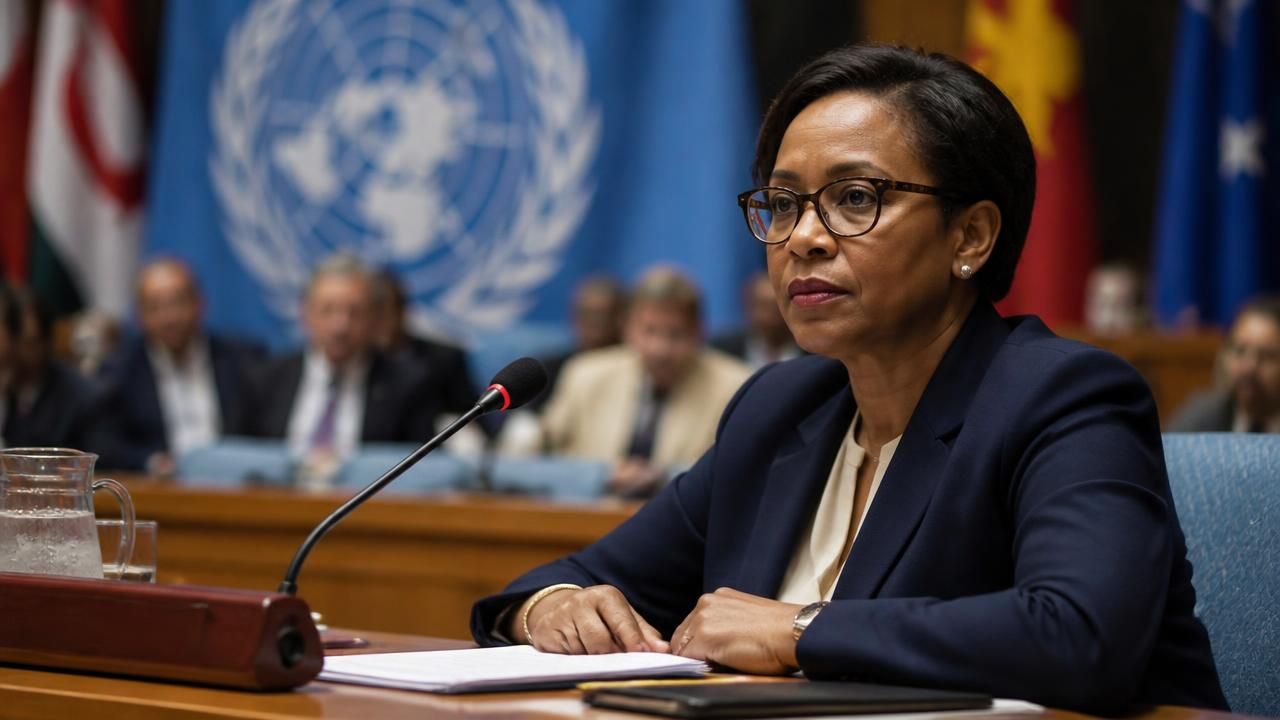
Among the names that have risen to the top of the pack is Carolyn Rodrigues-Birkett, Guyana's permanent representative to the United Nations, who made her case for the job and laid out her view of the UN's future in an interview with Bloomberg Businessweek Daily.
Three Straw Polls, No Consensus
The straw polls are non-binding, conducted behind closed doors in the Council's consultation room. Members mark each declared candidate as encourage, discourage or no opinion. The votes are tallied and shared with the candidates — and, in recent cycles, with the wider world, a transparency reform pushed by civil society groups during the landmark 2016 selection.
That process ended decisively: Guterres, then Portugal's prime minister and a former UN high commissioner for refugees, topped every round and was recommended by acclamation. This time, by contrast, three rounds have produced no clear leader, a result that simultaneously reflects genuine indecision and the determination of the P5 — the United States, Russia, China, France and Britain — to keep their options open for as long as possible.
The lack of a consensus candidate is not entirely surprising. The body is more fractured than at any point since the Cold War, and the secretary-generalship is one of the few prizes on which Washington, Moscow and Beijing all believe they can exert leverage.
Who Is Carolyn Rodrigues-Birkett?
A career diplomat, Rodrigues-Birkett served as Guyana's minister of foreign affairs and international cooperation from 2020 to 2024, representing one of the fastest-growing economies in the hemisphere as it navigated a contested border case with Venezuela and the rapid expansion of offshore oil production.
Her earlier postings include ambassadorial roles in Brazil and at the Organization of American States, and she has been a fixture in multilateral negotiations on development finance, climate adaptation and small-island resilience. She took up the UN post in New York in 2024, arriving just as Guyana began a two-year term as an elected member of the Security Council — a seat the country used to press the case for small states and for reform of the Council itself.
Her candidacy carries several layers of symbolism. Guyana would be the smallest country ever to hold the post. It would also be the first Caribbean nation to do so. And, in an organization that has had nine secretaries-general in eight decades and not one woman, she would break a glass ceiling that campaigners have been hammering at since the 1990s.
A Vision for a UN Under Siege
Rodrigues-Birkett has framed her pitch around credibility and delivery — the argument that a UN whose mandates outrun its resources must either reform or see its authority erode further.
“The world needs a United Nations that is credible, that delivers for the people it was created to serve, and that is willing to reform itself,” she said in the Bloomberg interview, describing a body that must prove its relevance to member states that increasingly question whether it has any.
That message lands in a harsh environment. The United States, historically the UN's largest financial backer, has retreated from several multilateral commitments and sharply curtailed humanitarian funding, leaving agencies scrambling to close shortfalls. Guterres has responded with the “UN80” reform initiative, a package aimed at cutting costs, consolidating duplicate mandates and restructuring the secretariat.
Whoever takes over in January 2027 will inherit those cuts, a peacekeeping apparatus under strain, and a Security Council whose permanent members are the principal protagonists in the conflicts the UN is meant to resolve.
The Rules of the Game
Under Article 97 of the UN Charter, the secretary-general is appointed by the General Assembly on the recommendation of the Security Council. In practice, that gives the P5 an effective veto. A candidate needs at least nine affirmative votes in the 15-member Council, with no negative vote from any permanent member, before the recommendation goes to the Assembly — usually for a formal appointment by acclamation.
- Informal stage: lobbying, regional endorsements and straw polls in the Council.
- Formal stage: a closed-door Council vote, followed by a recommendation to the General Assembly.
- Appointment: a General Assembly resolution, typically in the autumn before the term begins.
No formal rule requires geographic rotation, but an informal regional rhythm has governed most selections. Latin America and the Caribbean have held the post only once, when Peru's Javier Pérez de Cuéllar served from 1982 to 1991. Eastern Europe has never held it, a grievance that animated the 2016 race before Guterres prevailed.
What Happens Next
Further straw polls are expected as the Council narrows the field. Names that have circulated alongside Rodrigues-Birkett include senior UN officials, current and former heads of state and leaders of international agencies, with advocates for a female secretary-general pressing the case that eight decades of all-male leadership is itself a disqualifying precedent.
The politics are unforgiving. A candidate acceptable to Washington may be unpalatable in Moscow, and vice versa; China has its own calculus; France and Britain guard their influence. Small states, meanwhile, argue that a secretary-general from a small country may be precisely what a divided Council can tolerate — someone with less geopolitical weight to throw around, and therefore less threatening to the powers that must approve.
For Rodrigues-Birkett, that argument is central. If the deadlock holds, it may also prove to be the decisive one. The clock, however, is running: the General Assembly is expected to appoint the tenth secretary-general well before the gavel falls on Guterres' tenure at the end of next year.