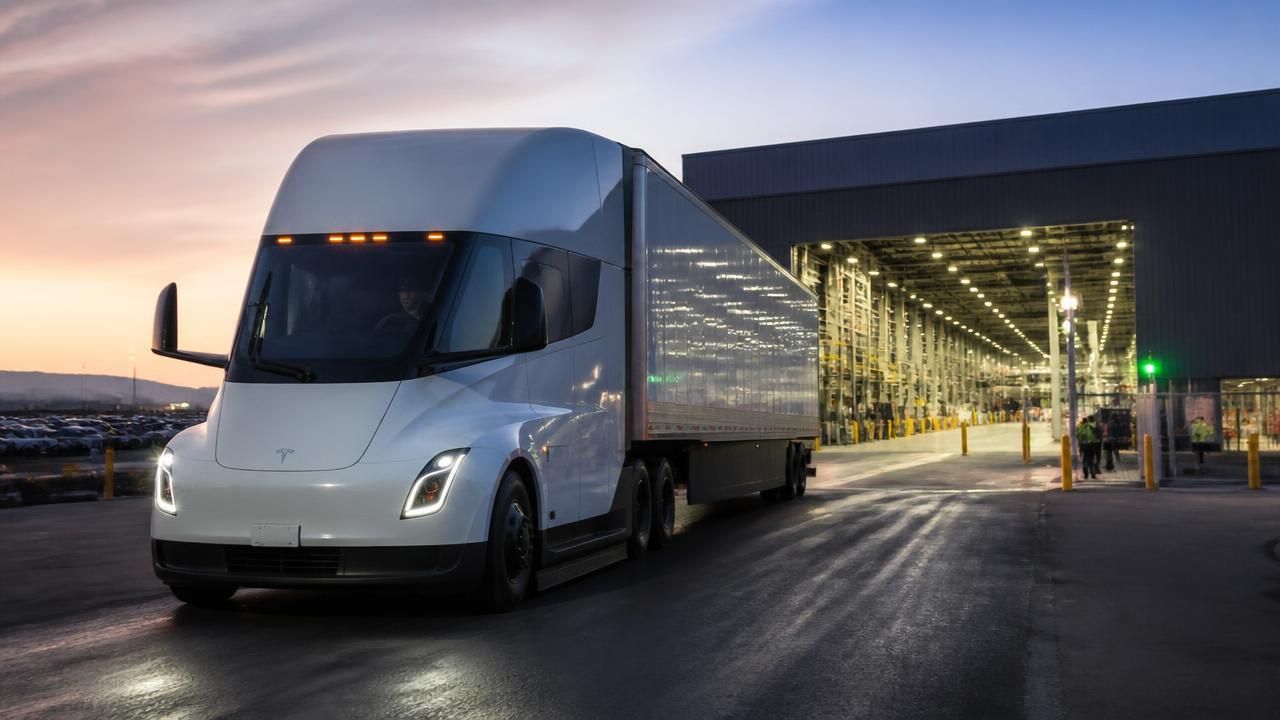
Nearly nine years after a slick concept reveal promised to upend heavy trucking, Tesla says the wait is over. The company announced that the Tesla Semi is in volume production as of April 2026 and staged an evening event at its new Semi factory next to Gigafactory Nevada to prove it to customers and investors alike.
The Verge, which has tracked the program since the beginning, framed the milestone with a weary headline: “Here’s the Tesla Semi… again.” The outlet noted the truck was “first introduced in concept form in 2017” and is only now entering volume production “nearly a decade after its initial introduction.” That tension — genuine manufacturing achievement versus an extraordinarily long runway — ran through coverage across outlets.
A truck nine years in the making
Tesla first showed the Semi in November 2017, promising a 500-mile range, dramatically lower operating costs and a driving experience closer to a passenger car than a diesel cab. Reservations poured in from fleets including PepsiCo, UPS, Walmart and Anheuser-Busch. Then came years of delay: battery cell constraints, the Model 3 and Model Y production ramp, the pandemic, and repeated pushes of the delivery timeline. Limited “first deliveries” finally reached PepsiCo in late 2022, but low-volume hand-building continued long afterward.
Remember the Tesla Semi? The long-gestating, heavy-duty truck first introduced in concept form in 2017 is finally in volume production as of April 2026 — nearly a decade after its initial introduction.
The new factory, built alongside Gigafactory Nevada, is central to the story. Tesla says the plant can produce 50,000 trucks a year, or roughly 1,000 per week — a figure that would make the Semi a serious player in the North American Class 8 market rather than a demonstration project.
What Tesla actually announced
The Thursday evening event was, in essence, a customer and investor confidence exercise. Tesla used the occasion to announce a raft of new — and returning — fleet customers, including PepsiCo, US Foods, DHL, WattEV, ABF, Einride, IMC and OK P. Several of those names had appeared on Tesla’s reservation list years earlier, which is part of why the announcement read as much like a re-confirmation as a fresh reveal.
- Production: Volume manufacturing underway as of April 2026 at the Nevada Semi plant.
- Capacity: A stated 50,000 trucks per year, about 1,000 per week.
- Customers: PepsiCo, US Foods, DHL, WattEV, ABF, Einride, IMC and others.
- Location: A dedicated Semi factory adjacent to Gigafactory Nevada.
Shacknews distilled the news to its simplest form — “Tesla Semi launches in high volume production” — a headline that captures how the story initially circulated: as a production milestone rather than a product reveal.
Europe, range and the payload question
Not all coverage focused on Nevada. Electrive examined the Semi’s prospects for European operators, reporting that the truck offers decent range and excellent payload relative to the continent’s electric long-haul incumbents. That framing matters. In Europe, where stricter CO2 targets for heavy trucks are pushing fleets toward electrification faster than in the US, the Semi would compete against established models from Volvo, Scania, Mercedes-Benz and MAN — companies that already sell electric tractors at scale.
The European angle also raises unresolved questions Tesla did not fully answer at the Nevada event: which battery chemistry and capacity the production Semi uses, what its certified range is under real-world loads, and how quickly it can charge. Tesla has previously pointed to megawatt-level charging and an 800-volt architecture, but independent verification of loaded-range figures remains scarce.
How the coverage diverged
The same event produced noticeably different stories depending on the outlet. The Verge leaned into the saga’s longueurs, treating the event as the closing chapter of a famously delayed program. Business-oriented aggregators, including MSN, positioned the Semi as one piece of a “busy month” for Tesla and emphasized what investors should watch. One MSN headline even pointed to a “September 24” event date, a scheduling detail that conflicted with other reports of a Thursday evening gathering — a reminder that Tesla’s rolling announcements and sparse official communications leave room for confusion.
Trade and enthusiast outlets, meanwhile, treated the news as straightforwardly bullish. Shacknews’s headline carried no caveats. Electrive added the technical nuance European fleet managers need.
The competitive stakes
Tesla is not entering an empty field. Freightliner’s eCascadia, Volvo’s VNR Electric, BYD’s heavy trucks and a wave of startup competitors are already in customer hands, and diesel incumbents retain vast service networks that Tesla is only beginning to build. Charging infrastructure — particularly the Megawatt Charging System standard — remains the sector’s biggest bottleneck.
Still, scale is the thing Tesla has that most rivals lack. If the Nevada plant genuinely reaches 1,000 trucks per week, the Semi would shift from curiosity to volume product, applying pressure on both diesel and early electric competitors and giving Tesla a second, freight-sized lever on transportation emissions.
The company’s next task is converting announced customers into delivered trucks and published performance data. Until independently tested Semis are hauling freight at scale, the story remains what it has been for nine years: a promise, now with a factory attached.