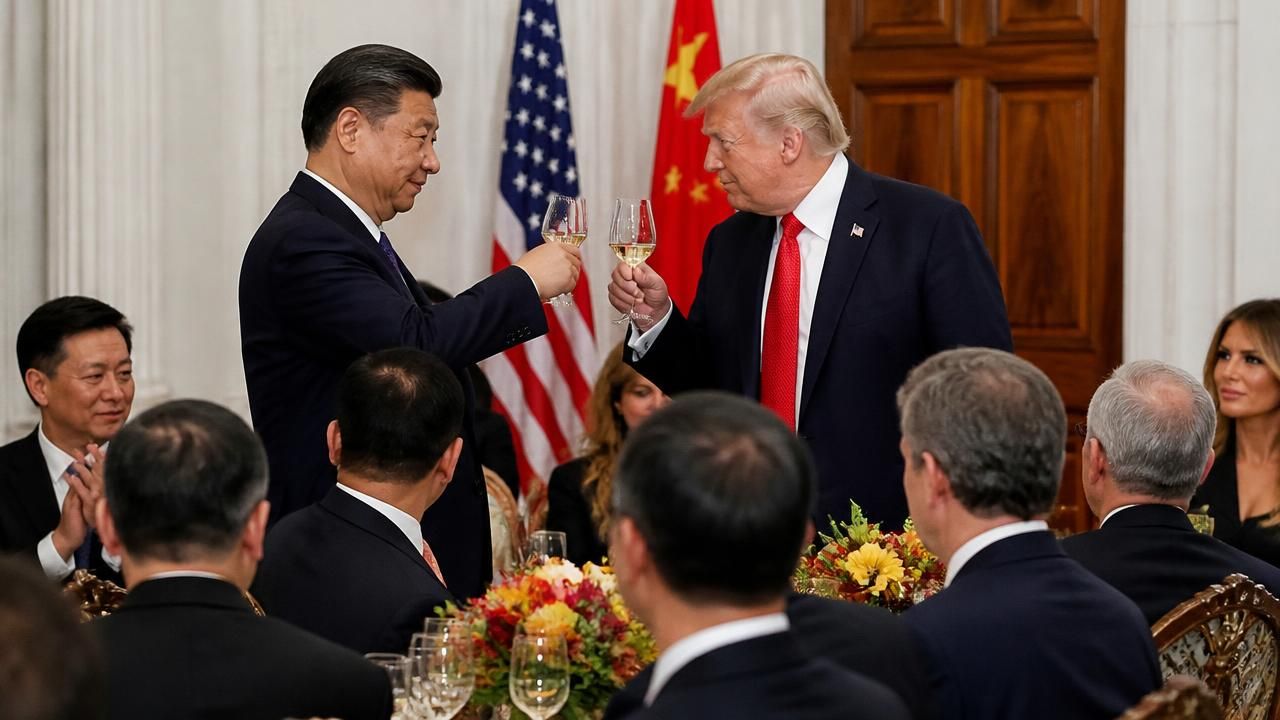
President Donald Trump welcomed Chinese President Xi Jinping to a White House state dinner on Thursday night, an evening that paired the weight of great-power diplomacy with the softer, more theatrical rituals of Washington hospitality: a carefully scripted menu, a guest list stacked with technology executives, and a bottle of wine carrying half a century of history.
According to accounts from NPR, the Associated Press and other outlets, the dinner featured crusted sea bass and baby bok choy, a lineup of tech titans at the tables, and the kind of stagecraft — seating charts, fashion, and food — that turns a diplomatic meal into a public statement.
A Menu Built to Signal Warmth
The bill of fare was anything but casual. Crusted sea bass and baby bok choy anchored the evening, a combination designed to read as elegant rather than extravagant, and one that reporters immediately contrasted with the fast-food imagery that has long attached itself to Trump's public persona. Coverage framed the menu as a deliberate tonal choice: refinement as a form of respect, and a nod to Chinese culinary tradition through the vegetable course.
The dinner was billed under the theme "Toast to Peace," a phrase that served as both a ceremonial flourish and a message to be read by audiences in both capitals.
Toast to Peace
NPR emphasized the human-scale details — who sat where, what guests wore, and what was served — describing the evening as the "glitzier" side of diplomacy. The Associated Press similarly led with the fusion of "tech titans, sea bass and glitzy diplomacy," a framing that treated the dinner as a story about image as much as substance.
The Guest List as a Policy Document
Perhaps the most scrutinized element of the night was not the food but the invitations. The guest list was heavily weighted toward the technology industry, a pairing that MSN framed explicitly as a signal of American priorities — asking, in effect, what a room full of tech leaders at a China dinner says about where Washington believes the relationship's center of gravity now lies.
That emphasis is not incidental. The U.S.-China relationship is currently defined as much by competition over semiconductors, artificial intelligence, data and supply chains as it is by traditional diplomacy. Seating those executives alongside the two leaders suggested a recognition that the commercial and technological dimensions of the relationship are now inseparable from its strategic ones.
NPR also noted that the fashion choices of attendees became a subject of coverage in their own right — a reminder that state dinners function as televised theater, in which clothing, placement and choreography carry meanings that official readouts rarely capture.
Wine From Nixon's Historic Trip
Among the most evocative details reported was the decision to serve wine connected to Richard Nixon's historic 1972 visit to China — the trip that reopened relations between Washington and Beijing after decades of estrangement and was famously described as "the week that changed the world."
The gesture was laden with symbolism. By reaching back to the Nixon-era opening, the evening implicitly invoked a golden age of engagement, even as the current relationship is marked by tariffs, export controls, and disputes over Taiwan and technology. Regional outlets, including South Korea's SBS, highlighted the wine as the night's most narratively potent detail, treating it as evidence that the historical arc of the relationship was being deliberately invoked.
Trump on Friendship, and on the Ballroom
Trump used the occasion to praise U.S.-China friendship, striking a warm tone toward Xi, and also talked up the White House ballroom — a pet project he has promoted as a venue for exactly this kind of large-scale hosting. For the president, the dinner served double duty: a diplomatic overture abroad and a showcase at home.
Regional coverage, including MyNBC5, stressed that framing, pairing the president's praise of bilateral friendship with his enthusiasm for the ballroom itself — a juxtaposition that captures how the event was simultaneously about statecraft and about the president's own preferred aesthetics of power.
How the Story Was Framed
The coverage divided along predictable but revealing lines:
- Wire and public-radio outlets (AP, NPR) treated the dinner as a study in diplomatic spectacle, foregrounding menu, wardrobe and seating logistics.
- Aggregators and television partners (MSN, MyNBC5) emphasized the guest list and the president's own remarks, framing the event around political messaging.
- International broadcasters (SBS) seized on the historical wine, reading the evening through the long lens of U.S.-China relations.
Why It Matters
State dinners rarely produce policy. They produce atmosphere — and atmosphere, in a relationship as consequential and as fragile as the one between Washington and Beijing, is not nothing. A warm room can smooth the path toward future negotiations over trade, technology and security; a cold one can foreclose them.
Thursday's dinner, with its sea bass and bok choy, its tech luminaries and its Nixon-era vintage, was an attempt to project warmth while acknowledging the new terrain on which the relationship now sits. Whether the toast to peace translates into anything more substantial will be measured not at the table, but in the months of negotiation that follow.