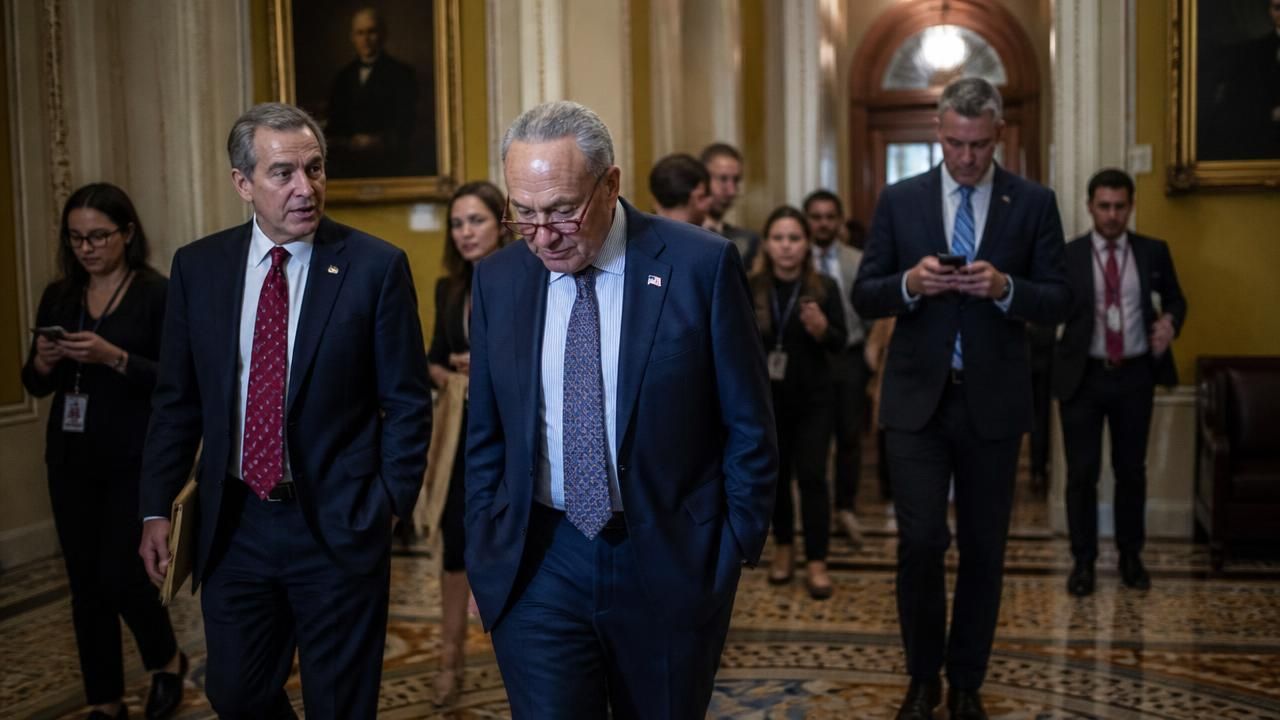
Senate Republicans voted down a Democratic war powers resolution aimed at ending the U.S. war with Iran, defeating the measure in one of the chamber's last votes before the November midterm elections. The vote, first reported by NPR and confirmed by The Guardian, marks the latest in a series of failed congressional attempts to claw back war-making authority from the White House — and it landed at a moment of unusual turbulence inside the president's own party.
According to NPR, the resolution was introduced by Senate Democrats under the War Powers Act framework, the 1973 law requiring the president to notify Congress within 48 hours of introducing armed forces into hostilities and to withdraw them after 60 days absent congressional authorization. The vote came as some Republicans have begun to distance themselves from President Trump over the ongoing conflict, a shift that Democratic campaign arms were quick to amplify.
A Familiar Outcome, a New Political Context
The DSCC, Senate Democrats' campaign committee, framed the result bluntly in a vote alert titled "Senate Republicans Again Vote to Continue Price-Spiking Iran War Amid National Backlash," arguing that the war's economic costs — particularly energy prices — are becoming a liability for incumbents. Red-state and conservative outlets such as RedState emphasized the procedural regularity of the outcome, noting that the war powers vote failed "again," a framing that treats the result as predictable rather than remarkable.
Senate Republicans again voted to continue a price-spiking war amid mounting national backlash — a vote Democrats say voters will remember in November.
The divergence in framing is instructive. Left-leaning outlets center the human and economic cost of continued hostilities; conservative outlets center the vote's failure as routine. Both, however, converge on one fact: this was not a party-line lockstep vote.
Seven Defections — and the Districts That Matter
Reporting from Staten Island's SILive noted seven Republican defections on the Iran vote — while pointing out that Rep. Nicole Malliotakis was not among them, and quoting her explanation for staying with the majority. The defections cut across geography, with Michigan Republicans breaking with Trump not only on Iran but also on artificial intelligence and data center policy, according to NBC News.
The House picture is equally fractured. The Twin Cities Pioneer Press reported that Iowa Republicans locked in battleground House races voted to halt the Iran war — a reminder that the conflict is playing very differently in swing districts than in safe seats. MSN's aggregation of campaign coverage highlighted that "these GOP candidates in tight races are calling for a quick end to the Iran war," suggesting a widening gap between the party's national posture and its most vulnerable candidates' messaging.
The Midterm Math Behind the Vote
Timing is everything. The vote came in the final legislative window before November, when the Senate map has tightened dramatically. One MSN analysis noted that Republicans held a 57% Senate edge in July; by the fall, the forecast had become a pure toss-up. From Maine to Texas, a handful of Senate races now threaten the GOP majority — races in which an unpopular, open-ended war could prove decisive.
That anxiety isn't confined to Washington. In New Hampshire, House Republicans outlined a "Granite Guarantee" platform contingent on holding their majority in November, according to InDepthNH, while a judge there rejected an injunction seeking to block a school budget cap vote. In Missouri, Republicans asked a federal court to revive a gerrymandered congressional map and block a referendum, KCUR reported — another front in the broader fight over who gets to draw the lines before November.
A Senate Agenda Under Strain
The Iran vote was not the only high-stakes item on the Senate's calendar. The CLARITY Act — a crypto market-structure bill — failed in a Senate vote after overnight talks collapsed, with markets sliding to near-record lows in the aftermath, according to The Coin Republic and MSN. Meanwhile, MSN reported that "big crypto is trying to block Democrats' Senate dreams," underscoring how industry money is now flowing into primary and general election fights.
Technology policy more broadly is also in play. The Next Web, citing Reuters, reported that a new Senate bill would let Washington block AI models — a proposal that would give federal regulators unprecedented authority over model deployment. Combined with the Senate's push to rewrite the rules for college sports and ongoing litigation over a new USPS rule that a second federal judge has blocked while the Supreme Court deliberates, the chamber's lame-duck agenda is unusually crowded.
What Happens Next
War powers resolutions are rarely successful; Congress has passed only a handful since 1973, and presidents of both parties have generally treated them as advisory. The practical effect of this week's vote is therefore limited. Its political effect may not be.
Democrats intend to use the roll call as a campaign document, pairing it with rising prices and the cost of the conflict. Republicans, meanwhile, must manage a coalition in which candidates in battleground districts are openly calling for a quick end to the war while the Senate majority continues to fund and authorize it. With control of the chamber now rated a toss-up and only weeks remaining, the gap between the party's national position and its most competitive candidates' instincts may prove as consequential as the vote itself.
- What happened: Senate Republicans blocked a Democratic war powers resolution to end the U.S. war with Iran.
- When: One of the chamber's final votes before the November midterms.
- Why it matters: Seven GOP defections, battleground House members voting to halt the war, and a Senate map now rated a toss-up.
- Also on the docket: The failed CLARITY Act crypto bill, a new AI-model blocking bill, college sports rules, USPS litigation, and state-level redistricting fights.