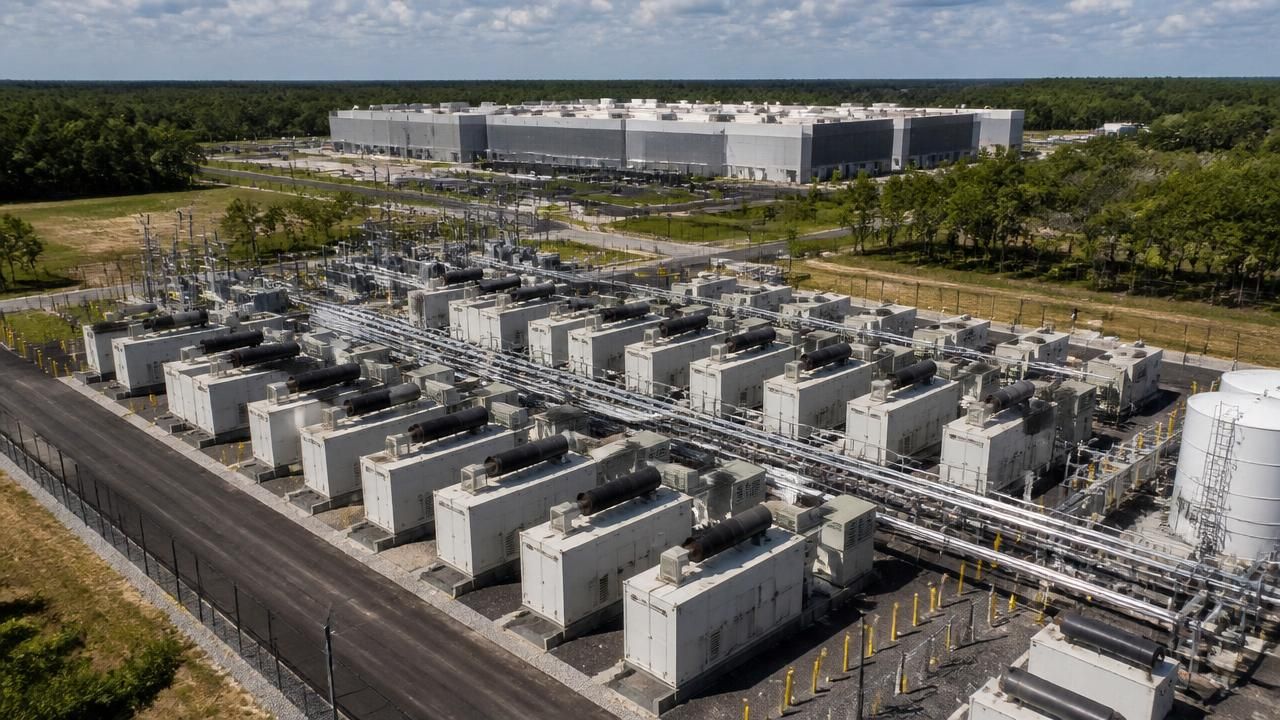
New Jersey has ordered the operator of one of the East Coast's largest planned data centers to pay a $1.1 million penalty for secretly installing and running dozens of gas-fired generators in violation of the state's Air Pollution Control Act, regulators announced this week.
The facility, operated by DataOne in Vineland, Cumberland County, was found to be running 62 natural gas generators — none of them permitted — at a site that has been billed as New Jersey's largest AI data center and a cornerstone of the region's fast-expanding computing infrastructure.
How the Violations Came to Light
The case did not originate with a routine inspection. According to reporting by Ars Technica, the New Jersey Department of Environmental Protection (DEP) opened its investigation after The Guardian and the nonprofit newsroom Floodlight published a joint investigation in August. That reporting relied on thermal drone footage showing that 45 of the 62 generators were actively operating at the time.
State rules require permits for any generator with a capacity of 37 kilowatts or higher. The DataOne units were running at 1,982 kilowatts each — more than 50 times the threshold that triggers the permitting requirement. In other words, the equipment was not marginally outside the regulatory perimeter; it was orders of magnitude beyond it, and entirely undocumented.
The drone imagery proved decisive. Thermal cameras can detect the waste heat plumes of operating combustion engines from the air, giving journalists a tool that bypasses the site-access and self-reporting limitations that often shield industrial facilities from scrutiny. The resulting evidence was specific enough — count, location, operating status — to underpin a formal state enforcement action.
Why Regulators Track These Generators
New Jersey officials were blunt about the public-health rationale behind the permitting regime. Gas generators, the DEP noted, emit "carbon dioxide, nitrogen oxides, carbon monoxide, and other combustion-related pollutants." Those pollutants are linked to a well-documented set of harms: worsening asthma, triggering heart attacks, and contributing to premature deaths.
States track gas generators like DataOne uses because they emit "carbon dioxide, nitrogen oxides, carbon monoxide, and other combustion-related pollutants," officials from New Jersey's Department of Environmental Protection noted.
Nitrogen oxides in particular are a precursor to ground-level ozone and fine particulate matter, both of which disproportionately affect low-income and minority communities located near industrial sites. Vineland, in southern New Jersey's agricultural belt, sits in a region that has historically drawn less environmental-enforcement attention than the state's densely industrialized northeast corridor.
The AI Boom Meets the Grid
The DataOne case lands at the intersection of two accelerating trends. The first is the explosive growth of AI computing, which has driven demand for data center capacity — and for the electricity to feed it — to levels that utilities and grid operators are struggling to absorb. The second is the growing use of on-site, behind-the-meter generation as a workaround, letting operators power up faster than interconnection queues and transmission upgrades allow.
That workaround has a regulatory blind spot built into it. Generators installed for backup or peak-shaving purposes are often treated as minor sources, subject to lighter oversight than a utility-scale plant. When dozens of them are clustered at a single campus, however, their aggregate emissions can rival those of a small power station — a fact that the current permitting framework, designed around individual units, can fail to capture.
The $1.1 million penalty is significant but small relative to the capital costs of a hyperscale data center, raising questions about whether fines of this size function as a genuine deterrent or simply as a cost of doing business. Environmental advocates have long argued that penalties must scale with the economic benefit of noncompliance to change corporate behavior.
How Different Outlets Framed the Story
Coverage of the fine varied notably in emphasis, reflecting each outlet's audience and beat.
- Ars Technica, a technology publication, led with the mechanics of the violation — the capacity figures, the missing permits, the drone evidence — and treated the story as a case study in how tech infrastructure outpaces regulation.
- NJ.com, the state's largest local newsroom, framed it in the language of local accountability and scale, calling the facility "N.J.'s largest AI data center" and describing the penalty as "stunning."
- MSN's aggregation emphasized the headline number — more than $1 million — and the air-pollution violation itself, positioning it as a consumer-facing environmental story.
- Yahoo News localized the same event around Vineland, foregrounding the community affected rather than the technology.
The differences are instructive. National tech coverage asks whether AI's power demands can be governed at all; local coverage asks who pays the price when they aren't.
What Happens Next
The fine does not, by itself, resolve the underlying question of whether the generators will be permitted, replaced, or shut down. DataOne has not publicly detailed its remediation plans, and it remains unclear whether the state will require retroactive permitting, emissions controls, or operational limits on the Vineland site.
More broadly, the case is likely to serve as a template. As AI data center construction accelerates across the country, state environmental agencies are being forced to modernize enforcement for a class of facilities that did not meaningfully exist a decade ago. Aerial thermal imaging, satellite monitoring, and third-party investigative reporting are increasingly supplying the evidence that regulators lack the staff to gather themselves.
For now, New Jersey has sent a clear signal: the permits apply to the AI era too. Whether the penalty is large enough to matter will be tested the next time a campus of generators spins up without one.