The four astronauts assigned to NASA’s SpaceX Crew-13 mission will spend their rotation aboard the International Space Station running a dense slate of biomedical and human-performance investigations, including a new NASA–European Space Agency collaboration aimed at understanding how microgravity disrupts blood flow and clotting, according to a NASA mission update released April 30, 2026.
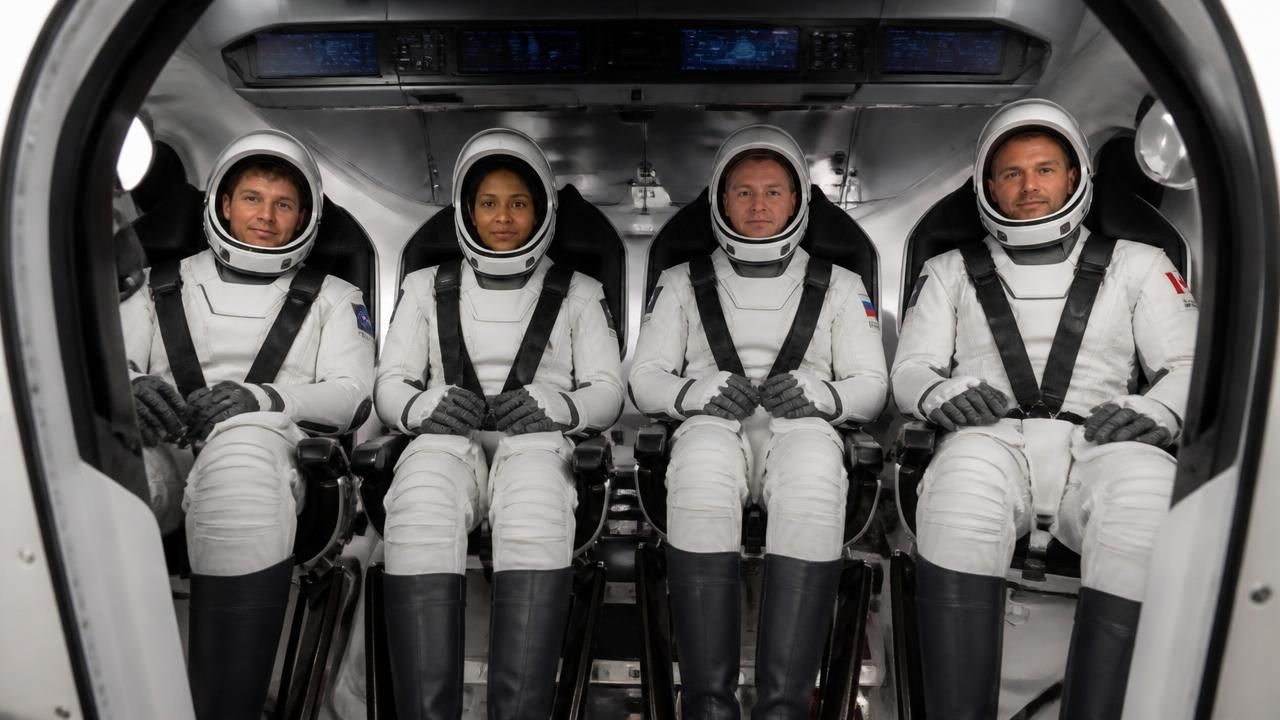
The announcement, illustrated with a photograph of the crew in pressure suits seated inside a Dragon mockup during preflight training at SpaceX headquarters in Hawthorne, California, offers one of the clearest windows yet into how the two agencies intend to use the orbiting laboratory as a proving ground for longer journeys to the Moon and Mars.
A four-nation crew
Flying aboard the SpaceX Dragon are NASA astronauts Luke Delaney and Jessica Watkins, Roscosmos cosmonaut Sergey Teteryatnikov, and Canadian Space Agency astronaut Joshua Kutryk. The multinational makeup of the crew is a reminder that the station remains one of the few arenas where the United States, Russia, Europe and Canada still operate in close, continuous partnership — a diplomatic dimension that often goes unmentioned in technical mission descriptions.
Delaney and Watkins bring NASA’s astronaut corps to the flight deck, while Teteryatnikov represents Roscosmos under the long-running seat-exchange arrangement that keeps at least one Russian cosmonaut aboard the U.S. segment and one NASA astronaut aboard the Russian segment. Kutryk’s presence reflects Canada’s contribution of robotics and crew time to the station program.
Blood flow and clotting: the Venous Haemostasis collaboration
Central to the mission’s research portfolio is Venous Haemostasis, a joint NASA–ESA effort that builds on earlier studies of how blood moves through astronauts’ veins in weightlessness. By coordinating blood collections and other physiological measurements across the two agencies, researchers can reduce how often crew members need blood drawn while combining analytical results into a larger, more statistically useful dataset.
“In space, weightlessness can disrupt normal blood flow in astronauts’ veins,” a NASA researcher involved in the effort said in the agency’s release.
That disruption is not hypothetical. Studies of long-duration crews have documented stagnant or reversed blood flow in the internal jugular vein, and at least one astronaut developed an occlusive jugular thrombosis during a flight — a finding that startled flight surgeons and pushed venous health toward the top of space medicine’s agenda. Because clot formation in space is difficult to treat and evacuation is impossible, understanding who is at risk, and why, has become a priority for both agencies.
The pooled approach also addresses a chronic problem in spaceflight research: sample size. With only a handful of people in orbit at any time, every additional blood draw is precious, and every duplicated experiment costs crew time. Combining NASA and ESA protocols is a way to stretch both.
Vision, brain and the SANS puzzle
NASA is also evaluating methods to counter the vision and brain changes associated with long-duration flight, a constellation of symptoms known as Spaceflight Associated Neuro-ocular Syndrome, or SANS. Extended stays in microgravity shift fluids toward the head, and some astronauts return with flattened eyeballs, swelling of the optic disc and blurred vision that can persist for months.
The condition is considered one of the most significant physiological barriers to a crewed Mars mission, and countermeasures — from lower-body negative pressure to specialized nutrition and exercise regimens — remain unproven at the scale a Mars transit would demand.
Piloting by hand, and the physics of coming home
The mission also folds in more operational research. Crew members will be tested on their manual piloting skills, a capability that matters if automated systems fail during approach or docking. NASA will additionally measure the forces astronauts experience during return to Earth, data intended to refine re-entry hardware and procedures — from seat design to descent profiles — as the agency prepares for flights beyond low Earth orbit.
- Venous Haemostasis: a NASA–ESA study of blood flow and clotting in microgravity.
- Manual piloting: assessment of crew handling skills in Dragon.
- Vision and brain countermeasures: methods to offset SANS-related changes.
- Health data collection: baseline and in-flight measurements to inform future missions.
- Re-entry force measurement: quantifying loads on the body during descent.
How the story is being framed
The mission has been covered from markedly different angles. NASA’s own release leads with the biomedical detail, casting Crew-13 as a laboratory rotation focused on human health. Aggregators such as MSN, by contrast, headlined the work as experiments that “could shape future Moon and Mars missions” — a framing that reaches for the exploration payoff rather than the physiology.
Other syndicated versions of the story circulated with minimal added context; at least two versions surfaced online only as error pages or security checks, a reminder of how thinly some science coverage is redistributed across the web. None of the secondary accounts added reporting beyond the agency’s original text, leaving the primary source as the substantive record.
Why it matters
Every biomedical result from the station is a data point for Artemis lunar missions and, eventually, a crewed Mars expedition — flights measured in years, not months, and far beyond the reach of a quick return to Earth. Clotting risk, vision loss, fluid shifts and the physical toll of re-entry are precisely the problems that grow more dangerous the farther crews travel from home.
Crew-13’s experiments will not solve those problems on their own. But by pooling scarce samples across agencies and testing countermeasures in orbit, the mission adds incremental, hard-won evidence to a field where the margin between a successful deep-space voyage and a medical emergency may ultimately be measured in a few millimeters of vein.