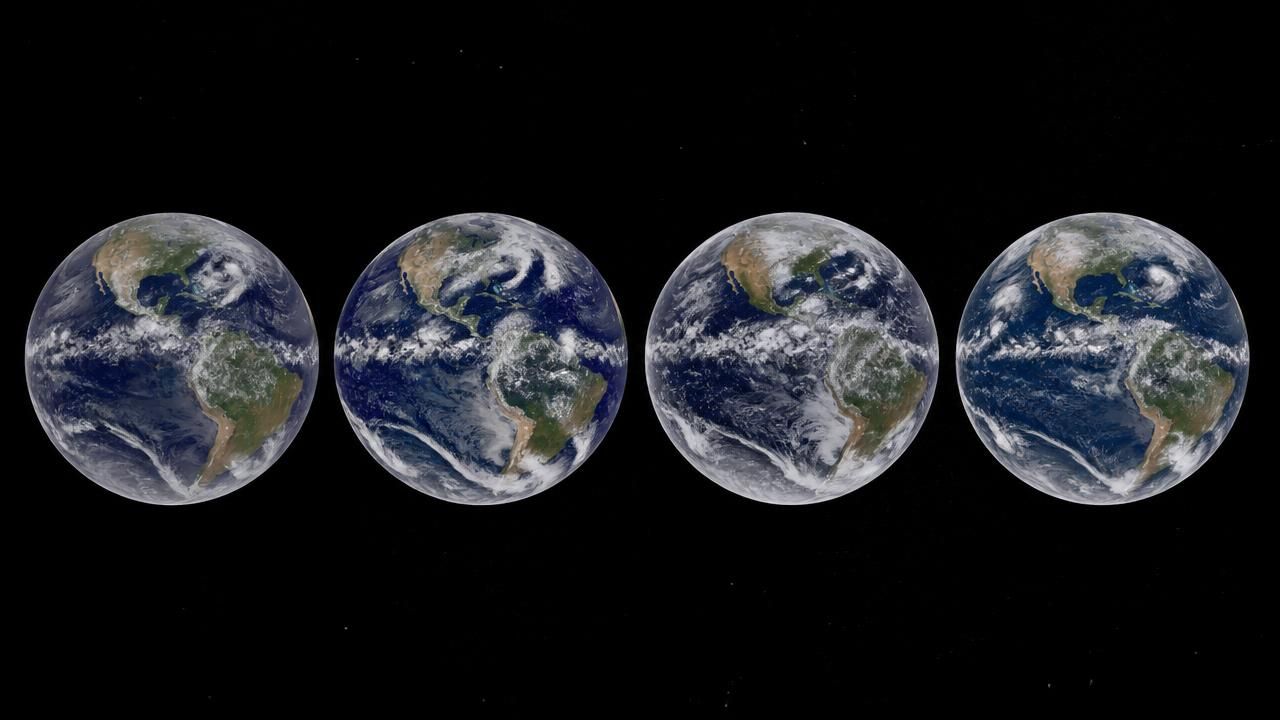
Twice a year, a camera parked roughly 1.5 million kilometres from Earth — between the planet and the Sun — captures a portrait that explains something most people learned in primary school and rarely think about again: why the seasons happen. Images from NASA's Earth Polychromatic Imaging Camera (EPIC) aboard the NOAA mission DSCOVR (Deep Space Climate Observatory) show Earth on the December and June solstices and the March and September equinoxes, illustrating how the tilt of Earth's axis shifts the continents' apparent positions through the year, the NASA Earth Observatory reported.
One camera, four turning points
EPIC is a ten-channel CCD camera that images the entire sunlit face of Earth from the first Lagrange point (L1), a gravitationally stable vantage roughly a million miles away. Because it never sees Earth's night side, its archive is a record of daylight — clouds, aerosols, ozone, vegetation and the slow migration of the seasons across the globe. NASA's Earth Observatory compiled four of those views into a single comparison — June, September, December, March — credited to NASA Earth Observatory/Michala Garrison.
The result is a visual answer to a question that trips up plenty of adults: the seasons are not caused by Earth's distance from the Sun. In fact, Earth is closest to the Sun in early January, deep in the Northern Hemisphere's winter.
The collision that gave us summer
What actually drives the cycle is axial tilt — about 23.5 degrees, the angle at which the planet leans as it orbits. NASA notes that this substantial tilt is thought to be the residue of a cataclysmic event: an ancient planetary body, Theia, smashing into Earth roughly 4.5 billion years ago, the same collision that is believed to have formed the Moon.
To visualise the mechanism, NASA suggests imagining Earth as a spinning top tilted to one side. Around the June solstice, the Northern Hemisphere leans toward the Sun, receiving more direct sunlight and longer days. Around the December solstice, the Southern Hemisphere does the same. At the equinoxes in March and September, the tilt is side-on to the Sun and daylight is roughly equal north and south of the equator.
Around the June solstice, the Northern Hemisphere leans toward the Sun, bringing more direct sunlight and longer days. Around the December solstice, the Southern Hemisphere does the same. That's why June — NASA Earth Observatory
Why the framing matters
The story is a reminder that seasonal change is a planetary geometry problem before it is a weather story. It also underpins practical science: solstice and equinox data anchor agricultural calendars, satellite calibration, energy-demand forecasts and climate records that stretch back centuries. The DSCOVR platform, launched in 2015, was designed primarily as a space-weather sentinel — watching the solar wind for storms that can disrupt power grids and satellites — but its EPIC instrument has turned it into one of the most recognisable public-facing Earth-observation missions.
- June solstice: Northern Hemisphere leans sunward; longest days in the north, shortest in the south.
- December solstice: The pattern reverses; Southern Hemisphere summer begins.
- March and September equinoxes: Tilt is perpendicular to the Sun; day and night are nearly equal worldwide.
- Common myth: Seasons are not driven by Earth's elliptical orbit — closest approach occurs in January.
Seasons of a different kind
The word "season" escapes astronomy constantly, and the same week's news cycle offered reminders of how elastic it has become. Gaming audiences tracked an outage at Epic Games as Fortnite transitioned into its latest chapter, with servers taken offline so the new "season" — the industry's standard term for a content cycle — could be deployed. Reports headlined the disruption as Fortnite Season 4: Override arrived, with updates appended as service was restored. In the same stretch, coverage of reality television noted a first: a Big Brother "live" eviction that was actually taped — a small break in the genre's founding conceit of real-time voyeurism, arriving in the middle of a broadcast season.
And in the political sphere, the phrase "campaign trail" carries its own seasonal rhythm. In June 2016, the United States was in the thick of a primary season that would soon hand both major parties their presumptive nominees — a moment when the word "season" described not axial tilt but a calendar of primaries, conventions and general-election sprinting. These are unrelated stories, and the reporting available on them was fragmentary, appearing largely as headline-level dispatches rather than full sourcing. But read alongside NASA's solstice imagery, they underline how thoroughly the language of seasons structures human time: sports seasons, fiscal seasons, holiday seasons, television seasons.
What the view from L1 tells us
There is a substantive reason to keep watching the astronomical version. EPIC's full-disk imagery gives scientists a benchmark for the planet's energy balance — how much sunlight Earth reflects back to space — and a daily record of vegetation greenness, cloud cover and atmospheric aerosols at a scale no ground network can match. Changes in the timing and intensity of the solstices and equinoxes, meanwhile, are not themselves shifting appreciably; what is changing is how the surface responds to them, as warming alters snow cover, growing seasons and the migration of species.
For NASA, the payoff is partly pedagogical: four images, four dates, one clear explanation. "Most kids learn in elementary school that the seasons are caused by Earth rotating on a tilted axis during its yearly orbit around the Sun," the agency observed. The EPIC images exist to make that sentence visible — a spinning top, seen from a million miles out, leaning into summer.