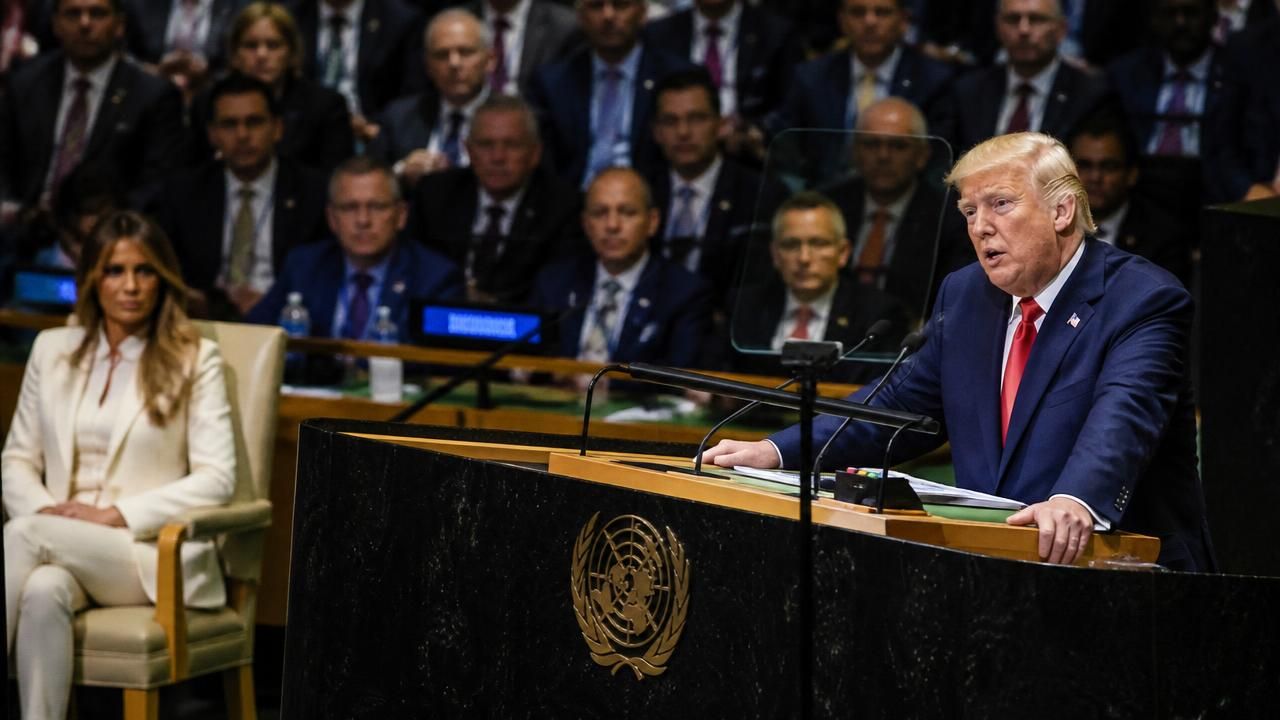
UNITED NATIONS — President Donald Trump took the rostrum of the United Nations General Assembly on Tuesday to defend the U.S.-Israeli war in Iran, declaring that Tehran is “a bully no more” and vowing that Washington would never permit the Islamic Republic to obtain a nuclear weapon.
The address, delivered on the opening day of the annual high-level debate at U.N. headquarters in New York, unfolded against a backdrop of widening wars and deepening distrust between Washington and some of its oldest allies. Secretary-General António Guterres opened the session with a bleak assessment of the global order, warning that “the fault lines in our world are widening” and calling on leaders to halt the conflicts multiplying across the globe.
A Chamber on Edge
The mood inside the hall was tense even before Trump spoke. According to live coverage from The Guardian, The Associated Press, Fox News, CBS News and The New York Times, the day’s agenda was dominated by three overlapping crises: the war in Iran, the conflict in Gaza, and Russia’s ongoing war in Ukraine. The AP framed the moment as one of “anxiety about Iran, AI and the future of world body itself” — a nod to the growing question of whether the 80-year-old institution can still function as a forum for resolving great-power disputes.
Trump arrived with first lady Melania Trump, who accompanied him into the building. The New York Post, emphasizing the theatrics of the moment, noted that the president delivered his “American power” remarks after riding “a working escalator” — a wry reference to a past episode that has become a recurring motif in coverage of his foreign trips.
Guterres: ‘The Fault Lines Are Widening’
In his opening address, Guterres offered a stark counterpoint to the president’s message of military resolve. The secretary-general called on world leaders to end conflicts, warning that the international system is being pulled apart by competing blocs and unilateral action.
“The fault lines in our world are widening,” Guterres told the assembled delegations.
His remarks set the tonal divide that would define the day: an American president arguing that strength and military pressure have restored deterrence, and a U.N. chief arguing that the same dynamics are accelerating global fragmentation.
Trump’s Case for the War
Trump’s speech was, by the accounts of multiple outlets, an unapologetic defense of the U.S.-Israeli campaign against Iran. India Today reported that the president declared Iran “a bully no more” and pledged that Tehran would never be allowed to develop nuclear weapons. Times Now, covering the address as a live event, highlighted Trump’s insistence that the United States retains “the most powerful military on Earth.”
The remarks effectively formalized a split that has been building for months. Where previous administrations used the General Assembly to build coalitions, Trump used it to present the Iran war as a settled fact and a warning to others.
Rubio and the Diplomatic Track
Yet the day was not entirely confrontational. Secretary of State Marco Rubio, who defended the Iran war before the assembly, also said the United States is open to meeting Iranian representatives at the United Nations, according to Times of India. That statement gained urgency as Iran’s president, Masoud Pezeshkian, traveled to New York for the summit, raising the possibility — reported by CBS News — of a direct encounter with Trump.
Times Now described the arrangement as “rival positions” on the same stage: two leaders presenting incompatible accounts of the war and its justification, with the diplomatic track held open largely as a contingency.
Meanwhile, Fox News reported that Treasury Secretary Scott Bessent predicted a shutdown of Iranian airline operations — a signal that the administration is preparing to escalate economic pressure even as it keeps the door to talks ajar.
Allies Adrift
If Iran dominated the agenda, friction with traditional partners ran just beneath the surface. USA Today framed the president’s address as taking place “amid rising tensions with Canada, Europe,” a reflection of disputes over trade, defense spending and the conduct of the Iran campaign.
The divergence in coverage was itself telling. American outlets leaned into live-blog framing and the optics of the day; the Guardian emphasized Guterres’s warnings and the diplomatic fallout; Indian and Gulf-facing outlets led with the confrontation between Trump and Pezeshkian.
Other News on a Crowded Day
The General Assembly was not the only story competing for attention. HuffPost’s live blog paired the speech with news that a grand jury had declined to bring charges in the death of Nolan Wells. Separately, Trump used the day to launch an exclusive streaming platform, according to MSN — a reminder that the president’s media ventures continue to run parallel to his diplomacy.
What to Watch
- A Trump-Pezeshkian meeting: Both leaders are now in New York, and Rubio has publicly left the door open.
- The U.N.’s relevance: Guterres’s warning about widening fault lines raises the question of whether the body can mediate a war in which a permanent member’s closest ally is a combatant.
- Allied cohesion: Frictions with Canada and European capitals show no sign of easing.
- Economic pressure: Bessent’s prediction of an Iranian airline shutdown suggests sanctions, not diplomacy, remain the primary instrument.
For now, the defining image of the day was a president using the world’s most prominent multilateral stage to defend unilateral war — and a secretary-general warning, in the same room, that the world is drifting further apart.