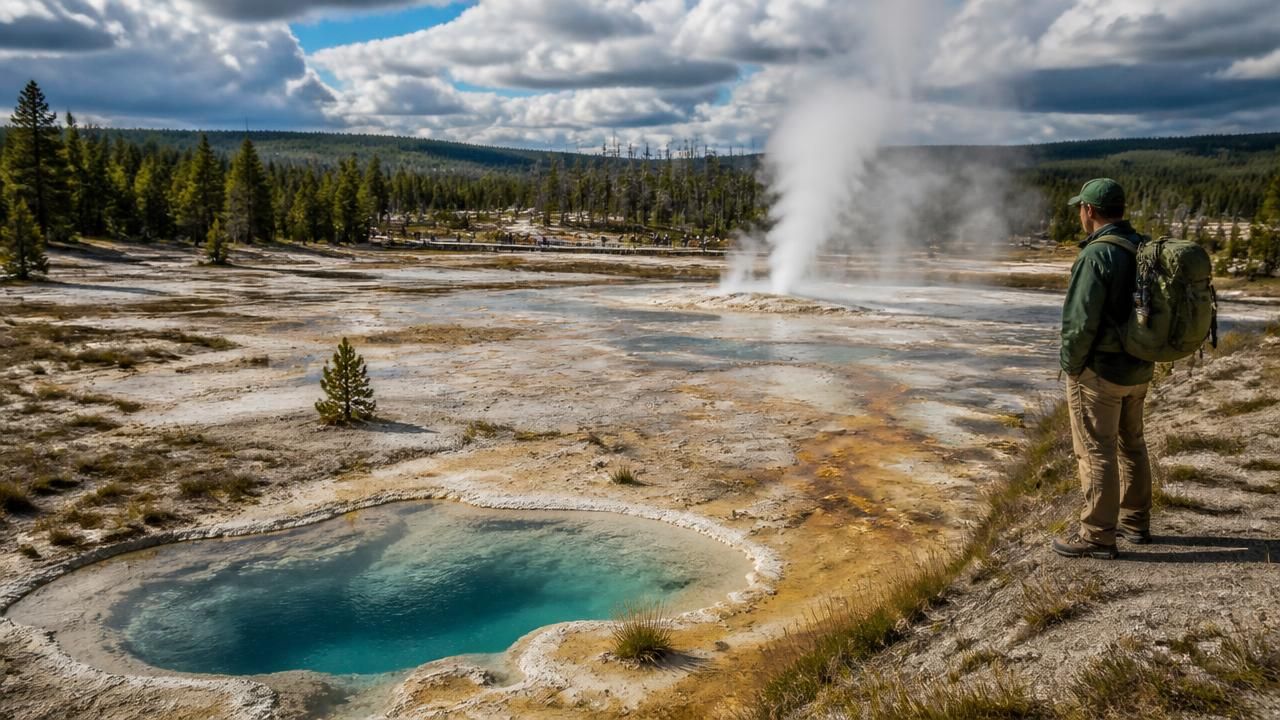
It would not begin with a bang. According to a new blow-by-blow analysis of a hypothetical Yellowstone super-eruption, the world's most famous caldera would announce itself weeks in advance — through migrating earthquake swarms, rapidly rising ground, restive geysers and shifting volcanic gases — before any catastrophic blast.
The analysis, which has circulated widely this week under headlines warning of the "end of humanity," attempts something volcanologists rarely do in public: walk through, step by step, what a worst-case VEI 8 eruption at Yellowstone would actually look like for the roughly 300 million people living in North America.
The warning signs would come first
Yellowstone is monitored continuously by the Yellowstone Volcano Observatory, a partnership of the U.S. Geological Survey, the National Park Service and several universities, using seismometers, GPS stations, gas sensors and satellite radar. In the scenario outlined by researchers, those instruments would pick up weeks of escalating unrest before an eruption.
- Earthquake swarms migrating across the caldera as magma forces its way upward.
- Rapid ground uplift, measurable in centimeters to meters, as the reservoir inflates.
- Abrupt changes in geyser behavior — Steamboat, Old Faithful and their neighbors going silent or erupting erratically.
- Rising emissions of sulfur dioxide and carbon dioxide from the soil and thermal features.
"A Yellowstone super-eruption would begin not with a sudden surprise, but with weeks of increasingly alarming warning signs," the scenario notes.
A minute-by-minute catastrophe
In the modeled worst case, those signals culminate in a VEI 8 eruption — the top of the volcanic explosivity index, a category that has not been recorded anywhere on Earth since New Zealand's Oruanui eruption about 26,500 years ago.
The opening phase would hurl ash and pumice tens of kilometers into the stratosphere. Pyroclastic flows — fast-moving clouds of gas and incandescent rock exceeding 700°C — would sweep across the surrounding landscape within minutes, sterilizing everything in their path. Within hours, ashfall would begin to bury parts of Wyoming, Montana and Idaho; within days, prevailing winds could carry ash across the Great Plains and toward the East Coast.
The human toll would not come primarily from the blast. Transportation networks would seize as jet engines ingested abrasive ash. Power grids, water treatment plants, communications and supply chains would fail across much of the continent. Agriculture in the Midwest — the continent's breadbasket — would be crippled for at least a growing season.
1.3 billion deaths: modeling the global aftermath
Several outlets, including MSN, seized on a far grimmer figure: an estimated 1.3 billion premature deaths worldwide. That number does not come from the eruption itself but from the cascading global consequences — stratospheric sulfate aerosols reflecting sunlight, surface temperatures dropping by several degrees for years, harvests failing and famine spreading through regions dependent on imported grain.
Such estimates are explicitly hypothetical. They extrapolate from ice-core and tree-ring records of historic eruptions such as Tambora in 1815, which produced the "year without a summer," and from climate models that remain uncertain about how ash and aerosols would be distributed.
Where the headlines outrun the science
Not every outlet framed the story the same way. Science-focused coverage emphasized the monitoring and warning-sign sequence. Aggregators leaned into apocalypse: MSN published at least two versions under headlines about "1.3 billion premature deaths" and the "end of humanity," while the Daily Mail promised a "minute-by-minute" account. One New York Post headline went furthest, declaring that Yellowstone was "nearing eruption as new study finds magma brimming below the surface."
That framing is where scientists push back hardest. The magma reservoir beneath Yellowstone is estimated to be only about 5 to 15 percent molten — a slushy crystal mush rather than a brimming tank of liquid rock. The USGS puts the annual probability of a Yellowstone super-eruption at roughly 1 in 730,000. Smaller lava flows and hydrothermal explosions — like the 1989 Porkchop Geyser blast — are far more likely, and still local rather than continental.
The odds are "not zero, but not something anyone should lose sleep over," researchers have repeatedly said of a caldera-forming event.
Why the exercise still matters
Scenario planning is not the same as prediction. Volcanologists argue that walking through a worst case is exactly how emergency managers identify where warning systems, ash-cleanup protocols and food-supply contingencies would fail — lessons that apply to smaller, likelier eruptions at Yellowstone and to volcanoes such as Campi Flegrei in Italy or Mount Rainier in Washington.
For now, the instruments in Yellowstone National Park keep humming, recording the caldera's slow breathing. The science says the magma is not rising to the surface tomorrow. The new analysis says that if it ever did, the world would have weeks of warning — and no good options.