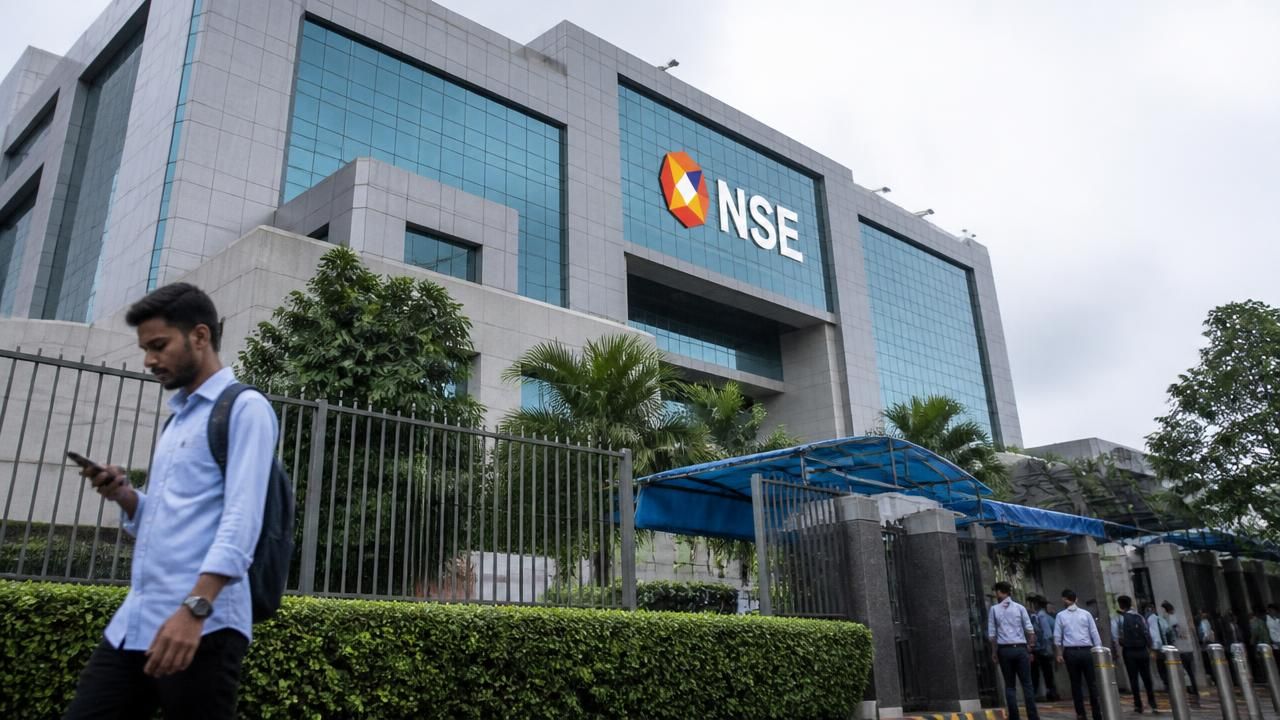
The National Stock Exchange of India Ltd. drew roughly $10 billion in bids for its $2.4 billion initial public offering, with the issue fully subscribed by the close of its second day and the institutional portion covered early, according to Bloomberg, Livemint, Financial Express and syndicated wire reports.
The deal — which Livemint described in its filing coverage as "potentially India's biggest ever" — was originally registered at up to ₹30,000 crore before being sized at ₹22,562 crore, or about $2.4 billion. The offer price was fixed at ₹1,785 per share.
A slow start, then a surge
Financial Express, tracking the book minute by minute in live coverage, reported that the ₹22,562-crore issue was subscribed just 0.43 times at the end of Day 1 — a muted debut that reflected soft retail participation rather than weak institutional appetite.
That picture reversed within 24 hours. By the second session the portions reserved for qualified institutional buyers were fully subscribed and the overall book had crossed the 1x mark, according to Bloomberg. Total demand eventually reached about $10 billion, implying an oversubscription of roughly four times the deal's base size.
LIC emerges as the single biggest bidder
The striking feature of the book was who filled it. Bloomberg, citing people familiar with the matter, identified Life Insurance Corp. of India as the largest bidder in the offering — a signal of the weight that domestic long-term institutions now carry in India's largest capital markets transactions.
"Life Insurance Corp. of India Ltd. was the biggest bidder in National Stock Exchange of India Ltd.'s initial public offering... highlighting strong demand from local long-term institutional investors even as retail participation remained subdued." — Bloomberg Markets
That split is central to how the listing should be read. Insurers, pension funds and sovereign investors are buying a long-duration asset — a stake in the infrastructure of Indian equity and derivatives trading — while retail buyers, who have poured record sums into Indian equities in recent years, stayed comparatively cautious at a valuation that leaves little room for error.
Anchors set the tone with ₹6,746 crore
Before the public window opened, NSE raised ₹6,746 crore from 189 anchor investors — roughly 30% of the total issue. LIC, Singapore's sovereign fund GIC and Goldman Sachs were among the key names in that group, according to reports, alongside a broad list of domestic and global funds.
- Issue size: ₹22,562 crore (about $2.4 billion)
- Offer price: ₹1,785 per share
- Day 1 subscription: 0.43 times
- Anchor allocation: ₹6,746 crore to 189 investors
- Total bids received: roughly $10 billion
- Status: Fully subscribed on Day 2; institutional portion covered
How the outlets framed it
Coverage of the same transaction diverged sharply in emphasis, a reflection of how differently financial newsrooms treat a landmark listing.
- Bloomberg led on the identity of the largest bidder and the institutional-versus-retail split, treating the deal as a test of domestic institutional conviction.
- Financial Express treated it as a live, tick-by-tick event, foregrounding the 0.43x Day 1 figure that framed early scepticism.
- Livemint framed the story around scale and process, highlighting the ₹30,000-crore filing that could have made it India's largest-ever IPO.
- Syndicated reports via MSN concentrated on headline milestones: full subscription on Day 2, the anchor cheque, and the final ₹1,785 price.
The net effect is a story told in three registers: a demand story, a book-building story, and a record-setting story. All three describe the same auction.
Why this listing matters
NSE sits at the centre of India's market infrastructure. It is among the world's largest derivatives exchanges by contract volume and a primary venue for the index options activity that has made India's retail trading boom one of the biggest in the world. A successful float hands the exchange a permanent capital base and a public currency for future expansion, and it gives global funds a listed vehicle through which to own Indian market infrastructure.
It also caps a long and difficult road to the public markets. NSE's listing ambitions were delayed for years by regulatory and governance scrutiny following a co-location controversy that led to leadership changes. The strong institutional bid suggests investors are looking past that history — at least for now — and pricing the franchise rather than the anecdote.
What happens next
Attention now shifts to allotment, the final shareholding pattern and the listing date. Two numbers will define the aftermath: the retail category's final subscription figure, which will show whether domestic small investors genuinely sat out or simply arrived late, and the first-day trading print, which will test whether ₹1,785 a share was a bargain or a ceiling.
For LIC, the deal continues a pattern of the insurer anchoring India's largest state-linked and market-infrastructure offerings. For NSE, the harder question begins after the bell: whether a newly public exchange can keep its derivatives dominance, diversify its revenue, and satisfy shareholders who now own a slice of the plumbing of Indian finance.