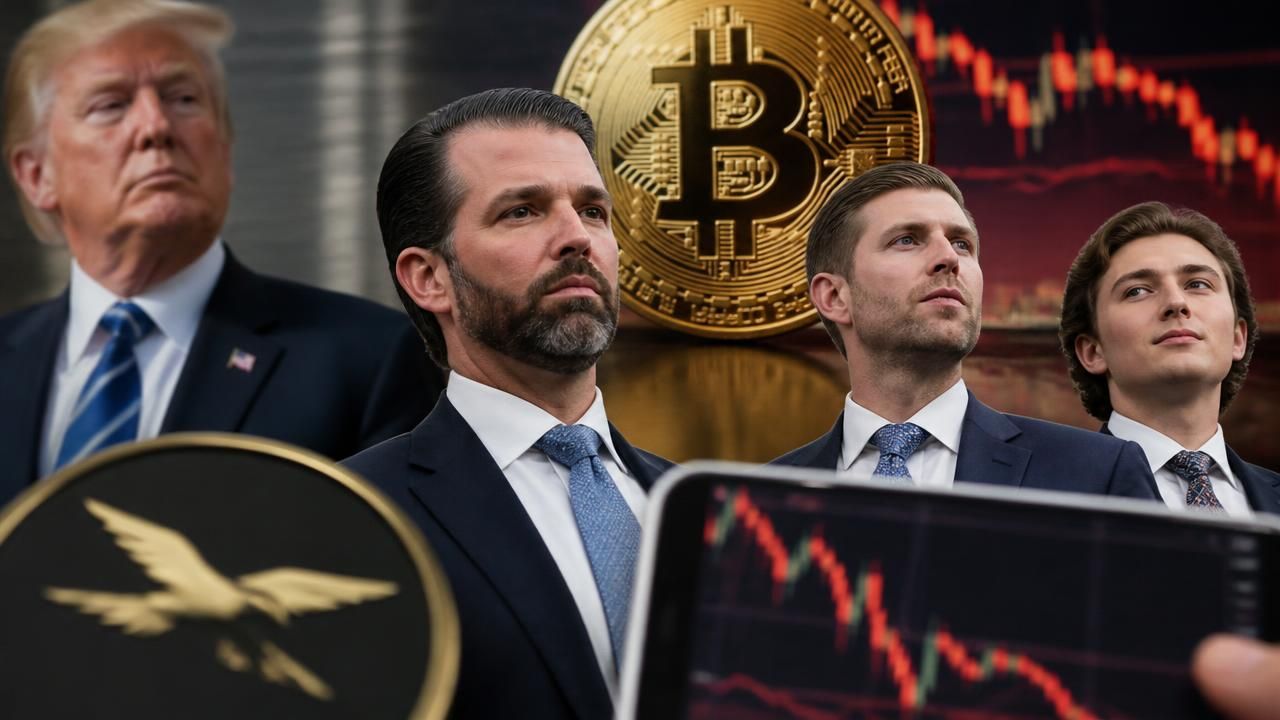
When Donald Trump Jr., Chase Herro and a slate of business partners took the stage at Manhattan's Jazz at Lincoln Center to unveil World Liberty Financial, they promised an expansive new architecture for decentralized finance backed by the Trump name. A year later, the venture has delivered one of the most striking financial asymmetries in modern American politics: enormous gains for the president's family, and steep losses for the retail investors who bought in.
According to financial disclosures and reporting across multiple outlets, Trump earned roughly $1.4 billion from cryptocurrency-related ventures in a single year — a figure that has reshaped both his personal balance sheet and the debate over conflicts of interest in the White House. Forbes, which tracks his net worth, has documented how crypto holdings transformed a fortune long anchored in real estate and branding. Meanwhile, The New York Times reported that nearly a million investors lost a combined $3.8 billion on the flagship Trump-linked crypto coin, and a Yahoo Finance summary of industry research put investors in Trump crypto ventures as a group about $4.7 billion underwater.
A Windfall for the Family
World Liberty Financial sits at the center of the story. The venture's governance token, WLFI, and its stablecoin business generated fees and token sales that flowed substantially to entities affiliated with the Trump family and its partners. Disclosures also showed that Steve Witkoff — a longtime Trump associate turned Middle East envoy — earned nearly $107 million from the Trump-affiliated crypto venture.
Zach Witkoff, Steve's son and the CEO of World Liberty Financial, has pushed back sharply on the cronyism charge. In his telling, the commercial success of the firm's stablecoin is itself the rebuttal: the product found genuine demand independent of political favor, and critics who frame the company as a pay-for-access scheme misunderstand how the business is run. The argument has not quieted skeptics in Congress or in the financial press.
The Investors Left Holding the Bag
The gap between family gains and retail losses has produced the most human coverage of the saga. Forbes profiled coin buyers who described ruinous outcomes, quoting one investor who said flatly: "I'm now broke." The pattern — concentrated insider allocations, promotional energy from political figures, and token prices that tumbled after launch — mirrors earlier cycles of speculative crypto mania, but with an unusual twist: the promoter's name is on the presidency.
Trump told reporters he was unaware of the magnitude of the windfall generated by his family's crypto ventures, saying he did not know about the earnings.
The statement drew immediate scrutiny. Financial disclosure forms filed as part of the federal ethics process list the holdings in detail, and The Hill's breakdown of the filing underscored how central digital assets have become to the president's wealth. Critics argue that a president cannot credibly claim ignorance of assets that formed part of his own disclosure obligations.
Banking Charter, Chinese AI, and a Legislative Traffic Jam
Two developments have widened the story beyond token prices. First, World Liberty Financial received approval to operate as a bank — a move that would place a Trump-affiliated entity inside the regulated banking perimeter, raising questions about supervision, deposit insurance, and the arm's-length relationship between regulators and a sitting president's business interests.
Second, the firm has backed a venture offering artificial intelligence services sourced from Chinese companies subject to U.S. restrictions — a striking position for a business tied to an administration that has made technological competition with Beijing a central organizing principle. The Arkansas Democrat-Gazette and other outlets reported the arrangement as a notable contradiction, given ongoing export controls on advanced chips and AI technology.
The political fallout has been absorbed unevenly. A quiet Republican divide has opened over whether the multibillion-dollar family empire constitutes a genuine conflict-of-interest crisis or simply the price of doing business with a president who never pretended to wall off his commercial life. Few GOP lawmakers have called for divestment; fewer still have defended the arrangement enthusiastically.
On Capitol Hill, the crypto bonanza has become the biggest hurdle for pending digital asset legislation. Market-structure and stablecoin bills that once looked like bipartisan consensus items now carry a Trump-shaped asterisk, with Democrats demanding ethics provisions and some Republicans wary of legislating while the president's own holdings are under scrutiny.
The Justin Sun Question
The Guardian focused on another dimension: the role of Justin Sun, the Tron founder and high-profile crypto investor who purchased large quantities of the Trump-linked token. Sun's entanglement with the venture — and the timing of his purchases relative to regulatory matters he has faced — has prompted questions about whether token sales functioned as a channel for influence. No court has established impropriety, and Sun has denied any quid pro quo.
The broader critique was captured by The Guardian's characterization of an administration it called the "most openly corrupt" presidency, an assessment echoed in progressive outlets and contested by the White House.
What It Means
Bloomberg's reporting noted a central irony: for all the promotional pageantry at Jazz at Lincoln Center, several of the venture's grander plans fell short of the pitch. The money, however, was real. So were the losses for ordinary buyers.
The episode now serves as a case study in three converging trends — the financialization of political celebrity, the retail crypto boom's recurring capacity for transferring wealth upward, and the erosion of informal norms separating a president's private interests from public policy. Whether it produces legislation, regulation, or simply another cycle of speculative enthusiasm may depend less on markets than on whether voters and lawmakers decide the arrangement requires a response at all.