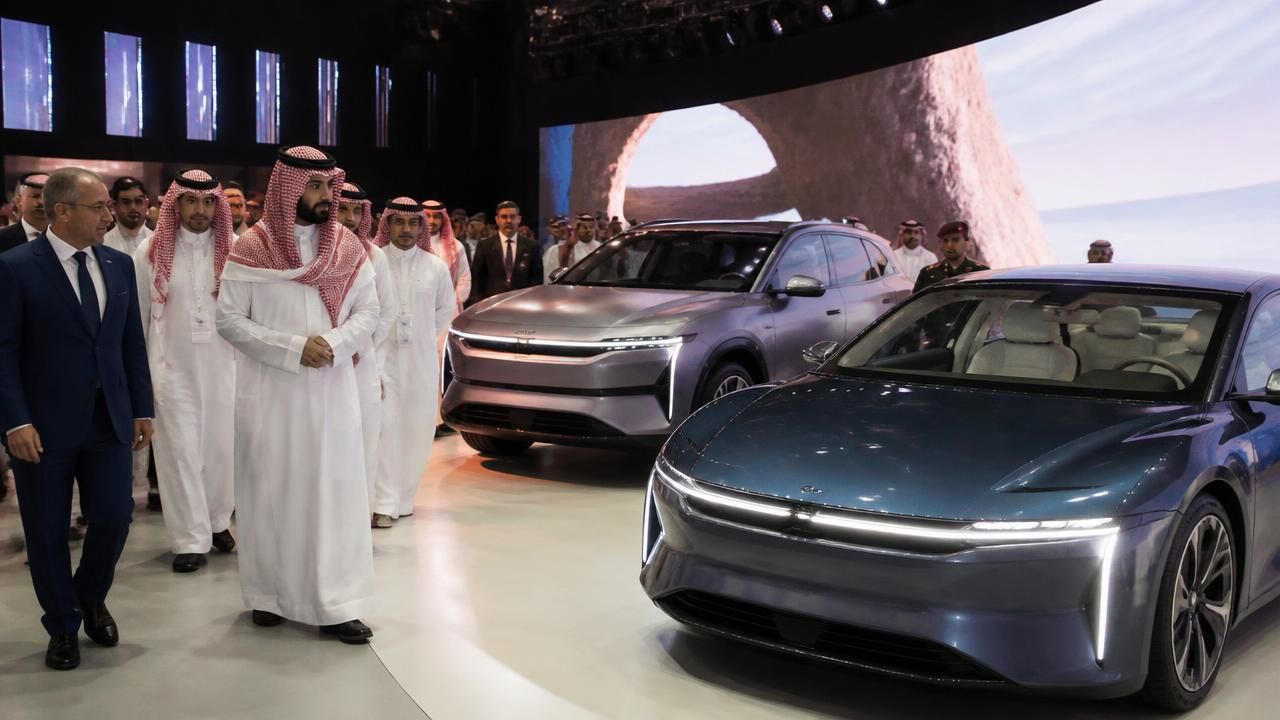
For a country that has spent nearly a century exporting the fuel that powers the world's cars, Saudi Arabia has never actually built one of its own — until now. Ceer, the Kingdom's first domestic automaker, has unveiled its flagship vehicles, the Exobot sedan and Exobot SUV, at its home base in King Abdullah Economic City on the Red Sea coast.
The reveal, staged under the patronage of His Royal Highness the Crown Prince, marks the most concrete step yet in Saudi Arabia's long-running effort to convert oil wealth into industrial capability. Ceer is a joint venture between the country's Public Investment Fund (PIF) and Foxconn, the Taiwanese manufacturing giant best known for assembling Apple's iPhones.
A National Project, Framed Two Ways
The story has landed very differently depending on where it is being read. State-aligned and regional outlets, including announcements carried by Yahoo Finance and MSN, framed the launch in explicitly national terms: "HRH the Crown Prince Launches CEER's Flagship Vehicles Further Strengthening Saudi Arabia's Position in the Global Automotive Industry." In that telling, the Exobot is a symbol of sovereignty, industrial policy and prestige.
Western tech and automotive press took a different angle. Ars Technica, which visited the factory on a trip funded by Ceer (the outlet notes it does not accept paid editorial content), situates the company squarely within Vision 2030, the Crown Prince's sweeping plan to diversify the economy away from hydrocarbons by the end of the decade. Others, like aggregator inkl, led with the design itself, calling the vehicles "These Absolutely Wild-Looking EVs."
"It may come as a surprise to some, but Saudi Arabia has never had a domestic automaker. That changes with Ceer."
That divide in framing is instructive. For Riyadh, Ceer is evidence that the Kingdom can manufacture sophisticated goods, not merely finance them. For outside observers, it is an open question whether a brand-new automaker with no heritage, no dealer network and no export footprint can compete in a global EV market already defined by Tesla, BYD and a crowded field of Chinese challengers.
What Ceer Is Actually Building
The name Ceer is Arabic for "to drive forward," and the company has attached that forward-looking branding to an ambitious product plan.
- Exobot sedan and Exobot SUV: the flagship demonstrators unveiled this week, showing what the company says it is capable of.
- Seven models by 2030: Ceer intends to grow its portfolio to seven vehicles by the end of the decade.
- A hybrid component: not every model will be purely electric — some will be hybrids, a pragmatic nod to charging infrastructure that remains uneven across the region.
- Five additional models still to come: subtracting the two Exobot flagships leaves five more nameplates to be revealed, according to ETAuto.
The company has been careful not to overpromise on geography. Sales are currently envisioned for the Gulf Cooperation Council region — Saudi Arabia, the UAE, Qatar, Kuwait, Bahrain and Oman — rather than Europe, North America or Asia. Ceer says it is building a competitive, world-class product, and that if demand exists, expansion beyond the GCC is possible.
Why Detroit and Foxconn Matter Here
The Foxconn partnership is the piece that makes the plan more than a brochure. Building cars at scale requires supply chains, battery sourcing, software integration and factory discipline — capabilities Foxconn has been assembling through its broader contract-manufacturing push into electric vehicles. Saudi capital supplies the balance sheet; Foxconn supplies process.
The location is equally deliberate. King Abdullah Economic City was conceived as a purpose-built industrial and logistics zone, and placing an automotive plant there gives Ceer access to a port, a special economic framework and a workforce the Kingdom hopes to train rather than import. Ars Technica's factory visit — arranged with travel and accommodation covered by the company — reflects how aggressively Ceer is courting international automotive media, a familiar playbook for new brands seeking legitimacy.
The Stakes Behind Vision 2030
Saudi Arabia's economic logic is straightforward. Global demand for electric vehicles is rising, oil's long-term outlook is uncertain, and a young population needs private-sector jobs. Automotive manufacturing is one of the highest-multiplier industries in existence: a single assembly plant can spawn hundreds of suppliers, logistics firms and engineering roles.
Yet the obstacles are substantial. Saudi Arabia has no established tier-one supplier base, limited domestic EV charging infrastructure, and a consumer market that — while wealthy — is far smaller than China, Europe or North America. Ceer will also compete against established Gulf importers who already sell well-known electric models.
Still, the symbolism carries weight. A region historically defined by what it pumps out of the ground is now trying to define itself by what it rolls off an assembly line. Whether the Exobot becomes a genuine export or a domestically admired showcase, its debut answers one question definitively: Saudi Arabia now has a car company of its own.