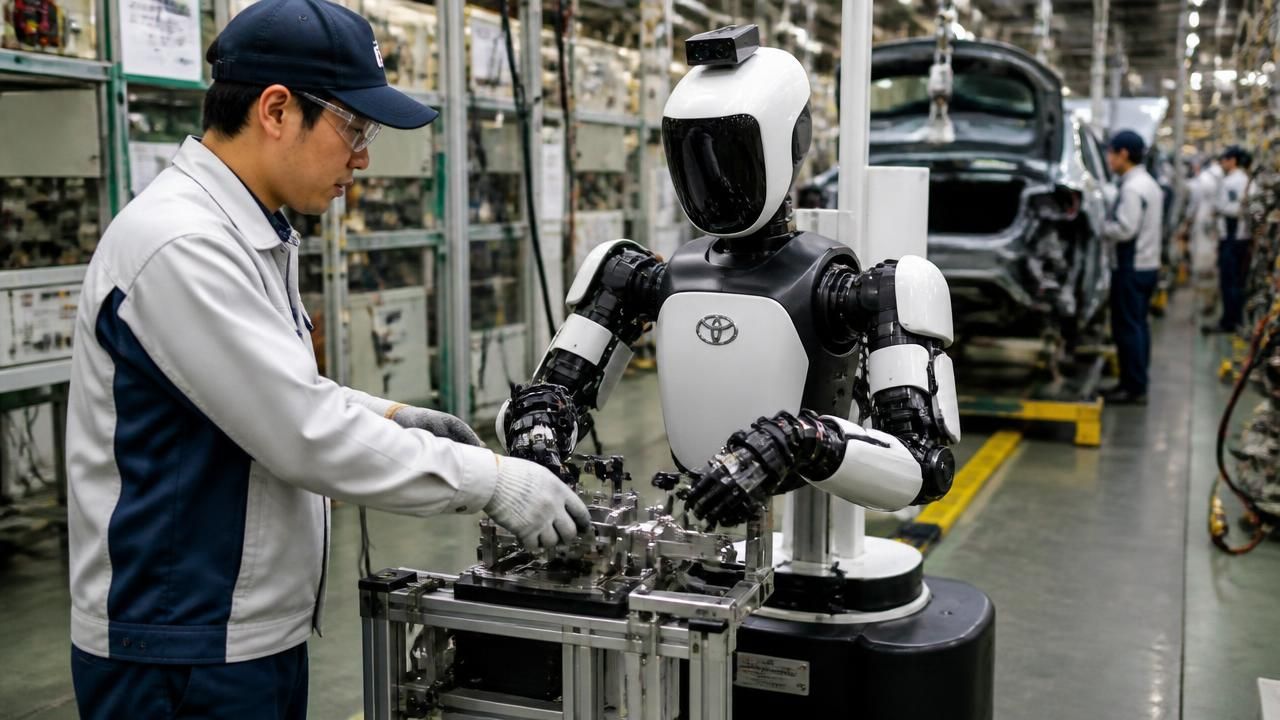
Toyota has begun putting humanoid robots to work on its assembly lines — and it is asking its own employees to teach them the job. The Japanese automaker has already deployed some of its ELEY humanoid robots in its plants, where workers are training the wheeled machines to perform tasks that require precise hand movements, according to a report by Nikkei Asia. The effort is an early step in a far larger plan: eventually placing 400,000 robots across the Toyota Motor group’s global manufacturing network.
The scale of the ambition is striking even by the standards of an industry that has spent half a century automating assembly work. Beginning in 2028, Toyota aims to invest about $6.42 billion every year in factory upgrades organized around the new robotic workforce. Of the 400,000 machines envisioned, roughly 150,000 would go into Toyota’s own automotive plants, while another 250,000 would be deployed at group companies that produce components and materials.
A blueprint measured in hundreds of thousands
The company has not published a detailed timetable beyond the 2028 start date, but the split between vehicle assembly and component manufacturing is revealing. Much of the hardest work in automotive manufacturing happens away from the final assembly line — in stamping, casting, machining and parts fabrication, where repetitive, physically punishing tasks have long been automated with fixed machinery. Humanoid and mobile robots would extend that automation into spaces that conventional industrial arms cannot reach.
- 400,000 robots targeted across the Toyota Motor group
- 150,000 planned for Toyota’s own automotive plants
- 250,000 planned for group companies making components and materials
- $6.42 billion in annual investment from 2028
Workers as teachers, not bystanders
The most unusual detail in the reporting is the role of Toyota’s existing workforce. Rather than being pushed aside during the transition, employees are being used as instructors. Workers wear “jigs” built around the shape of the humanoids’ fingers, physically demonstrating motions that require dexterity so the machines can learn them.
It is a hands-on approach to a problem that has frustrated robotics researchers for decades: machines are good at repeating a fixed motion, but struggle with the small adjustments — gripping a flexible part, threading a connector, feeling for resistance — that human hands handle effortlessly. Toyota’s answer is to let people show the robots rather than program them.
The robots themselves are not anthropomorphic from the ground up. They roll on wheels rather than walking, a design choice that trades mobility flexibility for stability and simplicity — and a reminder that the humanoid label covers a broad spectrum of machines.
Toyota workers are already helping to train humanoid robots as part of the automaker’s race to eventually deploy 400,000 factory robots.
The reassurance message
A Toyota executive said the robotic push is not meant to directly replace humans — a message that shaped how much of the coverage was framed. Business outlets led with the tension between the two ideas, with headlines such as “Toyota Wants 400K Robots In Its Factories — Says Human Jobs Are Safe” and “Toyota is installing 400,000 robots, but humans still matter.” The framing placed the human reassurance in the headline itself, acknowledging that readers would read the number first and the caveat second.
Technology-focused coverage, by contrast, emphasized the mechanical and machine-learning mechanics of the deployment — the jigs, the wheeled bases, the training process — treating the labor question as context rather than the lead. The difference in emphasis is an early sign of the debate that is likely to follow as the 2028 timeline approaches.
Why the timeline matters
Toyota’s decision to commit to a hard start date and a multi-billion-dollar annual budget separates it from the parade of robotics demonstrations that never reach a factory floor. Japan’s manufacturing base has been under pressure for years from a shrinking workforce, and automation has been presented by industry leaders as a way to maintain output rather than simply cut headcount. Toyota’s framing fits that pattern: robots take over the tasks that are hardest to staff, while human workers shift toward supervision, maintenance and training.
That argument faces obvious skepticism. Training a machine to do a job is, by definition, creating the capability to do that job without the person who taught it. Even where companies intend to redeploy workers, the skills involved change, and the number of people required per unit of output tends to fall.
What to watch
The next signals will come from how quickly Toyota moves beyond demonstrations. Watch for disclosures about which plants receive the first ELEY units at scale, whether the group companies adopt the same systems at the same pace, and how Toyota describes the net change in its workforce as the 2028 investment begins. The company’s stated position — that the robots are not meant to replace people — will be tested by the arithmetic of 150,000 machines in its own plants, and by whether the humans who trained them stay on the line or move somewhere else entirely.