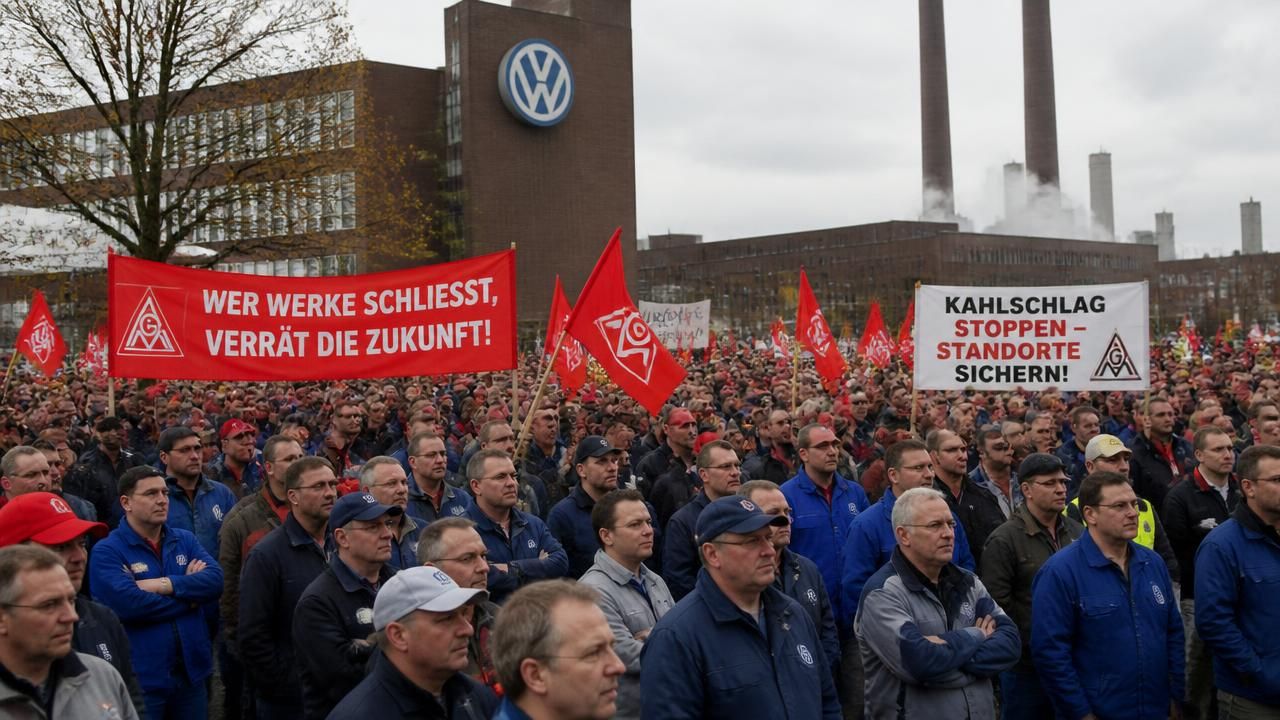
Tens of thousands of German automotive workers took to the streets in a coordinated wave of protests against plant closures, mass layoffs and what unions describe as a failure of industrial policy, as the country's flagship industry confronts its deepest structural crisis in decades. The demonstrations, reported across German and international media, place the country's most important manufacturing sector at the center of a widening political confrontation with the government of Chancellor Friedrich Merz.
A Crown Jewel Under Siege
For a quarter of a century, German carmakers functioned as the crown jewels of Europe's largest economy, punching above their weight in investment, exports and engineering prestige. That model is now under simultaneous assault. Ars Technica's analysis of the sector describes companies facing "multiple problems at once, from declining demand at home and stronger competition from abroad to the cost of punitive and arbitrary new tariffs, on top of preexisting structural challenges like an aging workforce and a slow recovery from COVID."
The demand collapse is stark. Total automotive sales in Europe have fallen from a peak of almost 18 million vehicles in 2019 to around 13 million in 2025 — a contraction of roughly five million units a year that has left the continent with substantial overcapacity. A growing share of that smaller market is being captured by Chinese entrants, who are themselves wrestling with excess domestic production capacity and are looking to Europe as an export outlet.
The Numbers Behind the Crisis
- European sales: down from ~18 million units in 2019 to ~13 million in 2025
- US import tariffs: currently set at 25%, with no guarantee of stability
- Volkswagen Group: considering the closure of four German factories
- Structural drags: aging workforce, weak post-COVID recovery, energy costs
The United States has historically been the most profitable market for German car exports — a fact that made the imposition of 25 percent import tariffs especially painful. Because that rate "could be subject to change at any time," according to Ars Technica, manufacturers cannot plan production or pricing with any confidence, compounding the uncertainty created by shifting electric-vehicle demand.
Volkswagen and the Unthinkable
The symbolic epicenter of the crisis is Volkswagen Group. Earlier this summer, news emerged that the company was weighing the closure of four of its German factories — a step that would have been unthinkable only a few years ago. Since then, the position has not improved. Factory closures, once treated as a hypothetical in boardroom discussions, now appear not just possible but likely.
The future is looking increasingly bleak for Germany's automotive industry. Since the turn of the century, car makers have been among the crown jewels of the German economy, punching above their weight in terms of investment and innovation.
How the Story Is Being Framed
The varying emphasis across outlets is instructive. General-interest aggregators such as MSN led with the human dimension — "German auto workers stage mass protests in bid to save jobs" and "Auto industry workers protest in Germany against job cuts, industrial policy" — framing the events as a labor story with a clear protagonist and antagonist. Bloomberg, by contrast, framed the same demonstrations as a governance problem: "German Car Industry Protests Highlight Challenges for Merz's Government," positioning the unrest as a political test for a chancellor still consolidating his authority. Trade and technology outlets like Ars Technica treated the protests as a symptom of a deeper industrial transition, emphasizing tariffs, overcapacity and electrification rather than the street action itself.
The protests also intersected with a broader moment of global labor mobilization. Reports from worldwide May Day demonstrations noted increased turnout alongside scattered reports of violence, underscoring that the German auto dispute is unfolding within a wider season of worker activism over wages, automation and industrial decline.
Why It Matters Beyond Germany
Germany's automotive sector is not simply an employer; it is the anchor of the country's export model and a bellwether for European manufacturing. A prolonged contraction would ripple through supplier networks, steel and chemicals producers, and the budgets of regional governments that depend on auto-plant tax revenue. Politically, it threatens to strengthen parties on both the nationalist right and the left, feeding a narrative that mainstream economic policy has failed the industrial working class.
The structural challenge is compounded by electrification. Chinese manufacturers have moved faster and cheaper on battery-electric vehicles, while German incumbents must simultaneously fund a costly transition, protect legacy combustion-engine profits and manage a workforce whose skills and age profile do not map neatly onto the new production reality.
What Comes Next
Union representatives are pressing for government intervention — subsidies, tariff diplomacy and commitments against forced redundancies — while management insists that capacity must shrink to match demand. The Merz government faces an uncomfortable squeeze: it can offer support to an industry that is vital to the economy, or it can insist that structural adjustment is unavoidable and politically costly either way.For now, the four Volkswagen plants remain open pending final decisions, and the tariff regime remains in flux. But the trajectory is clear. As one assessment of the sector put it, the industry is no longer debating whether painful change will come — only who will bear its cost.