Hundreds of flights were cancelled or delayed across the northeastern United States on Monday after construction crews in New Jersey accidentally severed a fiber-optic cable that carries critical communications for the nation's air traffic control network, prompting simultaneous ground stops at all three major New York City-area airports and cascading delays that reached Philadelphia and beyond.
The Federal Aviation Administration said the trouble surfaced first as a circuit failure inside the air traffic system. FAA Administrator Bryan Bedford later confirmed that an investigation into that failure led engineers to a severed Verizon fiber cable, according to ABC News. The agency halted departing traffic at John F. Kennedy International, LaGuardia and Newark Liberty International — a rare, region-wide shutdown of the three busiest airports in the country's densest airspace — while operations at Philadelphia International Airport were also thrown into disarray.
A single cable, a regional standstill
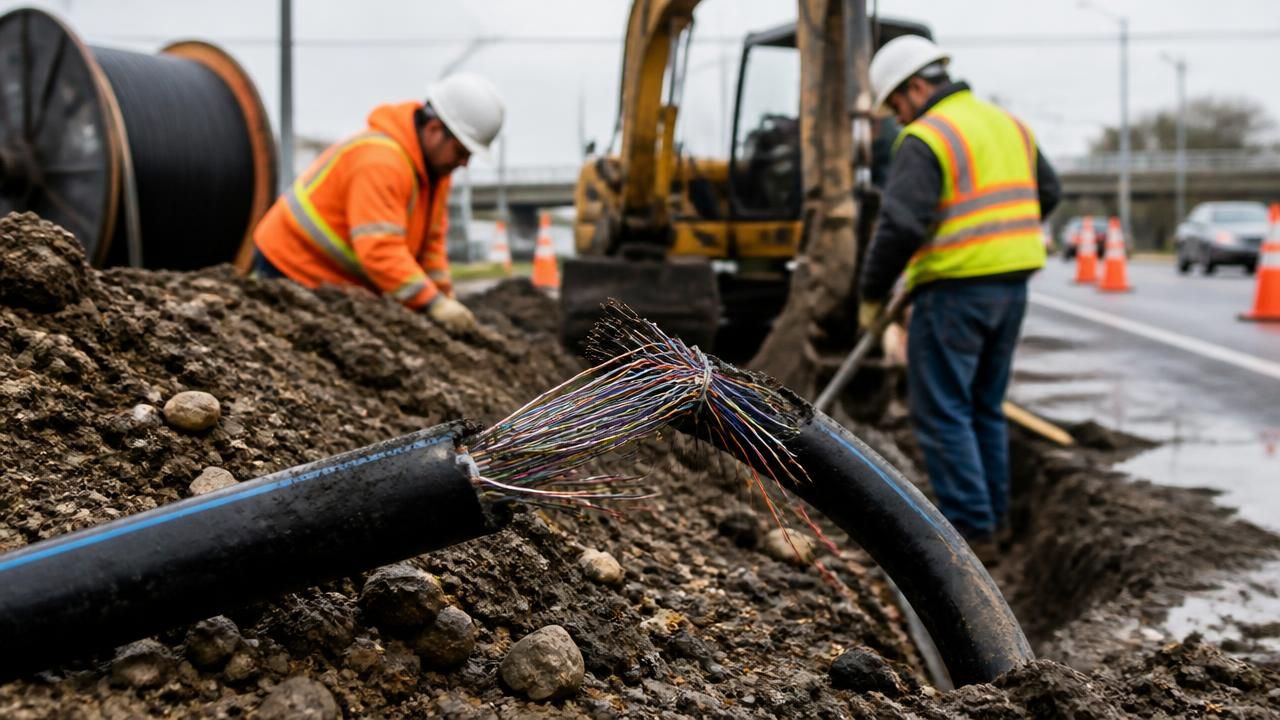
According to accounts from The Verge, CNBC and the BBC, the sequence was almost mundane until it was catastrophic: contractors digging in New Jersey struck and cut a Verizon fiber line that was carrying data relied upon by FAA air traffic control facilities in the region. The resulting outage rippled outward within minutes.
- Ground stops were issued at JFK, LaGuardia and Newark Liberty, freezing departures at the three airports.
- Philadelphia International and other Northeast airports absorbed diverted and delayed traffic.
- Hundreds of flights were cancelled or delayed, with knock-on effects expected to linger well past the initial outage.
- Rail service along the busy Northeast Corridor was also disrupted, drawing Amtrak into a dispute over who was to blame.
The episode exposed how thoroughly modern aviation depends on commercial telecommunications infrastructure that runs beneath — and often adjacent to — construction sites, rail yards and utility corridors. A backhoe in the wrong place can, in effect, become a national aviation event.
The blame game begins
Responsibility for the outage quickly became contested. In a statement to CNBC, Verizon said it bore "no responsibility for this incident," placing the fault squarely on the crews doing the digging.
"Construction contractors working in the area ... dug up and cut our cable." — Verizon
The finger-pointing did not stop with the telecom giant. Amtrak, whose Northeast Corridor service was also affected, publicly attributed its own disruptions to NJ Transit, the commuter railroad whose territory and contractors were involved in the work. The competing statements illustrated a familiar dynamic in infrastructure failures: the physical cause may be a single cut, but the accountability is distributed across a web of contractors, utilities, transit agencies and federal regulators.
Different outlets framed the story differently. Technology and business outlets such as The Verge and CNBC focused on the fragility of the underlying telecom infrastructure and Verizon's defensive posture; national and international broadcasters, including the BBC, emphasized the traveler-facing chaos at major hubs; and regional coverage highlighted the rail-versus-rail dispute between Amtrak and NJ Transit. Together, they painted a picture of an incident that was at once a construction accident, a telecom failure and an aviation crisis.
An aging system under strain
The disruption lands amid long-running concern about the resilience of U.S. air traffic control infrastructure. The FAA's systems are decades old in places, and the agency has repeatedly been urged by watchdogs and lawmakers to modernize and build redundancy into networks that were designed in a pre-digital era.
The comparison most often invoked is January 2023, when a failure in the FAA's Notice to Air Missions (NOTAM) system prompted the first nationwide ground stop since the September 11 attacks, delaying thousands of flights. That episode, like this one, raised the same uncomfortable question: how can a single point of failure — software then, fiber now — bring the world's largest aviation market to a halt?
Industry analysts note that air traffic facilities rely heavily on commercially leased fiber rather than purpose-built, fully redundant government networks. Where redundancy exists, it is not always diverse in its physical routing, meaning a single construction crew can sever both primary and backup paths if they run through the same trench.
What happens next
For travelers, the practical consequences were immediate: rebooked itineraries, overnight hotel stays and a backlog that can take days to clear in the tightly coupled Northeast airspace, where delays at one hub rapidly metastasize into system-wide schedule disruption.
For policymakers, the incident adds pressure to accelerate FAA modernization efforts funded under recent reauthorization legislation, and to tighten coordination requirements between utilities, transit agencies and contractors before excavation begins near critical communications lines.
For Verizon and the contractors involved, the question is legal and financial: who pays for hundreds of cancelled flights, thousands of stranded passengers and the operational damage to two of the country's largest transportation networks? The answer is likely to be argued in claims letters and, potentially, in court.
What is already clear is the lesson the day delivered. In an aviation system built on invisible threads of glass and data, the most powerful actor on Monday was not a jet engine or a control tower — it was a backhoe, and a cable no one thought to protect.