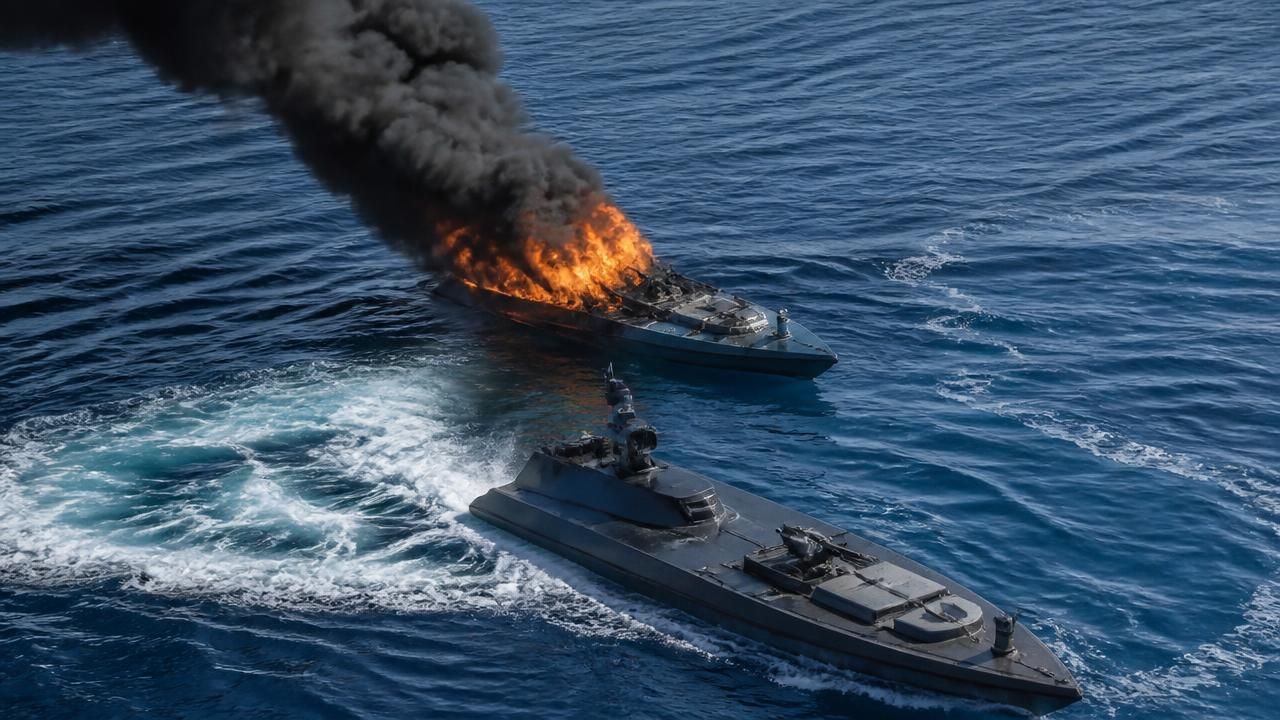
On September 12, a Ukrainian naval drone destroyed a Russian explosive drone boat in the Black Sea, scoring what defense analysts are calling the world's first uncrewed surface vessel (USV) versus USV kill. The lopsided engagement, reported by Ars Technica and naval analyst HI Sutton in Naval News, marks a military milestone: for the first time, one robotic boat has sunk another in combat.
According to Ars Technica, members of Ukraine's Defense Intelligence detected the Russian USV and directed a Ukrainian Navy drone boat to intercept. The Russian vessel was “positively identified” as an Orcan surface drone, equipped with a “jet ski type steerable water jet” and designed to ram targets and explode. The Ukrainian drone, identified in some reports as an armed Sargan-3000, used a remote-controlled machine gun turret to engage and destroy the Russian craft. Eurasian Times framed the event as “Ukraine Claims First USV-vs-USV Kill in Black Sea as Armed Sargan-3000 Reportedly Sinks Russian Sea Drone.”
Headlines varied across outlets, reflecting the fog of war and the high speed of modern conflict reporting. MSN, for example, ran a headline saying “Ukrainian sea drone sinks Russia's Izumrud warship,” a framing that appears to misidentify or conflate the target. Detailed naval analysis, by contrast, identifies the Russian vessel as an Orcan drone boat, not a crewed warship. The discrepancy underscores how aggregator headlines can distort tactical details even as the core story — Ukraine's growing mastery of naval drone warfare — remains consistent.
A New Phase in Drone Warfare
The Black Sea has been a proving ground for uncrewed systems since Russia's full-scale invasion in 2022. Ukraine has deployed waves of aerial attack drones, ground robots, and especially naval drones to offset Russia's larger fleet. Ukrainian USVs — including the Magura V5 and Sea Baby — have damaged or destroyed several Russian ships, including the Caesar Kunikov, Sergei Kotov, and Ivanovets. These attacks helped push Russia's Black Sea Fleet out of Sevastopol and reopened grain export corridors.
Russia has responded with its own USVs, including the Orcan. According to Sutton, Orcan drones have already been used to attack Ukrainian ports and ships. They often operate alongside flying Geran drones, which provide aerial reconnaissance and can boost communications between remote operators and the drone boats. The September 12 clash was therefore not a random encounter but the culmination of an escalating robot-vs-robot competition.
“The Russian vessel was ‘positively identified’ as an Orcan surface drone with a ‘jet ski type steerable water jet’ designed to ram targets and explode,” Sutton wrote in Naval News. Such Orcan drones, he added, “often work in coordination with flying drones such as Russian Geran drones that provide aerial reconnaissance and can boost communication between drone operators and drone boats.”
How the Engagement Unfolded
The battle began when Ukrainian Defense Intelligence detected the Russian USV in the Black Sea. Operators directed a Ukrainian Navy drone boat to intercept. The Ukrainian craft, reportedly a Sargan-3000, was armed with a remote-controlled machine gun turret — a relatively simple but effective weapon against a small, fast-moving explosive boat. The Russian Orcan, by contrast, was a kamikaze platform designed to ram and detonate. In the end, the Ukrainian drone's gunfire neutralized the threat before it could strike.
The engagement was “lopsided,” as Ars Technica put it, but its significance is outsized. It demonstrates that armed USVs can perform force protection and counter-drone missions, not just strike static targets or crewed ships. It also shows that Ukraine can detect, track, and destroy Russian drone boats in contested waters — a capability that could protect Ukrainian ports and shipping lanes.
The AI and Autonomy Angle
The USV-vs-USV kill comes amid a broader revolution in autonomous warfare. Ars Technica separately reported that a US company's AI now lets Ukraine's cheap kamikaze drones track targets on their own. Although the full article was unavailable, the headline alone signals a key trend: artificial intelligence is enabling terminal guidance and target tracking without a human operator constantly in the loop. The same logic is likely to migrate to naval drones. The Sargan-3000's remote-controlled machine gun still requires a human trigger, but future USVs may use AI to identify, track, and engage enemy drones autonomously.
That prospect raises difficult questions. Autonomous weapons could make drone-vs-drone combat faster and cheaper, but they also lower the threshold for escalation and raise concerns about accountability and proliferation. For now, the September 12 clash remains a human-directed operation. Yet the trajectory is clear: machines are fighting machines, with humans increasingly overseeing rather than piloting.
What It Means
- For Ukraine: The kill validates its investment in armed USVs and demonstrates an ability to counter Russian drone boats that threaten ports and civilian shipping.
- For Russia: The loss of an Orcan highlights vulnerabilities in its own USV program and may force it to adapt tactics, add defensive weapons, or rely more on aerial cover.
- For global militaries: The first USV-vs-USV kill is a watershed moment, akin to the first tank-vs-tank or aircraft-vs-aircraft engagement. Navies worldwide will study it as they develop their own uncrewed fleets.
- For arms control: The rapid spread of autonomous and remote-controlled weapons in the Black Sea underscores the lack of international rules governing machine-on-machine combat.
The September 12 engagement was small in scale — one drone boat destroying another — but large in implication. It confirms that the Black Sea is no longer just an arena for crewed navies. It is a laboratory for the future of war, where cheap, autonomous, and remotely operated systems can challenge conventional power. As AI improves and production scales, the next clash of drone boats may be decided not by a remote operator's joystick, but by an algorithm. The world's first USV-vs-USV kill is unlikely to be the last.