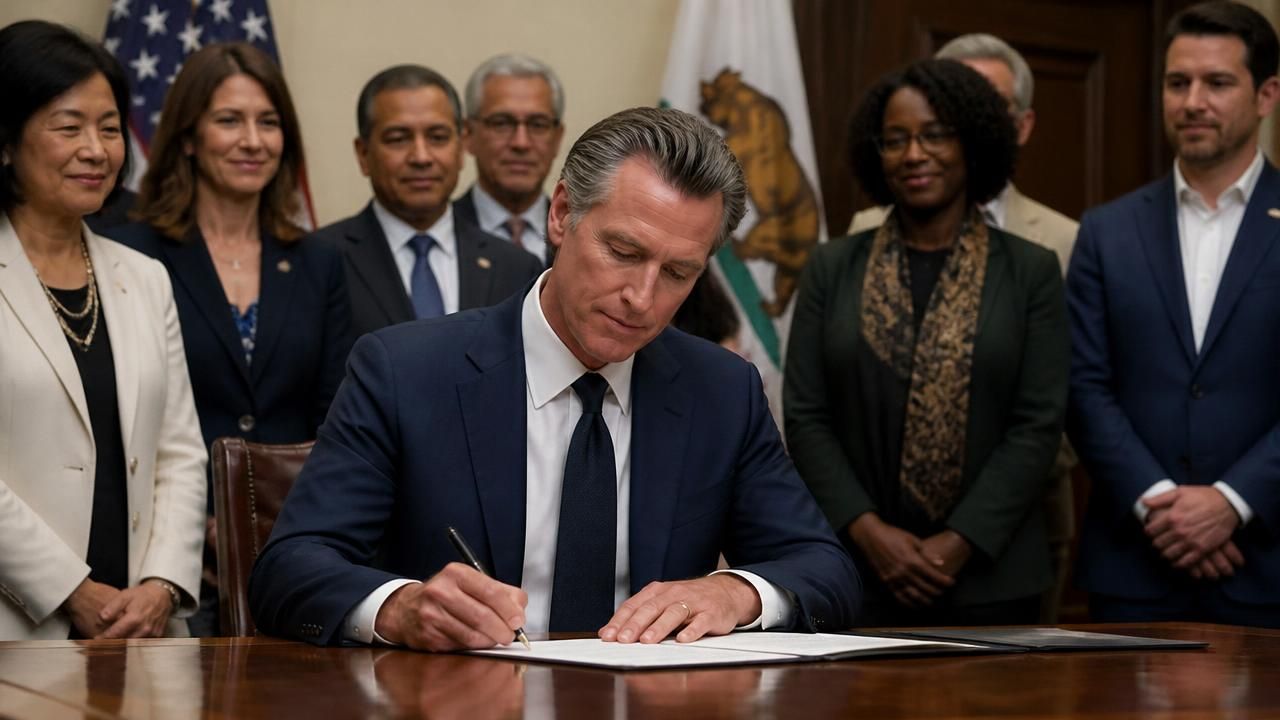
California Gov. Gavin Newsom has signed a package of seven bills aimed at preventing the state's fast-expanding AI data center industry from shifting the cost of its electricity and water consumption onto ordinary utility ratepayers, according to reporting by the Los Angeles Times and The Verge. The laws collectively represent the most aggressive state-level attempt in the country to make hyperscale computing facilities financially accountable for the strain they place on local power grids and water systems.
The signing caps a high-stakes negotiation in Sacramento that pitted the world's largest technology companies against consumer advocates, environmental groups, and local governments worried about rising utility bills and strained water supplies. Coverage of the deal framed it as a rare moment of consensus in a legislature that has often struggled to keep pace with the AI boom.
A New Rate Class for the AI Era
The centerpiece of the package requires the California Public Utilities Commission to establish a dedicated rate classification for data centers, separating them from the residential and commercial customers whose rates are currently affected by the enormous loads these facilities add to the grid. As The Verge reported:
The package of laws requires the California Public Utilities Commission to introduce a new rate classification for data centers while forcing them to pay for upgrades to local power grids and water systems.
In practical terms, that means data center operators will be expected to shoulder the cost of substation upgrades, transmission improvements, and other infrastructure that utilities have historically socialized across their entire customer base. Consumer groups have argued for years that residential customers were effectively subsidizing the buildout of infrastructure serving a handful of trillion-dollar technology companies.
Water Disclosure Becomes Mandatory
Additional bills in the package target the other critical resource consumed by AI infrastructure: water. Proposed data centers will be required to disclose their estimated water use to local governments before approval, along with detailed information about energy efficiency and drought planning. The facilities must also meet specified thresholds for energy, water, and fuel consumption.
The disclosure requirements matter because data centers rely heavily on evaporative cooling, a process that can consume millions of gallons of water annually at large sites. In a state that has cycled through repeated severe droughts, those numbers have become politically potent, particularly in inland communities where water availability is already contested among agriculture, residents, and industry.
Newsom Turns Fire on Washington
In remarks accompanying the signings, Newsom pointedly criticized the Trump administration for what he characterized as federal inaction on the resource demands of the AI buildout, a theme that Yahoo News highlighted in its coverage of the event. The governor's framing positions California as the regulatory laboratory for artificial intelligence's physical footprint while Washington remains focused on accelerating the technology's development.
That contrast is likely to intensify. Federal policy has largely prioritized permitting speed and energy abundance for AI infrastructure, while states — California, Virginia, Texas, Oregon, and others — are left to manage the local consequences of land use, water draw, and rate impacts.
What the Industry Says
Technology trade groups have generally not opposed transparency outright, but they have warned that a patchwork of state-level rate structures could slow construction and push projects to jurisdictions with lighter oversight. Operators also contend that modern designs, including closed-loop liquid cooling and on-site generation, have sharply reduced water intensity compared with older facilities.
California remains one of the largest data center markets in the country, trailing only Virginia by most industry estimates, and demand is expected to keep climbing as generative AI training and inference workloads multiply.
How Outlets Framed the Story
- The Verge emphasized the consumer-protection angle, leading with the new rate classification and the prohibition on passing utility costs to residents.
- Unite.AI framed the package as a direct regulatory strike on data center power and water consumption, emphasizing the number of laws enacted.
- Yahoo News foregrounded the political dimension, pairing the signing with Newsom's criticism of the Trump administration and the earlier legislative deal-making that produced the bills.
- Local coverage, including the Los Angeles Times, focused on the mechanics of implementation and what the CPUC must now do to translate the statutes into enforceable tariffs.
What Happens Next
The real test will come at the California Public Utilities Commission, which must now design the new rate class, define which facilities qualify, and determine how upgrade costs are allocated. That rulemaking process is expected to draw intense lobbying from both utilities and technology companies. Legal challenges are also possible, particularly over how aggressively the state can differentiate among customer classes.
For now, California has sent a clear signal: the AI boom will not be subsidized by household electricity bills or unaccounted-for water. Whether other states follow — or whether the industry routes new capacity elsewhere — will define the next phase of the artificial intelligence infrastructure race.