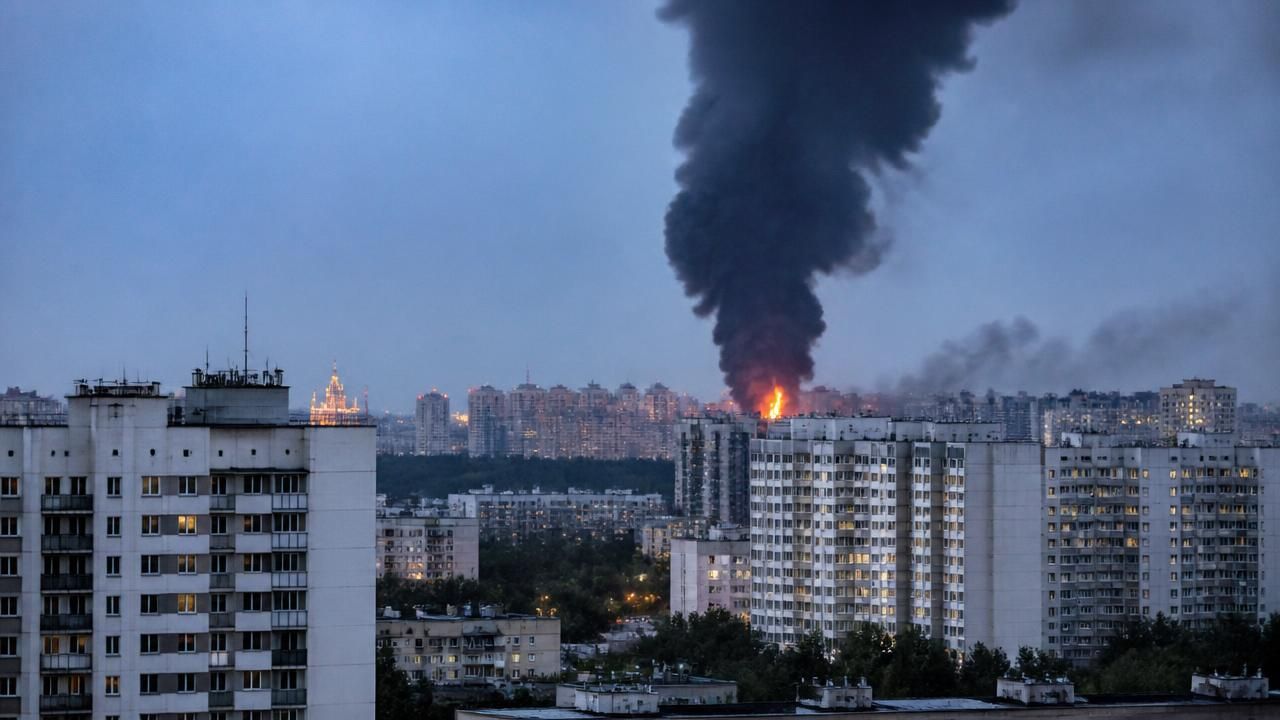
Ukraine launched one of the largest aerial attacks of the war overnight, firing more than 1,000 drones at targets across Russia — including hundreds aimed at Moscow in what the capital's mayor called the "largest ever" assault on the city.
The wave of strikes killed at least six people inside Russia, according to the Associated Press, and caused damage to a Moscow oil refinery and at least one residential building. Russia's defense ministry said it intercepted a large share of the incoming drones, though officials in Moscow acknowledged that debris and direct hits had reached populated areas and industrial sites.
The scale of the attack — and its timing — immediately reshaped how the story was told. U.S. outlets such as NPR and the Associated Press led with the sheer volume of drones and the human toll. International outlets, including Yahoo News, MSN and Sky News, framed it as a dramatic backdrop to Russia's parliamentary election, which was entering its final day of voting as the drones flew.
An unprecedented wave over the Russian capital
Moscow's mayor, Sergey Sobyanin, described the barrage as the "largest ever" attack on the Russian capital, a characterization that underscores how deeply drone warfare has penetrated the country's largest city after more than three years of full-scale war.
Moscow's mayor described the wave of drones as the "largest ever" attack on the Russian capital and said there had been damage to a Moscow oil refinery and a residential building.
An oil refinery in the Moscow region is a strategically significant target: Russia's refining network has been struck repeatedly over the past two years by long-range Ukrainian drones, denting fuel output and forcing Moscow to import refined products at times. A strike that reaches the capital's own industrial ring is a symbolic as well as an economic blow, signaling that Ukraine can now mass-produce and coordinate drones at a scale that overwhelms layered air defenses.
Eyewitness footage circulating on social media showed air-defense tracers over the city skyline, while airports in the region reportedly restricted traffic — a familiar pattern in a war where drone swarms have become a routine test of civilian infrastructure and public nerves.
Strikes coincide with Russia's election
The attack unfolded as Russians voted in parliamentary elections, a contest that opposition figures and Western governments have long dismissed as neither free nor fair. Russia's ruling party was on track to win, according to early results reported by international media, extending the Kremlin's grip on the legislature.
The collision of the drone barrage with the election created a politically charged moment in Moscow. The Kremlin has generally sought to insulate ordinary Russians from the war's costs, and a mass drone attack on the capital during a national vote undercuts that narrative. At the same time, analysts noted that Russian state media could use the attack to justify tighter security measures and to reinforce official messaging about external threats.
Russia retaliates against Zaporizhzhia
Moscow did not wait long to respond. Russian forces targeted Zaporizhzhia after the weekend barrage, according to MSN, striking the southeastern Ukrainian city that has endured repeated missile and drone attacks throughout the conflict. Zaporizhzhia, near the front line and home to Europe's largest nuclear power plant, has become one of the most frequently hit urban centers in Ukraine.
The tit-for-tat exchange reflects the war's shifting rhythm: Ukraine's deep-strike drone campaign against Russian territory is now matched, in near-real time, by Russian attacks on Ukrainian cities — a cycle in which each side's escalation becomes the other's justification.
The other side of the drone war
While Ukraine's long-range strikes dominate headlines, the battle in the skies above Ukraine itself has grown more dangerous. Russia's jet-powered drones have overwhelmed Ukrainian air defenses in recent weeks, killing dozens of people, according to reporting carried by MSN. These faster, harder-to-intercept variants — evolved from the Iranian-designed Shahed family — compress the reaction time available to Ukrainian gunners and mobile fire teams.
The asymmetry matters. Ukraine's attacks on Moscow are spectacular and symbolically potent, but they are built on relatively cheap airframes and saturation tactics. Russia's jet-powered drones threaten Ukrainian cities directly, and Ukraine's shortage of advanced interceptors leaves civilians exposed. Both sides are now engaged in a war of industrial attrition measured in production lines, not battles.
Europe's widening alarm
The strikes came amid growing anxiety in Western Europe about the war's spillover. In a Sky News live blog, French President Emmanuel Macron said Russia had targeted France with hybrid attacks and warned of a changing threat picture across the continent. European capitals have accused Moscow of sabotage, disinformation and election interference in recent months.
Separately, the same live coverage noted that 130,000 new conscripts had signed up for Russia's military and that 75 Russian diplomats had been expelled from Western Europe — two data points that illustrate how the conflict is simultaneously fought on the battlefield, in recruiting offices and in the diplomatic arena.
What happens next
Several dynamics will determine whether this weekend becomes an inflection point:
- Drone production: Ukraine's ability to repeat a 1,000-plus drone barrage depends on sustained manufacturing and Western component supplies.
- Russian air defense: Moscow will likely redeploy additional systems around the capital, potentially thinning coverage elsewhere.
- Political fallout: A mass attack during an election strengthens hardliners' arguments for mobilization and repression at home.
- Allied support: Continued U.S. and European air-defense deliveries will determine how well Ukrainian cities withstand Russia's jet-powered drones.
For now, the message from the weekend is unmistakable: the war has moved decisively into an era of mass drone warfare, where the front line is no longer a line at all — and where the skies over both Moscow and Zaporizhzhia are contested territory.