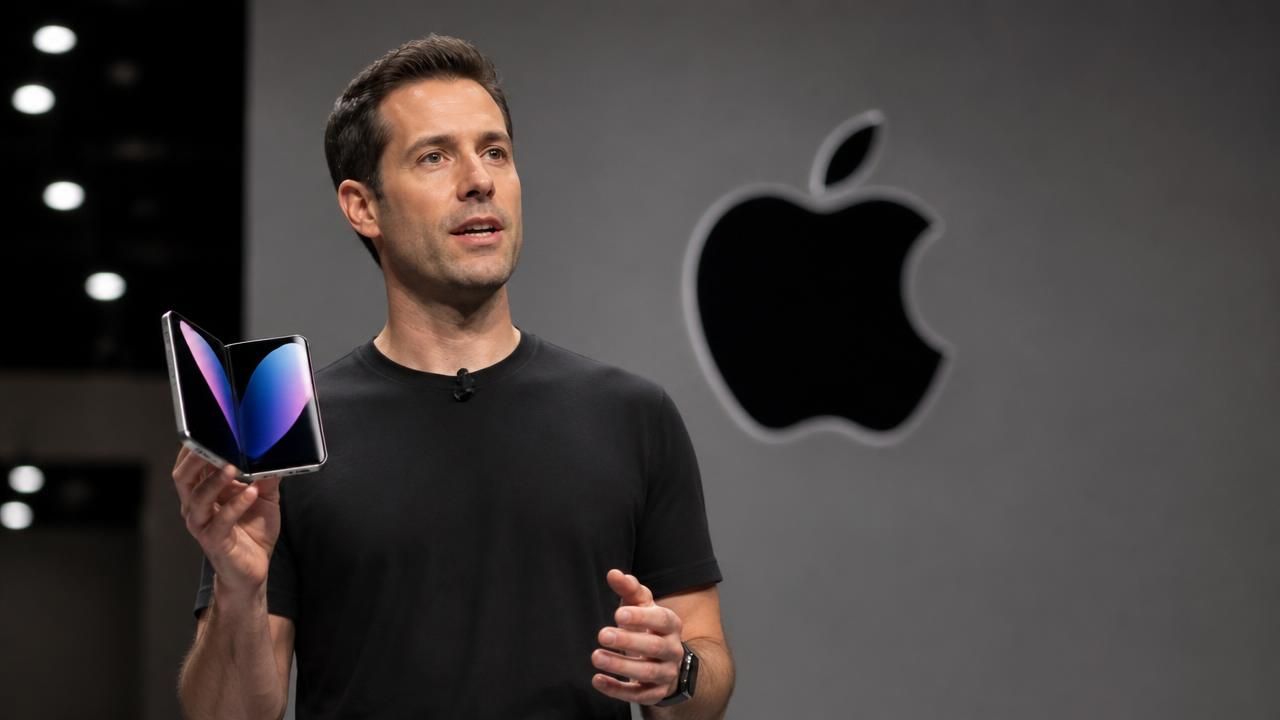
John Ternus has been Apple's chief executive for less than two weeks, but he has already done the thing Apple CEOs are remembered for: stood on a stage and sold a phone. At the company's annual September hardware event, Ternus presided over the debut of the iPhone Duo, Apple's first foldable smartphone — a launch that doubled as the first public audition of his leadership.
The timing was no accident. According to Bloomberg chief Apple correspondent Mark Gurman, who discussed the transition at length with The Verge's Decoder, the convergence of a new CEO and a new form factor was deliberate stagecraft. Apple treats its hardware events as narrative exercises, and this year's story — a fresh leader, a foldable iPhone, a company entering its AI era — was written to say something about where Apple is heading now that Tim Cook is no longer in the chair.
A handoff a year in the making
Ternus's elevation followed a wholesale reshuffling of Apple's leadership ranks over the past year, a period in which Cook — now the company's executive chairman — moved to install his successor and steady the bench beneath him. The transition was less a rupture than a managed continuity, with Ternus, a longtime Apple hardware executive known for obsessive attention to detail, cast as the engineer who can carry the culture forward.
His biography has become part of the story. As several outlets noted, Ternus holds no MBA and no advanced degree — just a bachelor's — a profile that contrasts sharply with the operations-and-supply-chain archetype that defined the Cook era. Outlets including MSN framed him as a details-obsessed product person, the kind of executive who has spent his career inside the machinery rather than above it. In his first memo as CEO, Ternus hyped a “huge launch next week,” signaling that he intends to lead publicly from the product side.
The foldable as first test
The Financial Times devoted a transcript to the question of whether the foldable iPhone is “John Ternus's first test as Apple CEO” — and the framing is telling. Apple arrives at foldables years after Samsung, Motorola and a wave of Chinese manufacturers, meaning the iPhone Duo must compete on execution rather than novelty. The FT also probed what Apple's “big goal after foldable iPhone” might be, hinting that the device is a bridge to something larger rather than a destination.
That distinction matters. For most of the last decade, Apple's problem has not been selling iPhones but replacing what they represent: a franchise that still generates the majority of the company's revenue and an ecosystem that has proven remarkably resistant to disruption.
The $100 billion question
Wall Street has made Ternus's mandate explicit. As Needham analyst Laura Martin put it in an appearance on CNBC:
“John Ternus needs to find the 'next $100 billion product for Apple.'”
The Futurum Group's CEO echoed the sentiment, telling Yahoo Finance that Apple's new chief must locate the company's next iPhone — “that's Ternus's big job.” CNBC catalogued three pressing challenges facing Cook's successor, a list that analysts have broadly agreed on: a hardware portfolio nearing maturity, an AI strategy that has trailed rivals, and a services business that faces mounting regulatory pressure.
Observer, meanwhile, argued that Apple's next “A.I. breakthrough” should be the company itself — a striking inversion of the usual product-first framing. In a piece published as Ternus took over, the outlet suggested that Apple's internal culture, rather than any single device, is what must be re-engineered for the AI era.
Leading with the old boss in the building
Complicating all of it is the fact that Ternus's predecessor has not gone anywhere. Morningstar identified the core challenge bluntly: leading when your old boss is still in the building. The New York Times framed the moment as Apple beginning “its next balancing act,” a phrase that captures the dual pressures of preserving a legacy and authoring a new one.
Historically, Apple has managed these transitions well — the 2011 handoff from Steve Jobs to Cook is the canonical example — but both cases involved a founder or an operator whose authority was largely uncontested. Ternus's authority is still being established, and it will be read in every product decision, every reorganization, and every earnings call.
An era begins, again
Commentary from Computerworld and Newser has already settled on a name for the moment: the Ternus age, or simply the Ternus era. What remains open is whether that era will be defined by the foldable iPhone, by an AI product that does not yet exist, or by something Apple has not shown anyone.
What is clear is the shape of the test. Ternus inherits a company at peak scale and peak scrutiny, one whose last great product category — the smartphone — is now two decades old. The Verge's interview with Gurman circled that question repeatedly: not whether Apple can still make excellent hardware, but whether it can find the next big thing at all.
- Watch the foldable's reception: early sales and durability reviews will shape the Ternus narrative for a year.
- Watch the AI roadmap: Apple's differentiation play is expected to run through on-device intelligence and silicon, not chatbots.
- Watch the bench: further leadership changes would signal how much of Cook's era Ternus intends to keep.
- Watch the stock: analysts have made the “next $100 billion product” the explicit benchmark for his tenure.
For now, Ternus has done what new Apple CEOs do: shipped something, told a story about it, and inherited the hardest question in technology — what comes after the iPhone.